
The short answer
A process can be slow compared with one rival and fast compared with another. This study turns that relational idea into a small probability model whose assumptions remain visible.
Record comparison
Chance and duration are different quantities
Keep the historical record distinct from the stipulated model.
| Question | Record or stipulated input | Consequence and limit |
|---|---|---|
| Common scaling | Multiply both rates by the same positive factor | Branch probability stays fixed; mean wait changes inversely. |
| A deadline | Run the clocks only until T | Some histories have no event before the deadline. |
Chronology
A timeline of the turning points
Joint synthesis
The selected stellar synthesis was published.
The selected stellar argument
B²FH’s selected timescale discussion makes neutron capture compete with beta decay at a branching nucleus. Capture times depend on neutron density and cross sections; the authors distinguish nuclei that decay before another capture from those effectively stable during the process.
This is a comparison of mechanisms, not a rule assigning every event to one fixed number of seconds. A branch probability can illuminate the distinction, while remaining much smaller than the paper’s network of reactions.
Sources for this section: [1]
Two stipulated clocks
Invent independent waiting times for capture and decay. Let c and b be constant event rates, measured in s⁻¹. In this model the chance of neither event by time t is exp(−(c+b)t). The density for capture to be first at t is c exp(−(c+b)t). Integrating from zero to infinity gives P(capture first)=c/(c+b).
The expected wait for either event is 1/(c+b) seconds. These formulas are derived from the stipulated constant-rate exponential clocks; they are not extracted nuclear-rate measurements. A finite exposure, changing environment or additional channel would change the problem.
Sources for this section: [1]
Worked comparison
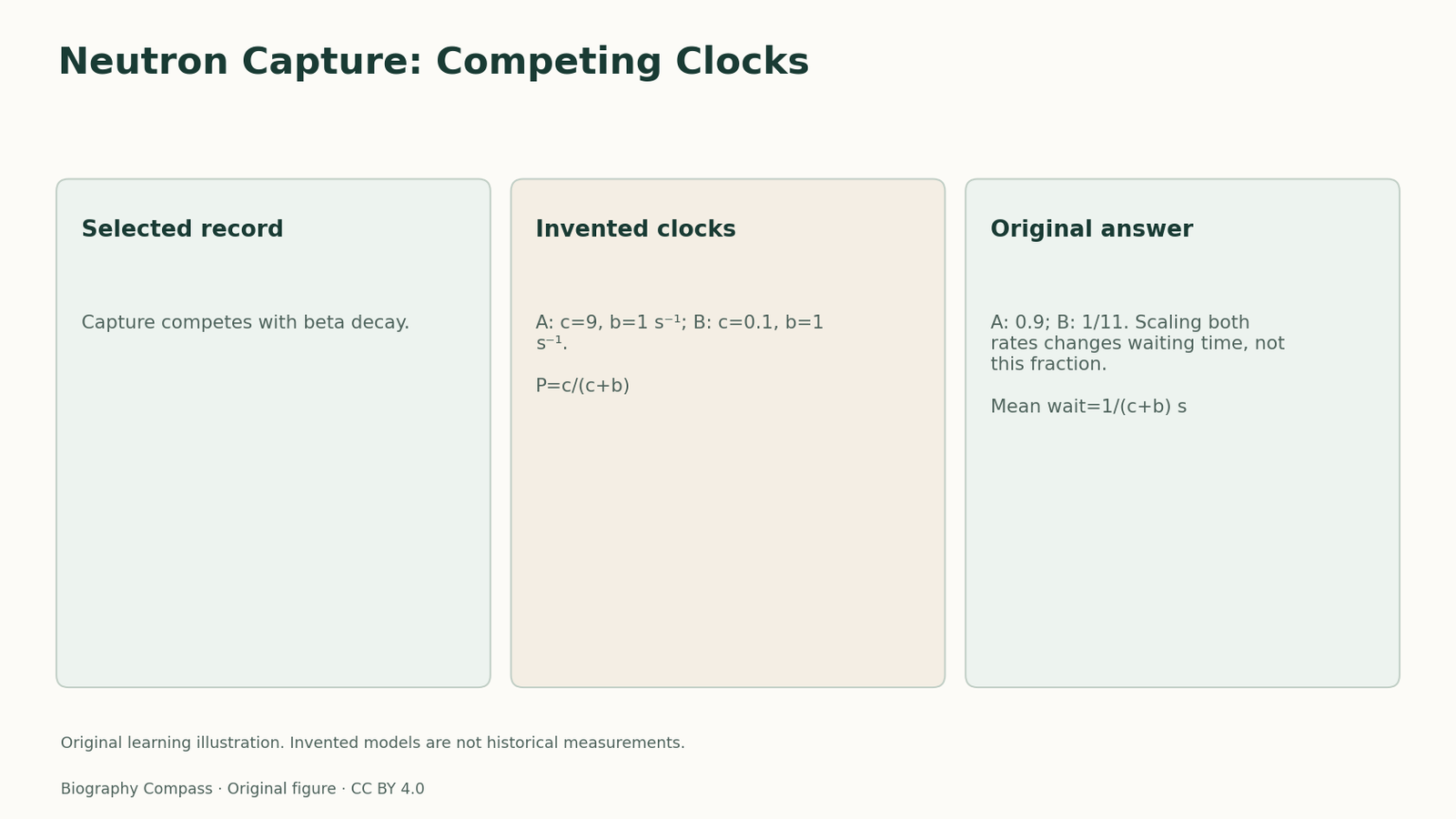
Case A uses c=9 s⁻¹ and b=1 s⁻¹. Case B uses c=0.1 s⁻¹ and b=1 s⁻¹. Calculate capture-first probability and the mean wait for either event. Then divide both rates in case A by ten. Which answer changes?
Reference answer: A gives 9/10=0.9 and 0.1 s. B gives 1/11≈0.0909 and 10/11≈0.909 s. The scaled A gives 0.9 again, but a mean wait of 1 s. Relative rates determine the branching chance here; their common scale determines the waiting time.
Sources for this section: [1]
What the small model leaves out
The result depends on allowing the clocks to run until one fires. With a deadline T, the unconditional probability that capture occurs first before the deadline becomes c/(c+b)×[1−exp(−(c+b)T)]. The remaining probability includes histories in which neither event happens.
Thus equal branching fractions need not mean equal outcomes during a short observation window. The exercise explains a distinction in reasoning; it does not reconstruct a star, endorse all historical site assignments or provide nuclear-operating instructions.
Sources for this section: [1]
Continue the chronology
Related history guides
Biography context
Explore United States through connected lives
Connected biographies
The working life behind the record
Quick answers
Common questions
- Is a lower event rate automatically the slow process in every context?
- No. The model compares it with a specified competing rate; it does not establish a universal threshold.
- Are the exercise rates stellar measurements?
- No. All rates are invented constant-rate inputs.
Primary and institutional sources
How this history was checked
Selected records support the historical discussion. Invented inputs and original answers are labelled; no complete uninspected work is claimed. This article was reviewed on 31 October 2026.