
The short answer
A translator’s name can remain on several versions while the text passes through other hands. An archive inventory makes those stages visible, but its descriptions cannot substitute for reading the marked documents.
Compare the selected record and the new task
Keep the choices visible
The historical premises and the invented response have different roles.
| Question | What a description supplies | What comparison still needs |
|---|---|---|
| Credit | A named translator. | Evidence for a particular alteration. |
| Version | A draft, edited master or proof. | The marked text and its sequence. |
| Extent | A physical page count. | An actual comparison before asserting content was cut. |
Chronology
A timeline of the turning points
Josephson translation
The bibliography’s English publication credit.
Brown versions
Draft, edited copy and proofs described.
The record preserves more than a finished title
The National Library bibliography names Hannah Josephson’s 1947 English translation of Bonheur d’occasion.
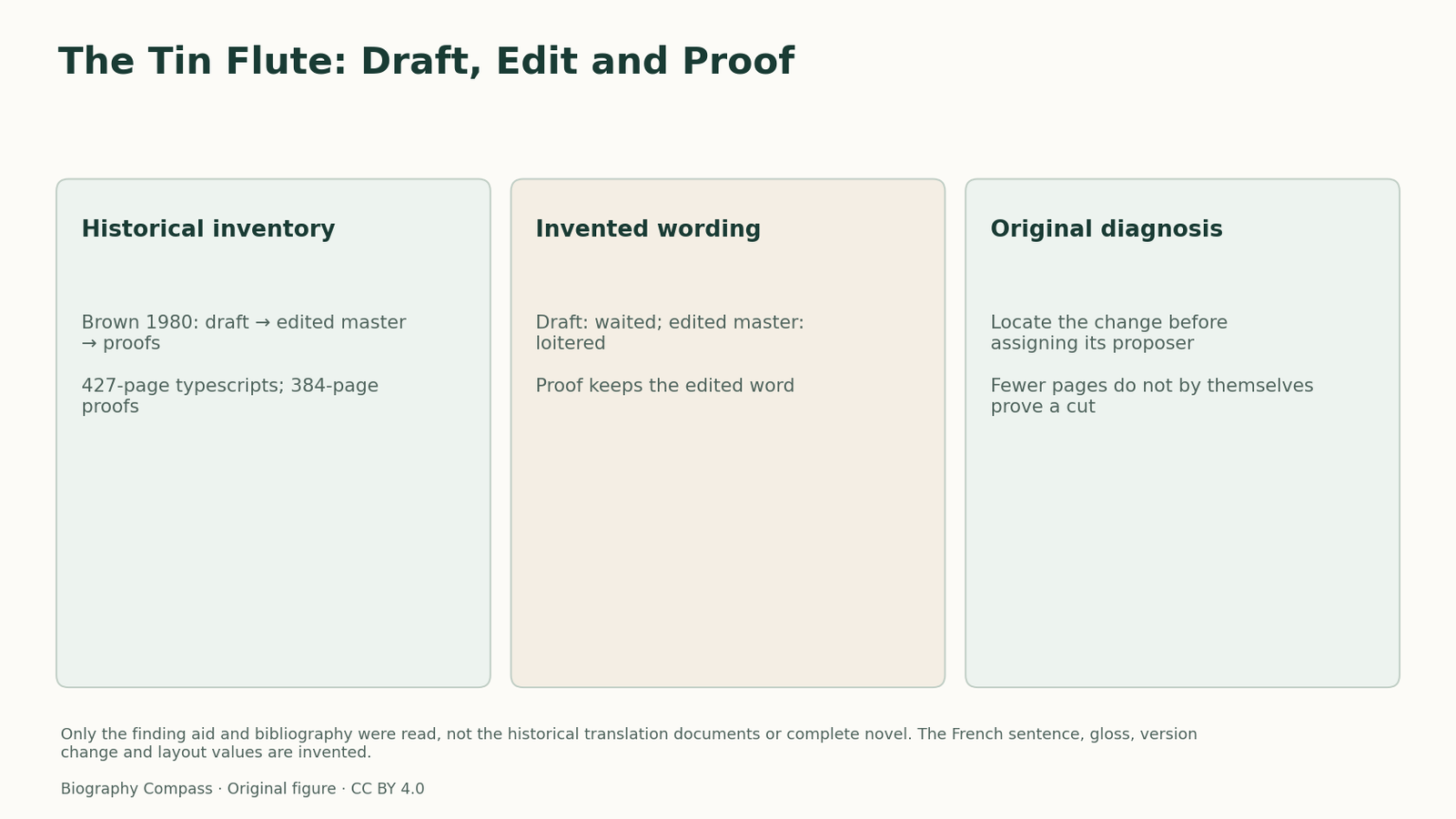
The 1989 finding aid separately describes Alan Brown’s 1980 typescript before revision, an edited master, publisher suggestions and page proofs. The typescripts are listed as 427 pages; the proofs as 384.
The descriptions identify possible comparison points. They do not show every changed word. Nor does a smaller proof-page total establish that 43 pages of content were deleted: type size, line length and other layout choices can alter pagination. The inventory is a route into evidence, not the evidence of a particular stylistic decision itself.
Original exercise: a register change
Use a French sentence created for this exercise: “Elle attendait près de la porte.” Stipulate the plain gloss “She was waiting near the door.” An invented translator’s draft reads “She waited by the door.” An edited master changes waited to loitered; the proof retains loitered. None of these lines comes from Roy, Josephson or Brown.
Identify the first supplied stage containing the new word. Explain how it changes the suggestion about the person’s presence. Can a catalogue label saying translated by the same person prove that the translator proposed the change? What would you consult next?
Reference response: locate before attributing
The change first appears in the supplied edited master. Waited states an action without supplying much judgment about its purpose. Loitered can suggest lingering without a clear purpose and may introduce a less neutral attitude. The plain gloss alone does not require that attitude; a real translation decision would need the surrounding text and intended register.
The version sequence locates an introduction of wording, not its individual proposer. Track changes, annotated sheets or correspondence could help distinguish a translator’s revision from an editor’s intervention. A later proof preserving the word does not independently establish who first chose it. This is a bounded comparison of invented records, not a verdict on either historical translation.
Keep pagination separate from textual extent
Imagine the same 1000 words set at 250 words per page in one mock layout and 200 in another. The layouts occupy 4 and 5 pages even though no words were added or removed. Actual proofs may also contain illustrations or preliminary matter, so a real extent comparison needs more than this simplified calculation.
A useful research note records the exact version, its physical description and the passage being compared. It preserves the named translator’s credit while leaving the authorship of an uninspected alteration unresolved. The next step would be to examine the documents identified by the finding aid, not invent their contents.
Continue the chronology
Related history guides
Biography context
Explore Canada through connected lives
Connected biographies
The wider working life
1909–1983
Gabrielle Roy
Novelist and journalistA writer whose fiction connects individual lives with the places around them.Read biographyQuick answers
Common questions
- Does the difference between 427 and 384 prove that text was deleted?
- No. Page extent alone does not establish a change in wording; layout and the actual texts must be compared.
Primary and institutional sources
How this history was checked
These selected passages and records supply the historical context. The exercise and reference response are original. This article was reviewed on 31 October 2026.