
The short answer
Starting from a known ending changes the work of a stanza. The writer must make a route towards it, while the chosen line can acquire a new context without ceasing to belong to its earlier source.
Compare the selected record and the new task
Keep the choices visible
The historical premises and the invented response have different roles.
| Question | Historical constraint | Original decision |
|---|---|---|
| Ending | A seed line closes each stanza in order. | Make a new route towards it. |
| Rhyme | The sixth and ninth lines rhyme with the tenth. | Choose words that carry meaning as well as sound. |
| Authorship | The borrowed line retains its source. | The surrounding imagery and argument still need making. |
Chronology
A timeline of the turning points
Hologram
Page’s book of glosas.
Critical account
Lecker quotes and discusses the foreword.
A ten-line stanza
Work towards one of our new seed lines.
A form described through a selected critical record
Lecker traces Page’s encounter with the glosa through Robin Skelton and Marilyn Bowering and identifies Hologram: A Book of Glosas as a 1994 publication.
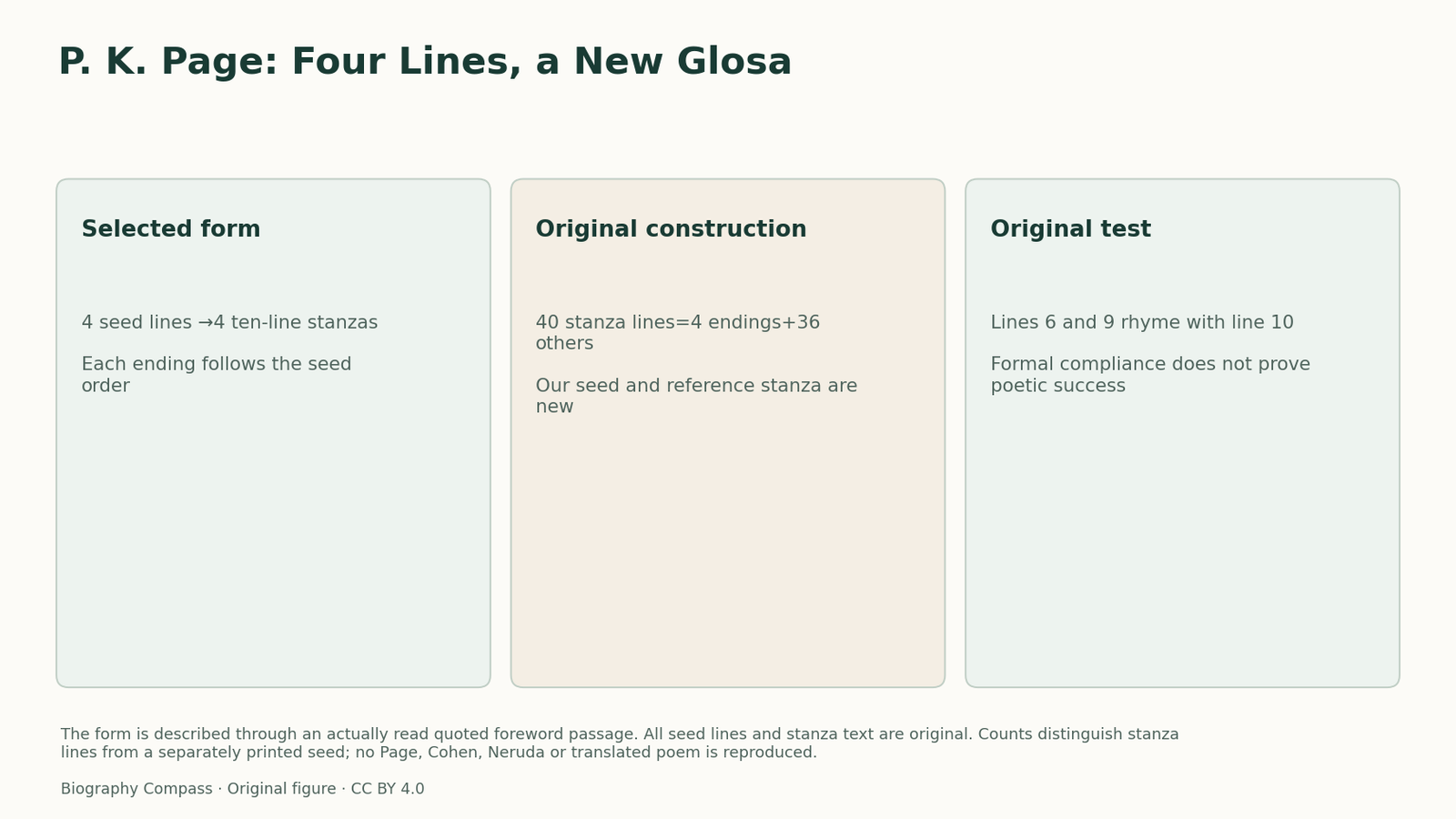
The foreword passage he quotes specifies four seed lines followed by four ten-line stanzas. Each stanza ends with the next seed line; lines six and nine rhyme with that tenth line.
We have read the quoted foreword passage and critical context, not the whole collection. The rule is enough to start a new exercise, but it is not a substitute for reading how an actual poem develops its meanings.
Use replacement lines that are entirely ours
For this task the four original seed lines are: “The rain has left a silver seam”; “A window holds the evening sky”; “Our careful plans survive a dream”; and “We let the last bus rumble by.” They are not quotations from Page or another poet. Draft one ten-line stanza that ends with the first line. Let lines six and nine rhyme with seam; do not fill the intervening lines merely to reach the count.
A complete four-stanza response would contain 40 stanza lines, including the 4 repeated seed endings and 36 other stanza lines. If the opening four-line seed is printed separately too, the page contains 44 line occurrences. That accounting counts repetitions, not 40 newly invented lines beyond the seed.
Reference stanza: an original route to the ending
1. We mark the hour beside the gate.
2. The shops are folding up their light.
3. A child is balancing a stone.
4. The last warm patch escapes the night.
5. We count the reasons we might stay.
6. The gutter draws a narrow stream.
7. A sparrow shakes the water loose.
8. Our talk grows slower at the curb.
9. The lamps begin their yellow gleam.
10. The rain has left a silver seam.
Test the constraint and then the poem
The supplied stanza has ten numbered lines. Stream and gleam rhyme with seam at the required positions 6, 9 and 10, and the final line repeats the first seed. These checks establish compliance with the stated formal constraints, not the quality of the writing.
A stronger revision might make the ending change the sense of an earlier detail, rather than arrive as a detachable slogan. Try a different first line and notice which earlier lines need rewriting. In a real glosa using another poet’s work, accurate attribution and permission where required remain distinct from meeting the pattern. No protected poem or translation is reproduced in this exercise.
Continue the chronology
Related history guides
Biography context
Explore Canada through connected lives
Connected biographies
The wider working life
1916–2010
P. K. Page
Poet and visual artistA writer and artist whose work invites attention to the relation between an inherited form and a new response.Read biographyQuick answers
Common questions
- Are the seed lines or reference stanza by Page?
- No. All are original replacements created for this exercise; no historical poem is reproduced.
Primary and institutional sources
How this history was checked
These selected passages and records supply the historical context. The exercise and reference response are original. This article was reviewed on 31 October 2026.