
The short answer
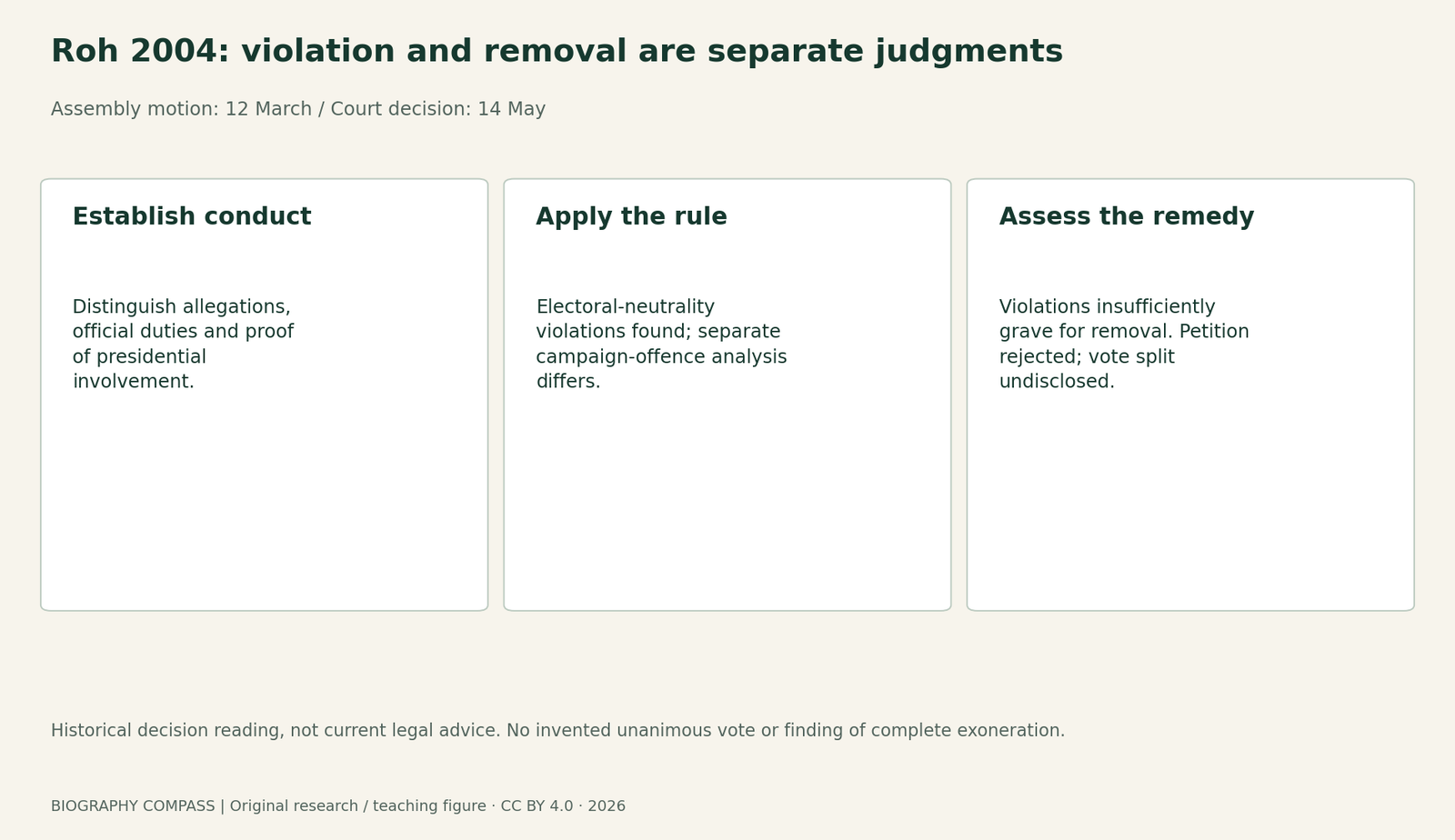
Finding that a president broke a legal duty and deciding to remove that president are separate judgments. How did the Constitutional Court connect them in May 2004?
Evidence, rule and outcome
What the Court distinguished
These are analytical distinctions within the 2004 proceeding, not current legal advice or predictions about other presidents.
| Issue | What the Court found or excluded | Consequence |
|---|---|---|
| Party-support statements | Breached electoral neutrality; did not meet the separate unlawful-campaign analysis | A finding of violation, assessed for gravity. |
| Confidence referendum | Proposal unconstitutional; referendum not conducted | Proposal and completed exercise remain distinct. |
| Associates’ wrongdoing | No proof of Roh’s instruction, abetting or illegal involvement in the cited post-inauguration acts | Not automatically attributable to the president. |
| Removal | Established violations insufficiently grave for removal | Petition rejected on 14 May 2004. |
| Vote split | Not disclosed in the published decision | Do not assert unanimity or a numerical split. |
Chronology
A timeline of the turning points
Press-conference statements
Roh’s support for a political party becomes a central legal issue.
Assembly motion passed
The legislature’s Judiciary Committee chair petitions the Court on its behalf.
Presidential powers suspended
The Court considers the impeachment case.
Petition rejected
The Court identifies violations but finds insufficient grounds for removal.
The motion, the allegations and the decision are different layers
The National Assembly passed the motion on 12 March 2004 with 193 concurrent votes out of an entire membership of 271. The chair of its Legislation and Judiciary Committee then filed the impeachment petition on the Assembly’s behalf. Presidential powers were suspended during adjudication. That legislative vote initiated a constitutional process; it was not itself the final judicial removal decision.
The published English translation first outlines questions and then presents the holding and reasoning. Its account of the Assembly’s accusations includes party support, treatment of constitutional institutions, corruption involving associates and alleged failures in governing. A reader must follow each accusation into the Court’s analysis. Material placed under a summary of the grounds for impeachment is a statement of the petitioner’s case, rather than a list of conduct already judicially established. The Court also treated the Assembly proceeding as a constitutional process between state institutions, rejecting the argument that due-process principles governing public power over private citizens applied directly to it.
Sources for this section: [1]
A partisan president still owed electoral duties
The Court treated the president as a public official covered by the electoral-neutrality obligation in Article 9 of the election law. His political role and party affiliation did not remove responsibility for the fairness of the electoral process. Its reasoning connected that responsibility to free elections, equal opportunity for parties and the president’s position as head of the executive.
Roh’s press-conference statements supporting a particular party on 18 and 24 February breached that obligation. But the Court separately analysed whether they constituted an unlawful electoral campaign. It rejected that characterisation: party-endorsed candidates were not yet specified, and the answers lacked the purposeful, active character required for that finding. Thus one set of remarks could violate neutrality without satisfying every other electoral offence alleged against it. The distinction depends on the elements of the rule being applied.
Sources for this section: [1]
Criticism of the law raised a different constitutional problem
After the National Election Commission addressed his conduct, Roh publicly disparaged the existing electoral legislation. The Court distinguished a political proposal to change a law from undermining its authority in response to an enforcement decision. A president could advocate revision, but had to do so consistently with the obligation to respect and protect the constitutional order.
The proposed national referendum on confidence in his presidency supplied another issue. The Court read Article 72 as concerning important policy questions, not an unrestricted device for asking whether the president should keep office. It held the proposal unconstitutional while observing that Roh had not actually conducted such a referendum. Keeping a proposed act distinct from its completion was part of assessing both what happened and how serious its consequences were.
Sources for this section: [1]
Associates’ misconduct did not automatically establish his
The Court separated events before the presidential term from acts performed in presidential duties. Allegations about unlawful campaign funds arising before Roh was elected and sworn in did not constitute impeachment grounds within that official-duty requirement. This was a jurisdictional and temporal distinction; it did not transform every earlier allegation into an affirmative finding of lawful conduct.
For misconduct by associates after he took office, the Court found no evidence in the proceeding that he instructed, abetted or was otherwise illegally involved in the cited acts. An aide’s wrongdoing and presidential involvement were propositions requiring separate proof. The Court also held that political incapacity or mistaken policy, by themselves, did not supply the legal violation required for impeachment. Political dissatisfaction remained meaningful in democratic judgment without becoming an automatic judicial ground for removal.
Sources for this section: [1]
The remedy required an assessment of gravity
Article 53(1) of the Constitutional Court Act connected a valid impeachment ground with removal. The Court rejected a reading that would mandate removal for every minor legal violation. It invoked proportionality and asked whether the violation was sufficiently grave in terms of protecting the constitutional order. It also considered the consequences of interrupting a presidency elected directly by the people.
This was not a rule that electoral popularity excused illegality. The reasoning described circumstances in which abuse of presidential authority could justify removal, including corruption, oppression through state institutions and attacks on other constitutional institutions. In Roh’s particular case it concluded that the established conduct did not threaten the basic democratic order or betray public trust to the degree necessary to end his term. Violations remained findings; the threshold for this remedy remained unmet.
Sources for this section: [1]
The final order should constrain the story told about it
The Court rejected the petition on 14 May 2004. Its conclusion stated that the number of justices required for removal had not been reached. It expressly declined to disclose individual opinions or their numbers under its interpretation of the rules then governing impeachment deliberation. The published decision therefore supplies no defensible basis for calling the vote unanimous or inventing a numerical split.
The translated volume also appends an aftermath commentary saying Roh returned to the exercise of office. A translator’s note marks that commentary as outside the Court’s official opinion. The distinction is useful: the holding establishes disposition, the reasoning explains it and the editorial aftermath supplies later context. Reading those layers separately produces a more accurate account than either complete exoneration or a claim that the Assembly’s motion had already removed the president permanently.
Sources for this section: [1]
Continue the chronology
Related history guides
Connected biographies
Read the connected biographies
1946–2009
Roh Moo-hyun
Lawyer and president of South Korea, 2003–2008Roh Moo-hyun progressed from self-directed legal study and advocacy in Busan to Parliament and the presidency, surviving an impeachment proceeding in 2004.Read biographyQuick answers
Common questions
- Did rejection mean the Court found no violation?
- No. It identified violations but concluded that removal required greater gravity than established in this case.
- Was the ruling unanimous?
- The published decision does not disclose the justices’ individual opinions or numbers, so a claim of unanimity is unsupported here.
- Did the Court hold a referendum on Roh’s presidency?
- No. It considered his proposed confidence referendum and found that proposal unconstitutional; the referendum was not conducted.
Primary and institutional sources
How this history was checked
Read the agreement, correspondence and judicial text in their stated documentary forms. Textual obligations, later actions and evaluative conclusions are kept distinct. This article was reviewed on 27 October 2026.