In this biography
Quick facts
- Born
- 1 September 1946
- Died
- 23 May 2009
- Birthplace
- Gimhae, South Gyeongsang Province, Korea
- Country
- South Korea
- Nationality
- Not independently established
- Known for
- Human-rights advocacy, the 2004 impeachment decision and the 2007 inter-Korean summit
- Born
- 1 September 1946, Gimhae
- Bar examination
- Passed 1975
- First Assembly election
- 1988
- President
- 2003–2008
- Died
- 23 May 2009
Why this life matters
His career connects legal advocacy and participatory politics with constitutional limits on presidential conduct and ambitious inter-Korean cooperation.
Timeline
Key moments
Birth
Born on 1 September in Gimhae.
Legal profession
Passed the bar examination, served as a judge and opened a legal practice.
Burim defence
Joined the defence team in a case that shaped his human-rights advocacy.
Parliament
Entered the National Assembly.
Ministerial service
Served as minister of maritime affairs and fisheries.
Presidency begins
Took office after his 2002 election.
Impeachment proceeding
Assembly vote on 12 March; Court rejected removal on 14 May.
Pyongyang summit
Signed the 4 October declaration with Kim Jong Il.
Death
Died on 23 May.
Legal study opened an unusual route to public life
Roh Moo-hyun was born in Gimhae on 1 September 1946 and graduated from Busan Commercial High School in 1966. He passed the judicial examination in 1975 and became a judge at the Daejeon District Court in 1977. A year later he entered private practice in Busan. The official chronology records a professional route built through examination and practice, rather than a conventional university law degree. It also helps explain the combination of technical legal argument and outsider identity associated with his later politics. Law initially supplied his occupation; work for defendants under authoritarian government helped change its political significance.
The Burim case changed the clients he defended
In 1981 Roh joined the defence team in the Burim case involving detained students and other democracy activists. The Roh Archive preserves autobiographical excerpts and interviews with participants, including defendants who recalled his attention to their treatment in custody and willingness to challenge the prosecution’s account. These are recollections collected by an institution associated with Roh, and they make the participants’ perspective visible. They establish the case’s place in his professional transformation without turning him into the sole defender or treating every remembered courtroom exchange as a verbatim transcript. His practice increasingly connected legal representation with human-rights and labour advocacy.
Sources for this section: [2]
Parliament brought advocacy into national institutions
Roh entered the National Assembly in 1988 and served on its Labour Committee and the special investigation into political corruption under the Fifth Republic. His subsequent career crossed successive opposition party organisations, including the Democratic Party and the National Congress for New Politics. He returned to the Assembly in 1998 and served as maritime affairs and fisheries minister in 2000–2001. Those stages provided legislative and executive experience before the presidential campaign. In 2002 he became the New Millennium Democratic Party’s presidential candidate. He took office in February 2003, moving from challenging the exercise of public power to bearing its responsibilities himself.
Impeachment tested the limits of presidential politics
On 12 March 2004 the National Assembly passed an impeachment motion by 193 votes out of a total membership of 271. Presidential powers were suspended while the Constitutional Court considered the case. On 14 May the Court rejected removal. It nevertheless found that Roh’s statements supporting a political party breached the obligation of electoral neutrality, and it criticised his treatment of election law and his proposed confidence referendum. Its conclusion was that the established violations did not have the gravity required to remove an elected president. This was a consequential distinction between unlawful conduct and the exceptional remedy of ending a presidential term.
Sources for this section: [3]
Cooperation was the purpose of the 2007 summit
Roh visited Pyongyang from 2 to 4 October 2007 and signed a declaration with Kim Jong Il. Building on the June 2000 declaration, the two leaders proposed expanded economic cooperation, improved transport connections, humanitarian exchanges and military talks. Their text envisaged a West Sea peace and cooperation zone and discussions among the directly concerned parties on ending the armistice regime. It also referred to implementation of the Six-Party Talks’ nuclear agreements. These commitments show the breadth of Roh’s engagement policy. They required follow-up by ministers, officials and other governments; a signed declaration did not by itself deliver every railway repair, industrial project or permanent peace arrangement.
Sources for this section: [4]
A presidency followed by a short retirement
Roh’s presidential term ended in February 2008, and he died on 23 May 2009. His earlier lawyer colleague and later chief of staff Moon Jae-in subsequently became president, carrying part of that political tradition into a different decade. The two careers should remain distinct: Roh signed the 2007 declaration, whereas Moon signed the Panmunjom Declaration in 2018. Roh’s enduring importance also lies in the constitutional record his presidency produced. The 2004 case affirmed that an elected president remained subject to legal duties while requiring a reasoned judgment about the seriousness of violations before removal. It preserves both accountability and the weight of an electoral mandate.
Quick answers
Frequently asked questions about Roh Moo-hyun
- Who was Roh Moo-hyun?
- Roh Moo-hyun was a lawyer and president of South Korea, 2003–2008. His career connects legal advocacy and participatory politics with constitutional limits on presidential conduct and ambitious inter-Korean cooperation.
- What is Roh Moo-hyun best known for?
- Roh Moo-hyun is best known for human-rights advocacy, the 2004 impeachment decision and the 2007 inter-Korean summit.
- When and where was Roh Moo-hyun born?
- Roh Moo-hyun was born on 1 September 1946 in Gimhae, South Gyeongsang Province, Korea.
- When did Roh Moo-hyun die?
- Roh Moo-hyun died on 23 May 2009.
Keep exploring
Lives connected to this story
- Moon Jae-in
Follow Roh’s former chief of staff and the separate diplomacy of the 2018 presidency.
- Kim Dae-jung
Read the predecessor whose 2000 summit supplied an earlier framework for the 2007 declaration.
- Roh Tae-woo
Distinguish the earlier president with the same romanised surname and a different political career.
Sources and further reading
Explore the evidence
These references support the biography and offer further reading. Official records, first-person accounts and independent reporting provide different perspectives; image records document attribution and licensing.
- 1. Presidential Archives, Republic of KoreaRoh Moo-hyun: presidential biographical chronology (Korean)
- 2. Roh Moo-hyun Foundation, Roh ArchiveRoh and the Burim case: collected participant testimony and autobiographical excerpts, 3 January 2014 (Korean)
Foundation reconstruction quotes autobiographies and collected oral histories. Participant recollections establish an advocacy trajectory; courtroom dialogue and torture allegations are attributed to their documentary genre rather than presented as findings of an acquired Burim retrial judgment.
- 3. Constitutional Court of Korea2004Hun-Na1, 14 May 2004: Impeachment of President Roh Moo-hyun, published English translation, printed pp.141–202
Published Court translation contains findings and rejection of removal; no claim of complete exoneration or a disclosed unanimous vote. Translator’s aftermath is marked outside the official opinion.
- 4. Leaders of the two Koreas; Ministry of Unification English textDeclaration on the Advancement of South-North Korean Relations, Peace and Prosperity, 4 October 2007
- 5. Presidential Archives, Republic of KoreaMoon Jae-in: presidential biographical chronology (Korean)
- 6. Leaders of the two Koreas; Ministry of Foreign Affairs, Republic of KoreaPanmunjom Declaration, 27 April 2018: English text submitted to the United Nations
- 7. Eric Draper / White HousePhotograph identity and item rights record
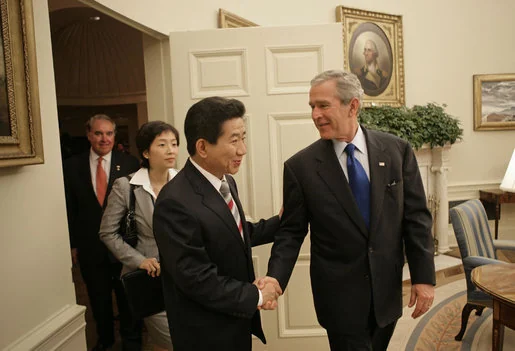
The official photograph depicts a 2006 meeting, not the 2004 court proceeding. Its complete supplied 515 × 351 file was retained without enlarging the image file.