
The short answer
Cass names both a place and a work of art. Its catalogue entry and later gallery discussion can explain how those two things connect without making the painting a literal record of everything at the station.
Reading the evidence
What each record establishes
Keep the subject of each record and the conclusion it can support in separate columns.
| Record | What it explains | Do not infer |
|---|---|---|
| 1936 visit | Sketching occasion and working companions. | Each detail was painted on the spot. |
| Painting record | Medium, image and human presence. | The actual arrival time of a train. |
| Exhibition and purchase | Distinct dates of public reception and ownership. | The work’s creation happened on either date. |
Chronology
A timeline of the turning points
Sketching and painting
The trip to the railway settlement precedes the completed work.
Centennial exhibition
The work is shown at the National Centennial Exhibition of New Zealand Art.
Purchase
Christchurch Art Gallery records the acquisition.
Start with the visit
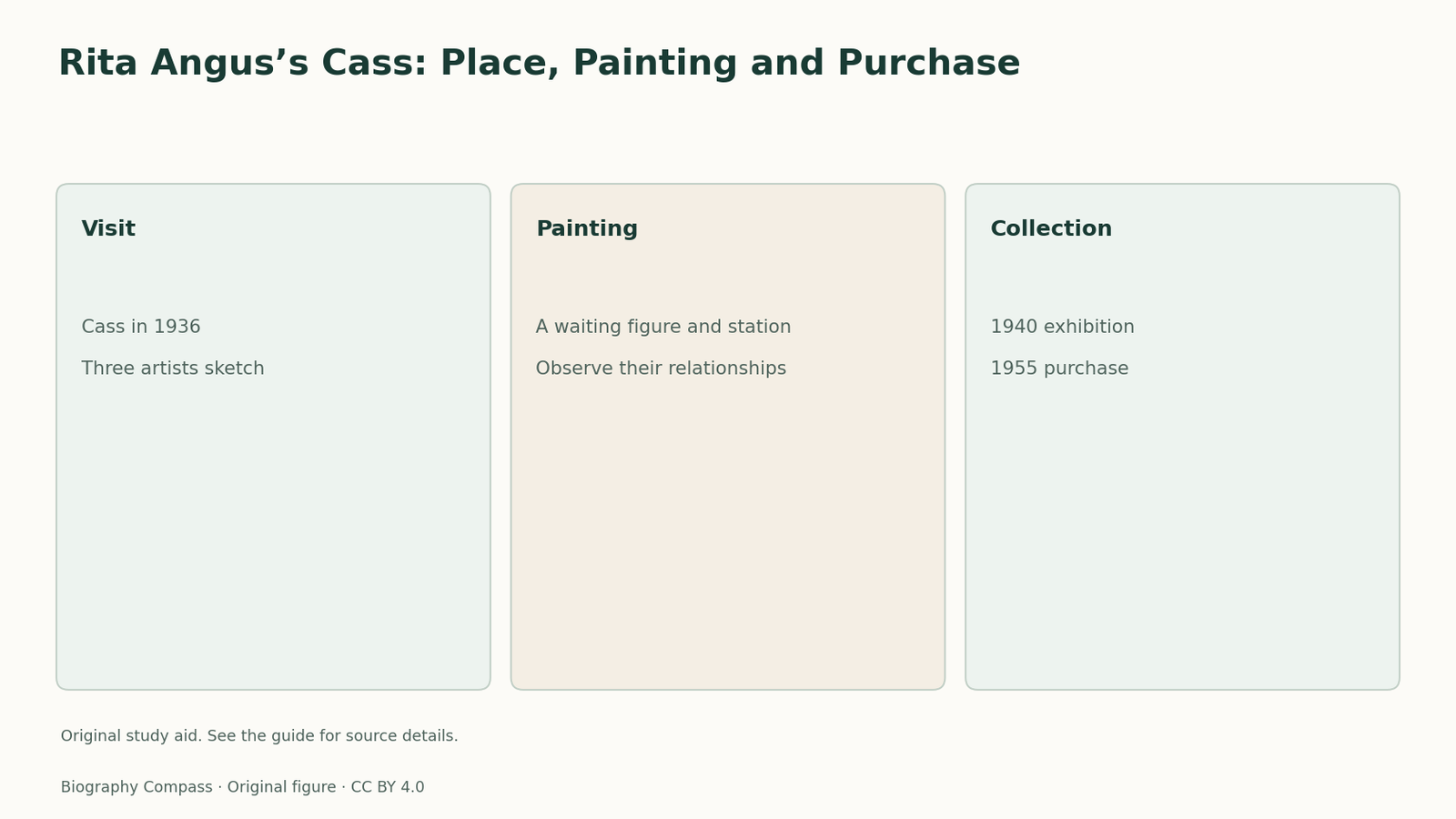
Christchurch Art Gallery records that Angus took a ten-day sketching trip to Cass with Louise Henderson and Julia Scarvell in 1936. The group’s visit locates the observation behind the picture. The same record describes several oils and watercolours made after the trip, a reason to distinguish looking, sketching and completing a particular work.
Do not assign a painting’s every decision to a single view from the platform. A painter can bring observed things into a relationship that is clearer on canvas than it would be in a chance photograph of the same place.
Sources for this section: [1]
Look at the things that allow waiting
The collection account identifies railway buildings, a stationary wagon and a solitary waiting figure. A later writer for the gallery describes visiting the site after knowing the image. That comparison is helpful because it exposes two kinds of expectation. The figure appears to await transport. The later visitor looks for details already made memorable by the painting.
Trace the relations between the figure and two built elements. The resulting description shows how the painting gives waiting a place in the composition. A timetable would answer a different question about the railway’s operations.
Record how the work entered public view
Add the 1940 Centennial exhibition and 1955 recorded purchase on separate lines beneath the making date. Now draft one caption that can be used without the chronology and one chronology that does not pretend to describe the image. Both should identify the same work while doing a different job.
Continue the chronology
Related history guides
Biography context
Explore New Zealand through connected lives
Connected biographies
Explore the people behind the records
1908–1970
Rita Angus
PainterA New Zealand painter whose precise compositions make ordinary signs of human presence unusually visible.Read biographyQuick answers
Common questions
- When did the gallery acquire Cass?
- Christchurch Art Gallery gives 1955 as the purchase year. The work is dated 1936.
Primary and institutional sources
How this history was checked
Selected first-person, exhibition and collection records support the factual claims. The reading exercise and comparison are editorial interpretations. This article was reviewed on 5 November 2026.