
The short answer
Why did Risdon combine a zinc venture with hydroelectric power?
A worked comparison
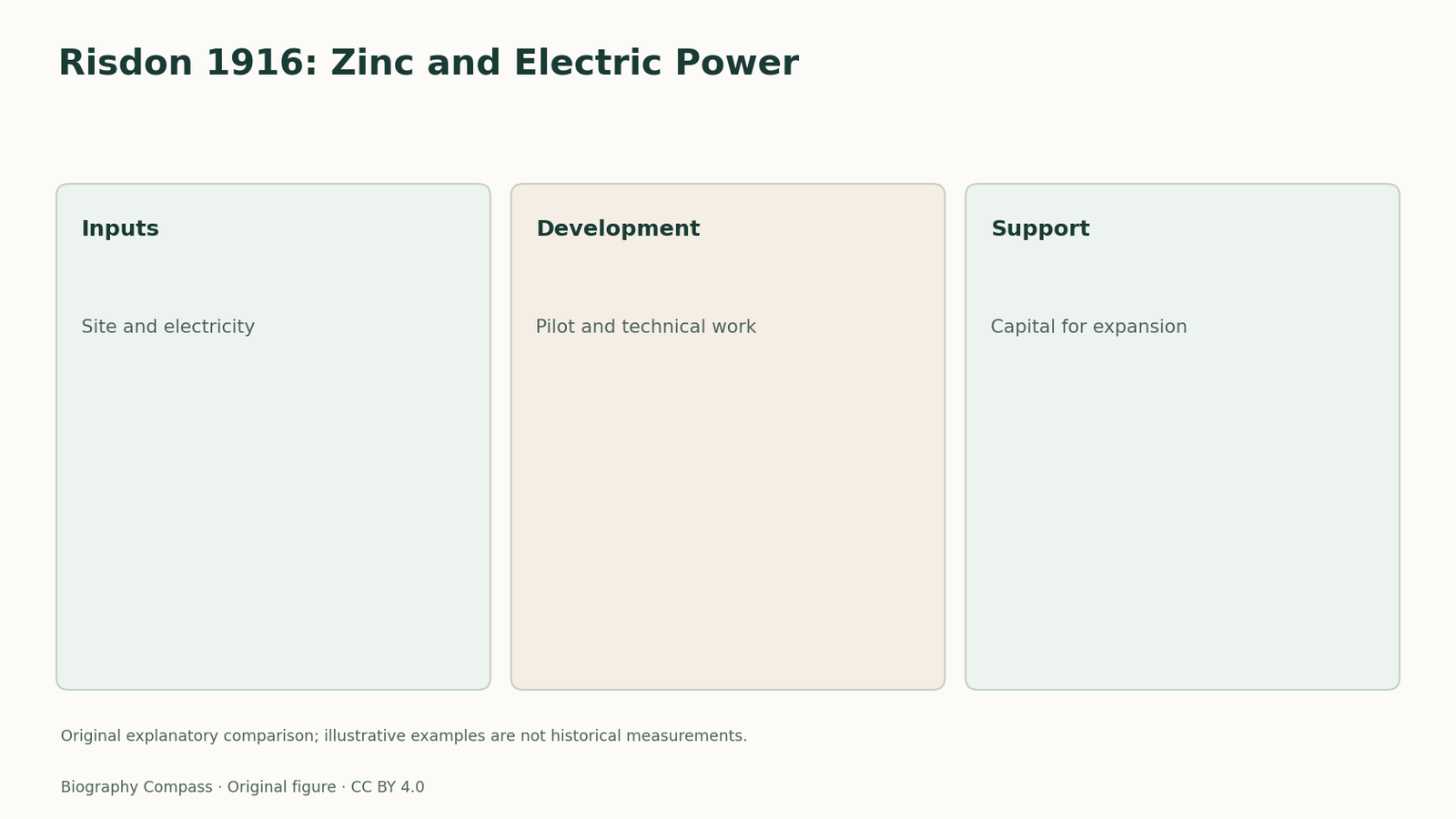
What each part contributes
Use the specific distinctions developed in the study.
| Part or record | What it establishes | Why the distinction matters |
|---|---|---|
| Land and power | Essential site and input | Not proof of a finished process |
| Pilot operation | Process at a limited scale | Not full-scale economics |
| Financial support | Time and resources for development | Not a substitute for engineering |
Why did Risdon combine a zinc venture with hydroelectric power?
Electrolytic zinc processing required an electrical supply substantial enough to support industrial operation. In 1916 the Collins House-associated venture selected Risdon near Hobart and negotiated with the Tasmanian government. The choice joined a metallurgical proposal to a source of power and a physical site. The question is how those commitments fitted together. A land agreement created room for a works, a power agreement supplied an essential input, and process development had to turn materials into saleable zinc. None of those functions alone constituted a completed commercial plant.
A power contract preceded a proven full-scale operation
The inspected historical paper dates Baillieu’s agreement for land and a substantial share of hydroelectric output to April 1916. Its account also preserves Robinson’s contemporary caution about the commercial maturity of the process. The juxtaposition matters: securing a scarce input could be a strategic decision even while technical uncertainty remained. That does not make the uncertainty imaginary or prove that success was guaranteed. It identifies two different decisions, acquiring the capacity to attempt a process and demonstrating that the process worked at the intended scale.
Sources for this section: [3]
Pilot work and expansion had different evidence
The mining history describes Herbert Gepp’s role in developing a pilot installation and subsequent larger stages. A pilot plant can test an operating process and reveal difficulties without establishing the economics of a full-scale works. Larger production requires further equipment, capital and stable operation. The distinction makes the Risdon sequence more useful than a single founding date. Formation in 1916, experimental production and later expansion are separate milestones, and a claim about one should not be used as an automatic substitute for evidence about the others.
Sources for this section: [4]
Finance could buy time for technical work
Baillieu’s support during the difficult expansion period is an example of the relationship between finance and engineering. Funds could keep development moving and prevent immediate failure, but money did not itself solve every metallurgical problem. Conversely, a technically promising process could fail as a business if resources ran out before difficulties were resolved. The biographical and industrial accounts therefore identify complementary contributions: Baillieu’s financial commitment, the partners’ organisation and the technical team’s work. Giving each its place explains how the venture survived without assigning the whole process to one individual.
Staged-development exercise and checked answer
A fictional company has secured a site and a long-term electricity supply. Its pilot can produce acceptable metal, but the proposed large plant has not yet operated. Which claims are supported? It has secured important inputs and demonstrated a process at pilot scale. Which claim remains unproved? Reliable and economical operation at the intended commercial scale. That is the checked answer. The example clarifies why site selection, supply contracts, pilot results and expansion finance require different evidence. Applied to Risdon, it preserves the sequence of decisions instead of turning the 1916 agreement into a claim that all later engineering problems had already been solved.
Continue the chronology
Related history guides
Biography context
Explore Australia through connected lives
Connected biographies
People and wider context
1859–1936
William Lawrence Baillieu
financier, industrial organiser and politicianWilliam Lawrence Baillieu was a financier, industrial organiser and politician, known for Collins House industrial ventures and support for the Risdon zinc works.Read biographyQuick answers
Common questions
- Did the 1916 land and power agreement prove that the full-scale zinc plant was already successful?
- No. The venture still required pilot development, technical work and later expansion.
Primary and institutional sources
How this history was checked
The source notes distinguish original records, institutional descriptions and later historical interpretation. Exercises and comparisons are original editorial analysis. This article was reviewed on 8 November 2026.
- Percival Serle, Dictionary of Australian BiographyBaillieu, William Lawrence
- Australian Dictionary of BiographyWilliam Lawrence Baillieu
- Peter Yule, economic history conference paperProvidence has indeed been good to us: selected Risdon discussion
- Australasian Institute of Mining and MetallurgyHistory of flotation: Risdon development passage