
The short answer
What had to be organised beyond making a weapon?
A worked comparison
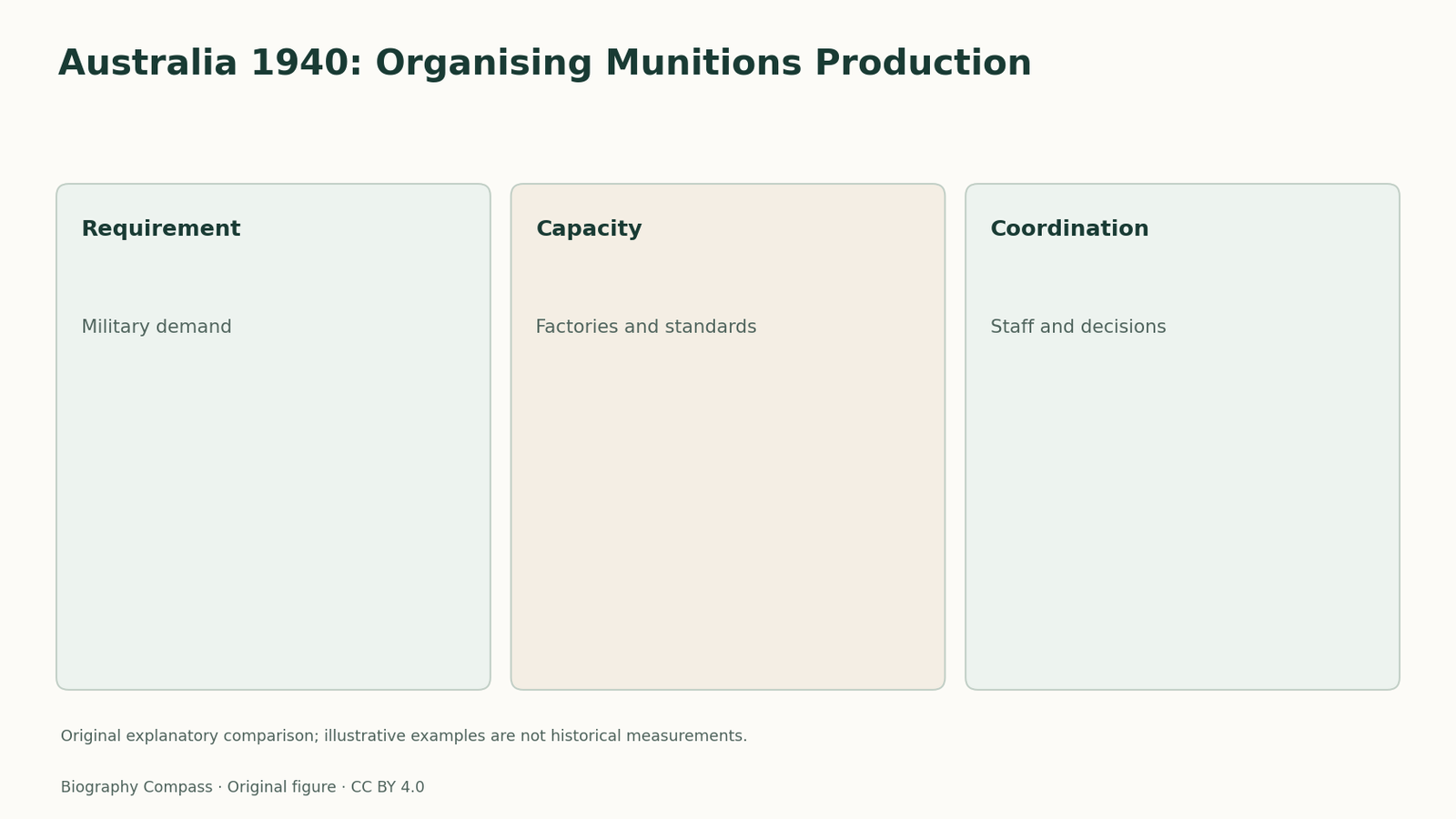
What each part contributes
Use the specific distinctions developed in the study.
| Part or record | What it establishes | Why the distinction matters |
|---|---|---|
| Military requirement | What was needed | Not itself a production plan |
| Technical standard | Compatible requirements | Does not allocate every task |
| Administrative staff | Information and coordination | Needed after agreement in principle |
What had to be organised beyond making a weapon?
Australian munitions production in 1940 required a connection between military demand and industrial capacity. Factories needed materials, tools, drawings, skilled work and an agreed production programme. Essington Lewis’s appointment placed a senior industrial manager within that public system. The relevant question is how requirements and capabilities were coordinated, rather than whether one individual personally made every item. His role also connected with standards organisations, where compatible requirements helped separate suppliers work towards a usable result. Production administration was therefore a concrete technical and organisational task.
A December minute shows coordination in practice
The Defence Committee minute of 17 December 1940 lists Lewis as Director-General of Munitions and N. K. S. Brodribb as his deputy among those present. Its subject concerns the proposed Eastern Group Supply Council. The record shows military officers, industrial administration and a delegation concerned with regional supply discussing a common proposal. Attendance establishes Lewis’s participation in that meeting; it does not assign every recorded view to him. The distinction makes the minute useful as evidence of institutional cooperation without turning a collective discussion into a personal speech.
Sources for this section: [4]
Agreement in principle left operating details to be settled
The committee recommended that the government agree in principle to establishing the supply council. It also stated that the precise scope of responsibilities and methods of operation required further consideration. This is a positive administrative distinction: agreement about the desirability of an organisation did not mean every practical rule was already fixed. Participants could support immediate preparation while identifying questions still to be resolved. A history that treats the recommendation as proof of a fully functioning council on that date would skip the work between authorisation, staffing and operation.
Sources for this section: [4]
Staffing was identified as a condition of effectiveness
The minute emphasises the provision of a competent nucleus staff so preliminary work could begin. That concern is unusually concrete. An organisation’s title and powers do not by themselves create the capacity to collect requirements, communicate with suppliers or coordinate decisions. Staff provide the continuing work through which those functions become effective. Read beside the industrial and standards accounts, the minute reveals several layers of production: factories manufacture, specifications coordinate technical expectations, and administrative staff connect information and decisions across the system. Each layer solves a different part of the problem.
Production-planning exercise and checked answer
A fictional committee agrees to create a supply office but has not appointed staff or defined how factories submit their capacity. Can that agreement alone establish that production has been allocated? No. The checked answer identifies additional steps: assign responsibility, provide competent staff, collect requirements and capabilities, then communicate decisions. The example follows the distinction made in the inspected minute without inventing an Australian production quota. It also explains why counting completed items is only one measure of the organisation’s work: a useful assessment must connect output to specifications, available capacity and the process that assigned the task.
Sources for this section: [4]
Continue the chronology
Related history guides
Biography context
Explore Australia through connected lives
Connected biographies
People and wider context
1881–1961
Essington Lewis
industrial manager and wartime production administratorEssington Lewis was a industrial manager and wartime production administrator, known for BHP’s development and the organisation of Australian munitions production.Read biographyQuick answers
Common questions
- Did the December 1940 recommendation mean every operating detail was already settled?
- No. The minute explicitly left scope and methods for further consideration and emphasised staffing.
Primary and institutional sources
How this history was checked
The source notes distinguish original records, institutional descriptions and later historical interpretation. Exercises and comparisons are original editorial analysis. This article was reviewed on 8 November 2026.