
The short answer
What made Richmond’s electric railway a system?
A worked comparison
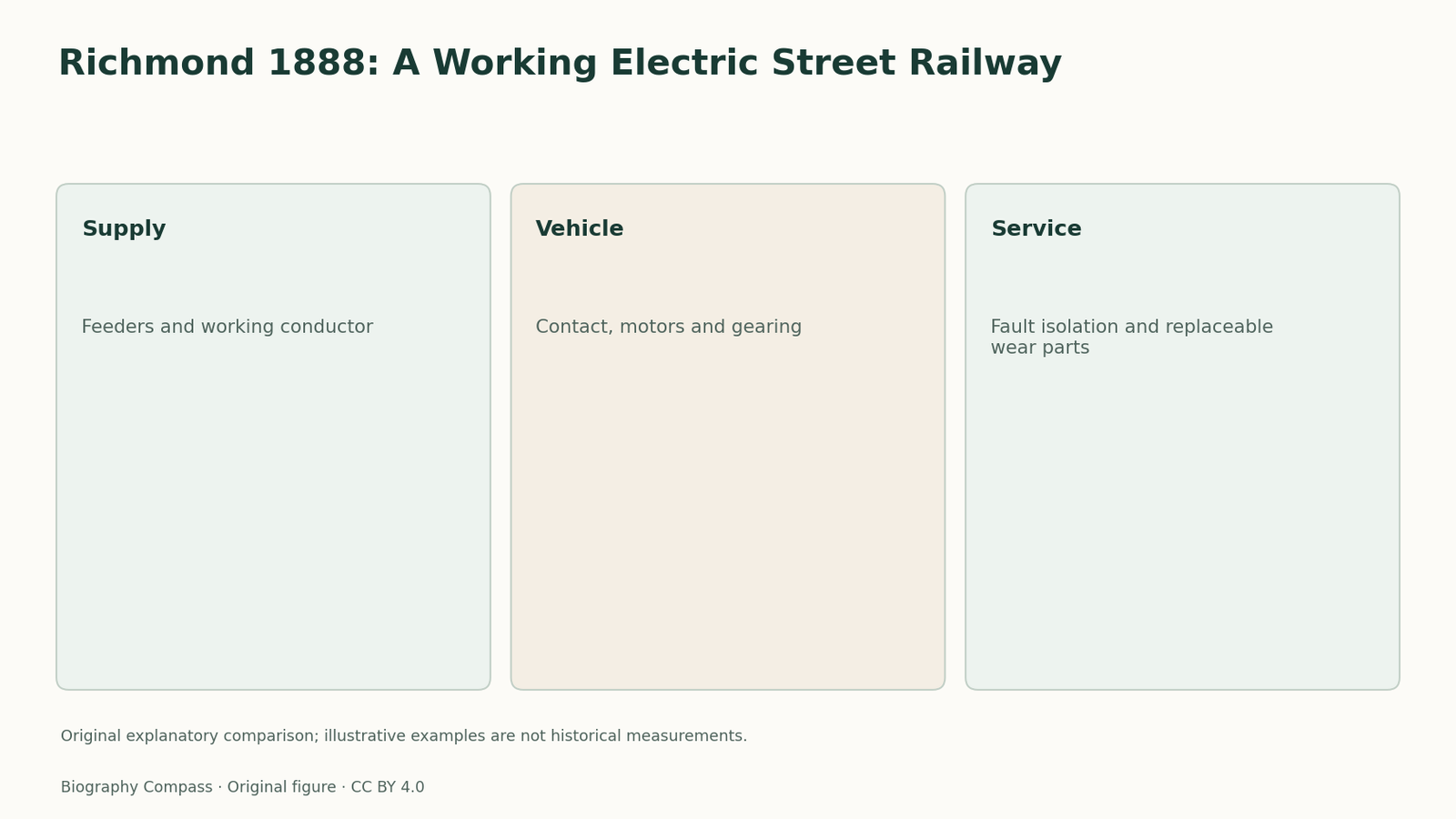
What each part contributes
Use the specific distinctions developed in the study.
| Part or record | What it establishes | Why the distinction matters |
|---|---|---|
| Motor and gearing | Convert power into wheel rotation | Different from collecting current |
| Feeder and contact wheel | Supply the route and connect the car | Different distribution functions |
| Sectional isolation | Contain a local electrical fault | Not a promise of fault-free operation |
What made Richmond’s electric railway a system?
An electric streetcar needs more than a motor. The September 1889 description of the Sprague system explains how the car obtained current, converted it to traction and remained serviceable when parts wore or faults occurred. Richmond’s 1887 contract and 1888 service are separate milestones; the later article is a retrospective technical account. Its useful evidence is the described arrangement of components. Studying those interfaces explains the engineering problem without treating a promotional account as an independently measured comparison with every competing railway.
Motor support connected electrical machinery to moving axles
The article describes two motors, each driving an axle through gearing. A motor’s relationship to the axle helped maintain the drive connection, while flexible support at the other end reduced the transmission of shocks. These are different functions within one mounting arrangement. Electrical output alone would not explain whether a motor could survive uneven track or remain aligned with the driven wheelset. The contemporary drawings and text therefore belong to a mechanical as well as an electrical story, with the support, gearing and accessible parts contributing to practical railway operation.
Sources for this section: [2]
Feeders and the contact wheel performed different jobs
The distribution arrangement used feeders alongside the working conductor above the track. The feeders supported the supply of current along the route, while the moving contact wheel connected an individual car with that overhead system. Rails and bonded connections formed the return arrangement described in the article. These components should not be collapsed into a single invention called the trolley. A worn collection wheel, a supply problem and a traction-motor problem could interrupt service for different reasons, requiring different inspection and maintenance tasks.
Sources for this section: [2]
Fault isolation and replaceable wear parts supported service
The source describes boxes and fuses that allowed a defective section to be disconnected while other parts of the route remained available. It also describes a replaceable wearing rim on the contact wheel. Sectional isolation addressed the geographical extent of an electrical interruption; replacement addressed deterioration in a particular component. Together they show that operating continuity was a design concern. The arrangement did not guarantee fault-free service, but it gave operators ways to contain trouble and maintain equipment rather than treating every failure as a reason to stop the whole railway.
Sources for this section: [2]
Maintenance-and-cost exercise with a checked answer
Suppose a fictional streetcar still receives current but its drive gearing is damaged. Would replacing the overhead contact wheel necessarily restore motion? No: current collection and mechanical transmission are separate functions. A second question uses the historical article’s reported operating-cost scope. It excluded motormen, conductors and roadbed repairs. Could that figure alone establish the total cost of running the railway? Again, no. Those omitted categories would need to be added on a comparable basis. The checked answers connect component diagnosis with accounting scope, showing why a successful system requires both functioning machinery and an honest definition of the costs being compared.
Sources for this section: [2]
Continue the chronology
Related history guides
Biography context
Explore United States through connected lives
Connected biographies
People and wider context
1857–1934
Frank Julian Sprague
electrical engineer and transport-system entrepreneurFrank Julian Sprague was an electrical engineer and transport-system entrepreneur, known for integrating motors, current collection and power distribution in electric railways.Read biographyQuick answers
Common questions
- Did Sprague’s reported railway operating cost include every expense?
- No. The inspected 1889 article excluded motormen, conductors and roadbed repairs; its figure cannot stand alone as the total cost.
Primary and institutional sources
How this history was checked
The source notes distinguish original records, institutional descriptions and later historical interpretation. Exercises and comparisons are original editorial analysis. This article was reviewed on 8 November 2026.
- M. Whelan, Edison Tech CenterFrank Julian Sprague
- The Electrical Engineer, preserved by Insulators.infoSprague System for Electric Railways, September 1889, pages 388–394
- Virginia Transportation Research CouncilRichmond electric-railway historical study, report 11-R18
- Century Association Archives FoundationFrank Julian Sprague member record