
The short answer
What was the Niagara commission deciding?
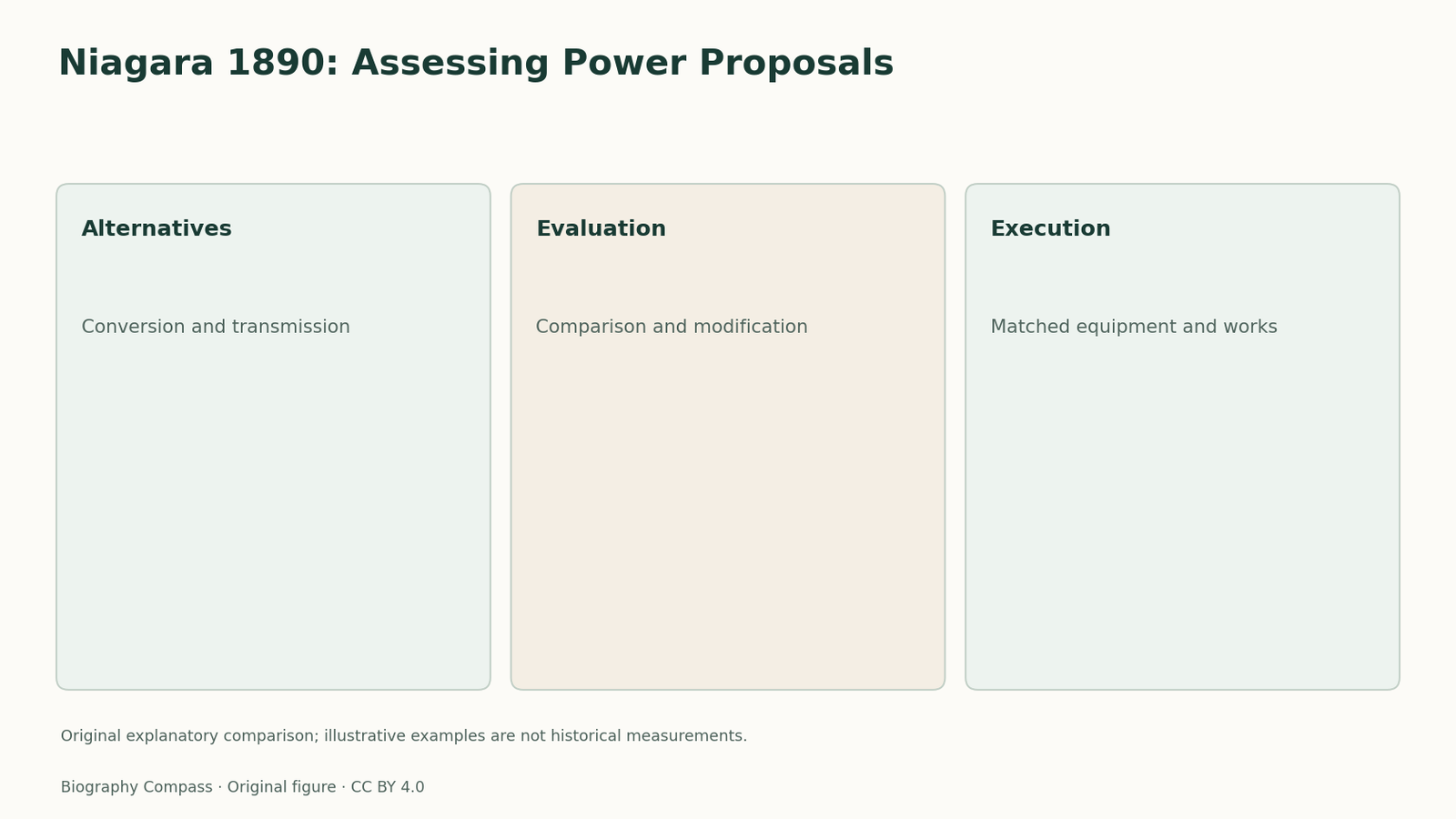
A worked comparison
What each part contributes
Use the specific distinctions developed in the study.
| Part or record | What it establishes | Why the distinction matters |
|---|---|---|
| Commission | Comparison of proposed systems | Not a completed plant |
| Prize outcome | No unchanged complete scheme endorsed | Further design remained |
| Shared civil works | Requirements common to alternatives | Equipment choices still separate |
What was the Niagara commission deciding?
The International Niagara Commission of 1890 addressed a problem that had several possible technical answers: how to turn the falls’ waterpower into useful industrial power and transmit it to customers. Mechanical, hydraulic and electrical arrangements could be proposed at different scales. Contemporary Scientific American reporting identifies Coleman Sellers as the American participant in a commission chaired by William Thomson. This establishes a formal process for examining options. It does not mean that the eventual generating plant, its electrical system and every transmission contract were already complete decisions at the moment the commission met.
Sources for this section: [2]
The proposals did not all use the same transmission method
The engineering history published through ETHW records seventeen submissions and distinguishes the transmission proposals. Only some used electrical methods, and those included different approaches to current. This is the concrete significance of the competition: the commission was comparing systems with different interfaces, not merely choosing the most attractive drawing of one predetermined machine. Water admission, turbines, generators or other conversion equipment, transmission and delivery to users had to fit together. A proposal that answered one of those questions well might still leave substantial work elsewhere in the chain.
Sources for this section: [4]
An award was not an instruction to build an unchanged scheme
The same history reports that no first prize was awarded for a complete combined project and that the commission did not recommend adopting any submission without substantial modification. That outcome is more informative than a simple winner story. An evaluation can identify useful elements while concluding that none of the offered systems is ready for direct execution. It also separates the competition’s judgement from later procurement decisions. Sellers’s consulting role belonged within this evolving process, in which learning from proposals could precede the selection and specification of actual equipment.
Sources for this section: [4]
Common works could advance before every choice was settled
The Niagara account describes work on a tailrace tunnel as a feature common to the project despite continuing decisions about equipment and transmission. Its function was to carry discharged water away after useful energy had been extracted. A shared civil requirement could therefore proceed while some other system choices remained open. This is a specific coordination problem: work that is compatible with several alternatives can be separated from work that depends on one final selection. The distinction helps explain staged construction without claiming that uncertainty had vanished or that all alternatives were equally workable.
Sources for this section: [4]
Systems exercise and checked answer
Imagine two proposals that use the same water intake and tailrace but different conversion and transmission equipment. Which construction task might be shared, and which purchase should depend on the chosen system? The checked answer is that a properly specified common waterway may serve both alternatives, while the conversion and transmission machinery must be matched to the selected arrangement. The example is a functional comparison, not a reconstruction of an uninspected Niagara bid. It explains why a commission could make progress by identifying common requirements and useful components even when it did not endorse a complete submission unchanged.
Continue the chronology
Related history guides
Sellers 1864: A Common Screw Thread
Understand Sellers’s 1864 thread system through angle, pitch, flats and committee endorsement, with an original compatibility and proportion exercise.
Read the timeline1892–1912Chicago Electricity: Loads and Central Stations
Understand Insull’s 1898 load-factor argument through energy, peak demand, capital costs and metering, with a checked example separating use from finance.
Read the timelineBiography context
Explore United States through connected lives
Connected biographies
People and wider context
1827–1907
Coleman Sellers II
mechanical engineer, educator and consultantColeman Sellers II was a mechanical engineer, educator and consultant, known for machine-tool engineering and participation in the International Niagara Commission.Read biographyQuick answers
Common questions
- Did the commission simply select a complete winning scheme for direct construction?
- No. The inspected engineering history states that no submission was recommended without substantial modification.
Primary and institutional sources
How this history was checked
The source notes distinguish original records, institutional descriptions and later historical interpretation. Exercises and comparisons are original editorial analysis. This article was reviewed on 8 November 2026.
- American Philosophical SocietyPeale-Sellers Family Collection: biographical history
- Scientific American, historical issueNiagara international commission report, 6 September 1890
- The Talking Machine World, historical issueColeman Sellers obituary, January 1908
- Engineering and Technology History WikiEarly Electrification of Buffalo