
The short answer
A comic answer can change the categories in a question. The exchange matters because neither the questioner’s demand nor the respondent’s qualification has to settle everything the audience wants to know.
Selected passages and original choices
Make the change visible
The historical example and the new writing plan have different jobs.
| Choice | Selected exchange | Original programme |
|---|---|---|
| Demand | Responsibility is treated as binary. | Ready means complete and usable. |
| Qualification | Duddy admits partial involvement. | A correct date substitutes for a whole programme. |
| Judgment | The exchange complicates authority. | The joke leaves the unfinished work visible. |
Chronology
A timeline of the turning points
Novel
The Apprenticeship of Duddy Kravitz.
A qualification
A binary demand meets a partial admission.
The question tries to close the case
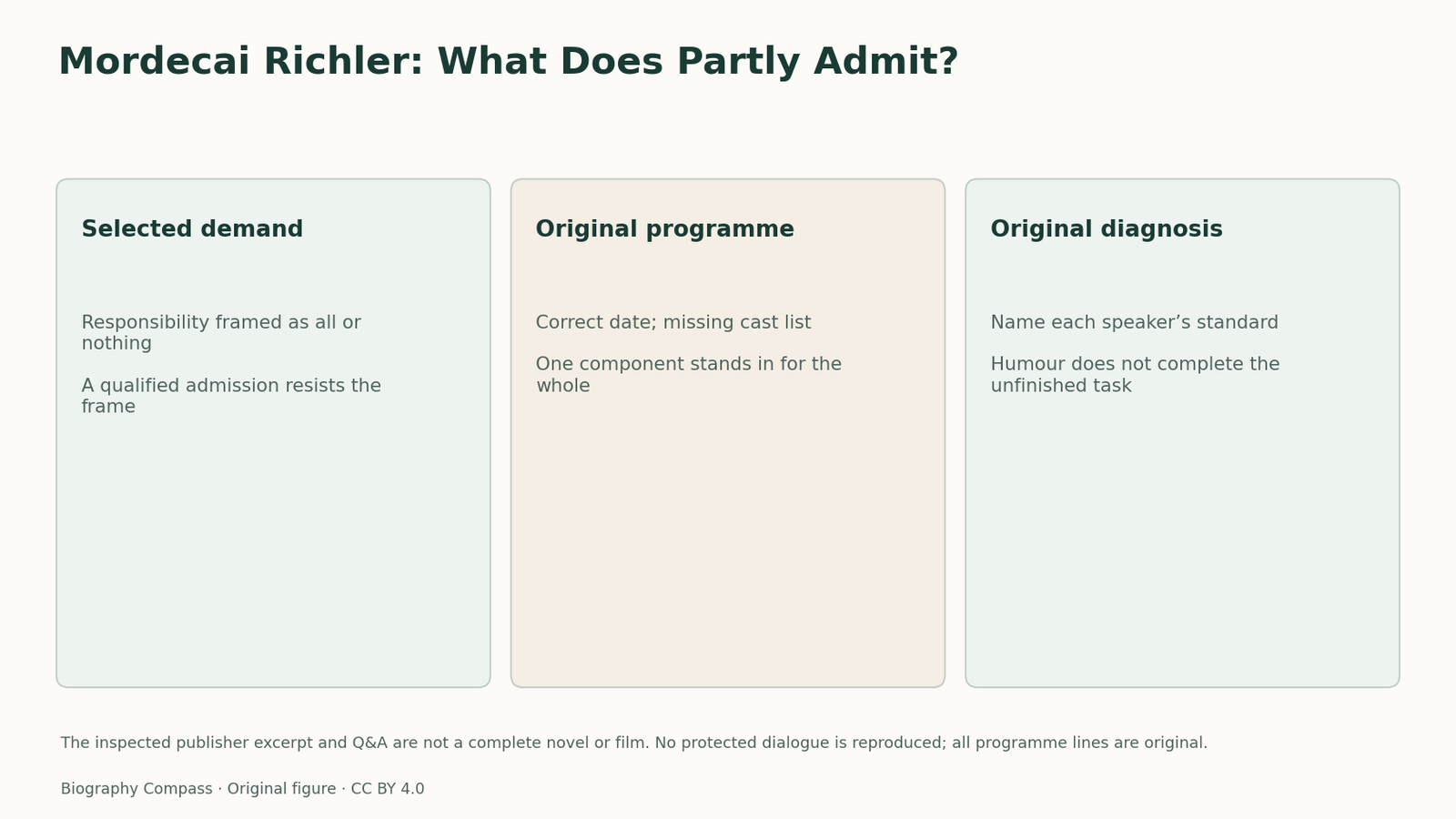
In the selected classroom exchange, Mr. MacPherson demands responsibility for a drawing. Duddy admits it only partly; the teacher insists that responsibility must be one thing or the other.
The qualification does not simply say no. It accepts some involvement while resisting the question’s complete alternatives. The comic friction is in the mismatch: the teacher wants a category settled, while the pupil makes the category harder to apply.
Keep the scene’s judgments in view
Earlier in the excerpt the teacher orders Hersh to erase the board despite his denial.
That action matters to our reading of the later exchange. Authority is already being exercised, not merely discussed in neutral terms. It does not follow that every evasive answer is admirable or that an admission establishes all the speaker’s motives. A reader can find the exchange funny while remaining critical of both speakers.
Richler’s professional life included commentary as well as fiction.
The selected dialogue supplies a particular comic mechanism. It is more useful to inspect that mechanism than to attach a general label such as satire and stop reading.
Original task: completion changes its meaning
Invent a community-theatre organiser and a volunteer preparing a printed programme. The organiser asks whether the programme is ready; the volunteer answers about one correct component while leaving a different important component unresolved. Write four to six lines so an audience can infer the mismatch without a narrator explaining the joke.
Reference exchange: Organiser: “Is the programme ready?” Volunteer: “The date is perfect.” Organiser: “And the cast?” Volunteer: “They can write their names in.” Organiser: “It is opening night.” Volunteer: “Then we have found the fastest way to make it accurate.” This is our invented programme and dialogue, not Richler’s text.
Reference answer: name the competing standards
The organiser means a complete usable programme. The volunteer substitutes correctness of the date, then turns incompleteness into an improvised advantage. The last line does not repair the missing cast list; it reveals the speaker’s effort to redefine success.
Revise the exchange so the volunteer genuinely lacks one piece of information rather than merely avoiding work. Does the comic effect change? Identify which line supplies evidence for that reading instead of assigning the speaker a personality from the outset. The task models a rhetorical mismatch, not a universal moral verdict about qualified answers.
Continue the chronology
Related history guides
Biography context
Explore Canada through connected lives
Connected biographies
The wider writing life
1931–2001
Mordecai Richler
Writer and screenwriterA novelist whose books reached adult and younger readers.Read biographyQuick answers
Common questions
- Does a qualified answer prove the speaker is innocent?
- No. The form of the answer does not establish the full events or the speaker’s motives.
Primary and institutional sources
How this history was checked
The selected passages below ground this study. The exercises and reference responses are original. This article was reviewed on 31 October 2026.