
The short answer
What did a defined RNA-transcript inoculation test establish beyond detecting a viral sequence or antibody marker?
Read the evidence
Different records within the same investigation
The following comparison distinguishes the specific questions answered by the inspected records.
| Record or test | What it establishes | What remains different |
|---|---|---|
| Association | Connects material with affected samples. | Does not alone demonstrate functional causation. |
| Functional evidence | Tests an attributed biological capability. | Must be interpreted within the investigated system. |
| Multiple outcomes | Constrain the relation between agent and disease. | Need separate identification and comparison. |
A recognised sequence left a further causal question
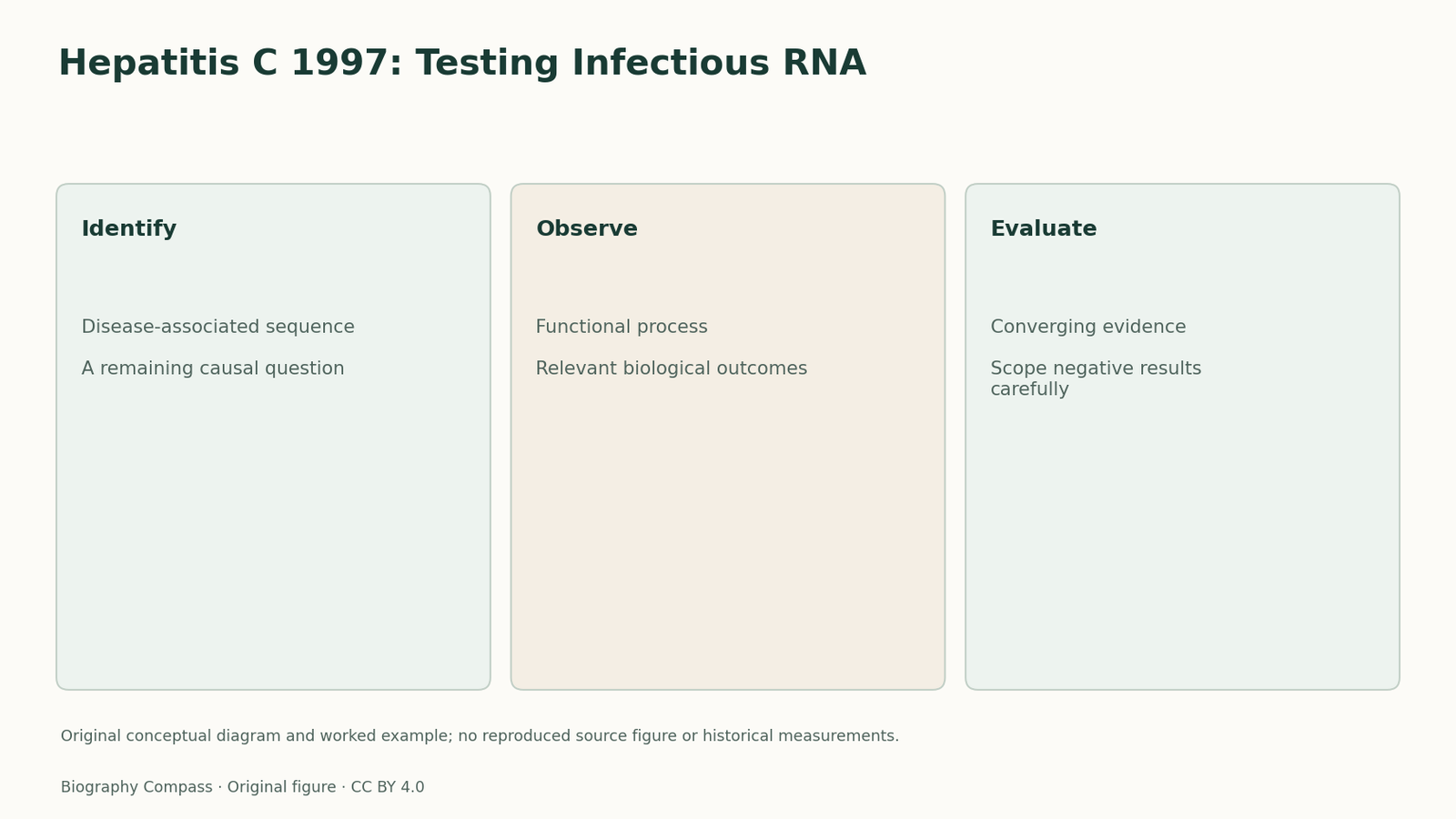
Molecular identification had linked HCV genetic material with non-A, non-B hepatitis. The next question was whether defined viral RNA could account for infection and disease in a tested biological system. The 1997 Rice-team paper addressed that stronger functional claim. It did not merely seek another association between a patient sample and a molecular marker. A useful history therefore distinguishes identifying material related to the disease from testing whether that material can initiate the biological process attributed to it.
Several outcomes supplied complementary evidence
Rice’s lecture describes changes in viral RNA, liver-enzyme measurements and tissue findings after the successful experiment. Those observations addressed different parts of the causal account. Detecting molecular material alone would not necessarily establish productive infection or the related tissue outcome. Conversely, a nonspecific disease indicator alone would not establish the identity of the responsible agent. Their combination made the interpretation more specific. This guide explains the evidential relationship without supplying viral construction, delivery, production or propagation procedures.
Sources for this section: [3]
Earlier failure had several possible interpretations
The first-person lecture also recounts unsuccessful attempts before the 1997 result. A negative outcome could reflect limitations in the tested material or the biological system rather than the universal impossibility of the proposed causal relationship. That does not make all failures meaningless; it means the conclusion must be limited to the comparison actually made. Distinguishing a failed test from a demonstrated absence of causal capability is especially important when the relevant functional system has not yet been independently established.
Sources for this section: [3]
The discovery was a sequence of contributions
Rockefeller’s institutional record connects Rice’s functional evidence with the broader hepatitis C programme, while the Nobel record recognises Alter, Houghton and Rice together. Clinical exclusion, molecular cloning and functional infection addressed related but separate questions. The chronology supplies an explanatory structure: each result reduced a different uncertainty left by earlier work. The collaboration also extended beyond the three laureates, as the original study’s authorship shows. Award summaries should therefore introduce the programme without replacing its specific experimental and credit record.
An original causal-evidence exercise and answer
Imagine three fictional records. A identifies sequence S more often in affected samples. B links defined S-related material with a reproducible biological process. C observes a relevant tissue outcome alongside that process. Which record alone establishes the entire chain? None, as stated. A concerns association; B addresses function in a tested context; C helps connect that function with an outcome. These letters are teaching labels and contain no infectious-material instructions. A strong answer asks which controls distinguish alternative causes and which observation measures each link. It also resists interpreting an unsuccessful preliminary B as proof that S could never matter. The lesson is to connect evidence at the right level, rather than granting one molecular observation every later causal conclusion.
Continue the chronology
Related history guides
Hepatitis C 1989: From a Clone to Identification
Examine the 1989 hepatitis C identification paper through antibody recognition, RNA evidence and host exclusion, distinguishing molecular identification from infectivity.
Read the timeline1961–2020Non-A, Non-B Hepatitis: Exclusion and Cause
Compare Alter’s 1975 clinical evidence through test sensitivity, residual cases and causal identification, with an original exercise showing what exclusion can establish.
Read the timelineBiography context
Explore United States through connected lives
Connected biographies
Researchers and related approaches
1952–
Charles M. Rice
Virologist and RNA-virus researcherCharles Rice investigated RNA viruses and helped establish functional hepatitis C genome evidence, connecting molecular identification with experimental infectivity.Read biography1912–1991
Salvador Luria
Microbiologist and scientific institution builderSalvador Luria studied bacterial viruses, helped establish microbial genetics and later combined research leadership at MIT with public political engagement.Read biographyQuick answers
Common questions
- Does sequence association equal functional infection?
- No. They answer different questions.
- Does one failed functional test disprove every causal role?
- No. Material and system limitations must be considered.
Primary and institutional sources
How this history was checked
The references below distinguish the original study from later explanations. The worked exercise and comparison are newly written for this article. This article was reviewed on 8 November 2026.
- Kolykhalov, Agapov, Blight, Mihalik, Feinstone and Rice, Science, 1997Transmission of hepatitis C by intrahepatic inoculation with transcribed RNA
- The Rockefeller University, 5 October 2020Rockefeller’s Charles M. Rice honored with Nobel Prize for research that contributed to a cure for hepatitis C
- Nobel Prize OutreachCharles M. Rice — Nobel lecture
- Nobel Prize OutreachCharles M. Rice — Facts
- Nobel Prize OutreachCharles M. Rice — Biographical