
The short answer
A Christchurch street painting connects Rhona Haszard’s student training with a modern approach to space and everyday traffic.
Read the evidence
Sources, interpretation and production roles
The records answer different questions about this work. The final exercise is an original teaching model.
| Record or question | Supported reading | Boundary or contrast |
|---|---|---|
| View | Through a lane towards a street | A directed look, not just a place name |
| Traffic | Motor vehicles in an urban scene | Modernity need not be a fixed symbol |
| Training | Possible encouragement from Nicoll | Not proof of dictated composition |
A lane becomes a spatial problem
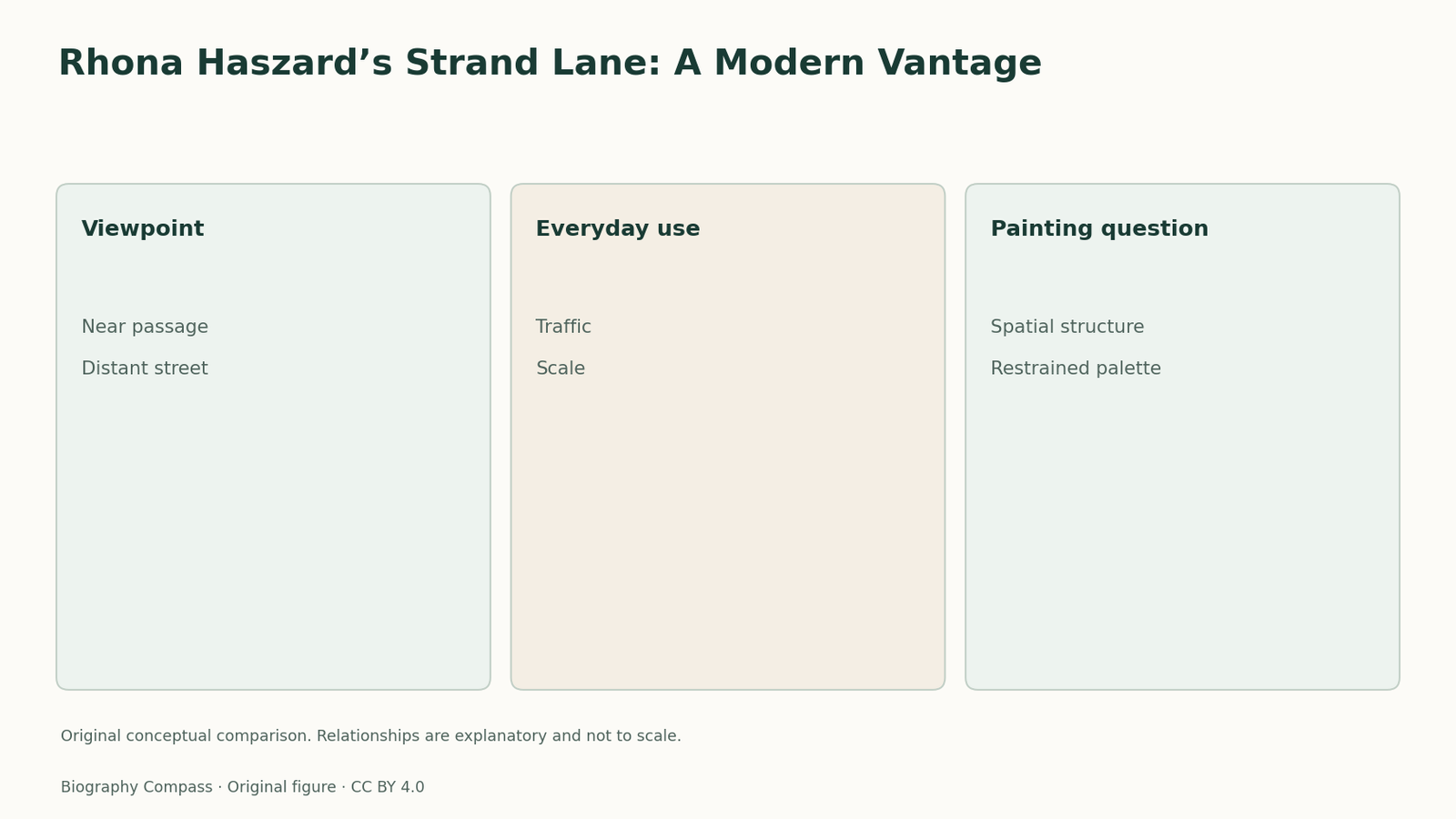
Christchurch Art Gallery identifies Haszard’s Untitled painting as Looking Through Strand Lane From Hereford Street, Christchurch. It is an oil on canvas on board associated with her Canterbury student period. The supplied title describes a direction of looking, not just a place: a viewer sees through one urban space towards another. The gallery emphasizes spatial structure and a restrained palette. The lane offers a directed view through the city, turning an everyday route into a sequence of near and distant spaces. It asks how a modest city subject can become an experiment in organizing a view, before the artist’s more extensively travelled career.
Sources for this section: [2]
Modernity can enter through an ordinary vehicle
The collection description notes motor vehicles as a modern element within the street view. Our interpretation is that this detail matters because it places the work’s spatial organization inside a changing everyday world. A lane is both an arrangement of surfaces and a route people and traffic can use. Those two functions can reinforce each other: the depicted passage directs attention, while contemporary vehicles keep it from becoming an abstract exercise detached from time. Nothing in this reading requires turning each vehicle into a symbol of progress. The more modest claim is that the painting joins formal decisions to recognizable aspects of urban experience.
Sources for this section: [2]
A student work need not be a rehearsal without value
The gallery links Haszard’s innovative structure and restrained colour to the likely encouragement of Archibald Nicoll, the art school’s principal. That is a qualified curatorial interpretation, not proof that a teacher dictated the composition. Our reading treats the painting as a finished instance of learning through making. It can be placed beside the later travels and brighter Post-Impressionist work described by Canterbury University Press without imposing an inevitable development from one to the other. Different settings and media opened different questions. The Christchurch lane is useful precisely because it shows a specific problem the artist addressed at an earlier stage. The passage thus offers a problem of attention as well as a recognizable urban subject.
Exercise: turn a route into a view
Draw an invented passage between two plain buildings, with an opening towards a second street. Make a second sketch in which the opening is blocked by a flat rectangle. A possible answer says the first offers a route for the eye and an imagined route for movement, while the second emphasizes a closed surface. Add a small vehicle to the first sketch and explain what changes: scale and a sense of ordinary use can become clearer without altering the buildings. Return to the gallery’s description and distinguish its observations from our exercise. The source identifies spatial structure, restrained colour and traffic; the model proposes ways to think about their relationships, rather than reproducing Haszard’s arrangement.
Sources for this section: [2]
Continue the chronology
Related history guides
Biography context
Explore New Zealand through connected lives
Connected biographies
People and related creative practices
1901–1931
Rhona Haszard
Painter and printmakerRhona Haszard pursued a short international career that connected Canterbury training with landscape painting, colour and new experiments in relief printmaking.Read biography1908–1970
Rita Angus
PainterA New Zealand painter whose precise compositions make ordinary signs of human presence unusually visible.Read biography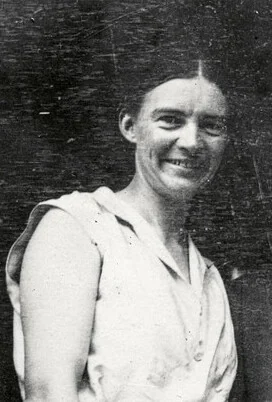
1905–1982
Olivia Spencer Bower
Painter, printmaker and supporter of artistsOlivia Spencer Bower developed a professional artistic life in New Zealand through travel, experimentation, exhibition and sustained attention to painting’s materials.Read biographyQuick answers
Common questions
- Is the Strand Lane work a still life?
- No. It is a Christchurch urban view, identified by the gallery through a descriptive title.
- What does the gallery emphasize?
- Its description focuses on spatial structure, restrained colour, motor vehicles and the context of her art-school training.
Primary and institutional sources
How this history was checked
The painting discussion follows Christchurch Art Gallery’s object description and training context; it does not claim a direct examination of the original. The reading exercises and comparisons are original analytical models. This article was reviewed on 8 November 2026.