
The short answer
A c.1943 oil portrait provides a specific example of how Olivia Spencer Bower’s training in drawing met her interest in spatial form.
Read the evidence
Sources, interpretation and production roles
The records answer different questions about this work. The final exercise is an original teaching model.
| Record or question | Supported reading | Boundary or contrast |
|---|---|---|
| Object | Oil on board, c.1943 | 83/08 identifies this version |
| Training | Canterbury, Slade and Fisher | Connections are not identical methods |
| Form | Contour and tonal contrast | Different routes to pictorial structure |
Identify the portrait before interpreting it
Christchurch Art Gallery identifies Portrait of Alison Pickmere as an oil on board made about 1943, accession 83/08. The approximate date is part of the object’s identity and should remain approximate. The gallery describes it as one of Olivia Spencer Bower’s early portraits, made while she studied with A. J. Fisher at Elam in Auckland. This provides a specific question for looking: how did a painter known for watercolour use the more solid structure of an oil portrait? The support is flat, but the gallery’s account concerns a sense of volume. The gap between those two conditions makes the portrait’s construction a useful object of study.
Sources for this section: [2]
Training connects two art schools
The gallery notes that Fisher had studied at the Slade, where Spencer Bower herself had trained in 1929. Their shared institutional background does not prove that they worked identically. It does, however, place the portrait within a history of learning how to turn drawing into a painted arrangement of forms. Spencer Bower’s earlier Canterbury training included drawing and painting from life. Our interpretation is that the portrait offers a meeting point between those disciplines: a sitter is represented through spatial decisions that have to function on a flat board. The work is both an image of a person and a construction made by a trained painter.
Shape, contrast and the appearance of volume
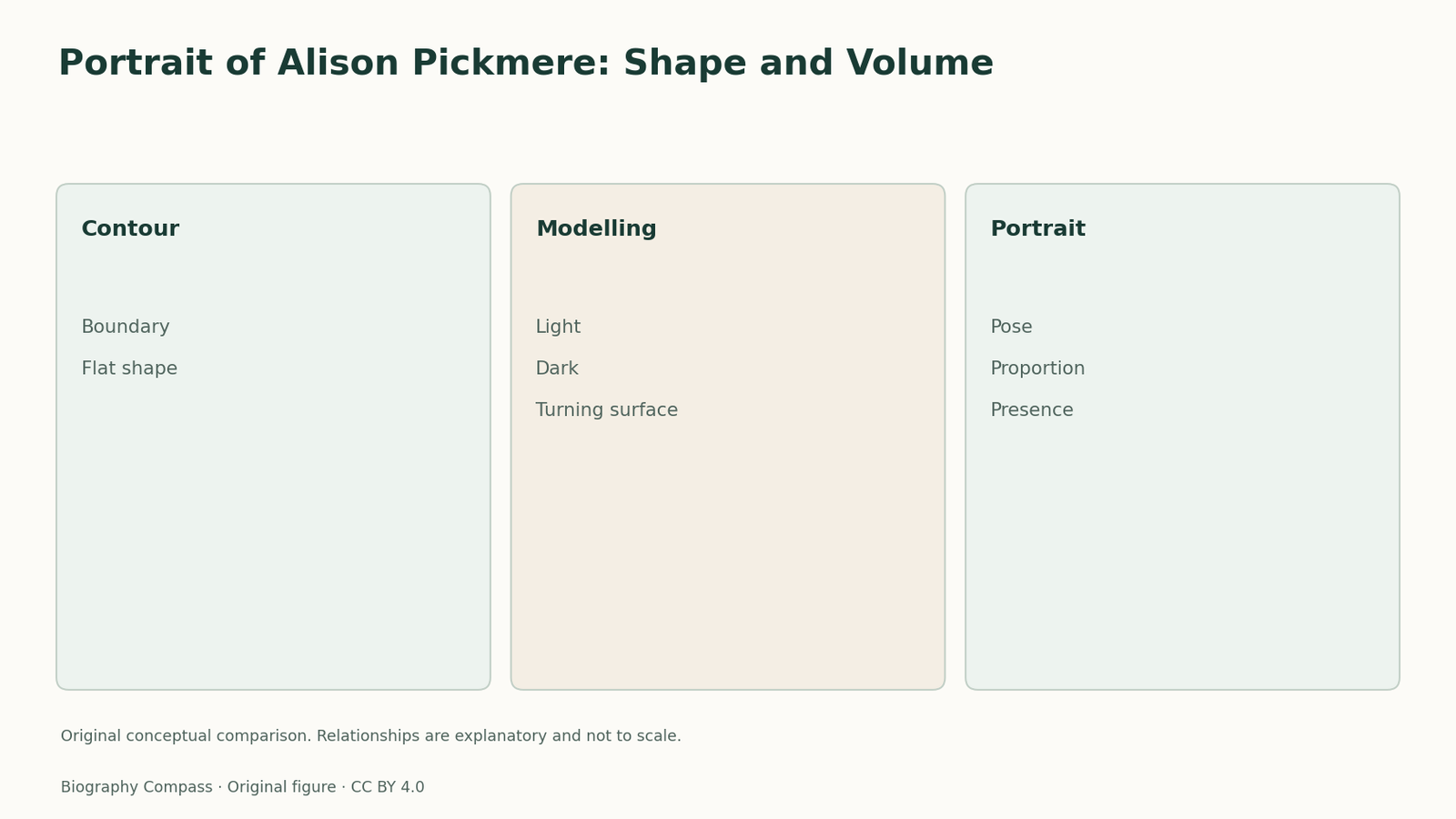
The collection text emphasizes geometric shapes and contrasts of light and dark as means of creating volume. It also notes the pose’s emphasis on the sitter’s neck and delicate features. These are the gallery’s stated observations; our analytical extension is to distinguish contour from modelling. A contour can delimit an area, while a change in light and dark can make that area appear to turn in space. The two need not compete. Their relationship gives a portrait an organized surface and a sense of bodily presence simultaneously. This formal question is more precise than describing the portrait simply as realistic, modern or attractive.
Sources for this section: [2]
Exercise: a boundary is not a shadow
Draw an original oval above a short column to stand for an invented head and neck. Make one version using outlines alone and another using three tones within the same boundaries. A possible answer observes that the second can suggest a turning surface, even though both occupy an equally flat sheet. Now change the length of the column without changing the tonal scheme and explain how pose and proportion create another effect. Use these distinctions to formulate two questions for the Pickmere portrait: where does a boundary organize the surface, and where does contrast suggest volume? The comparison separates proportion, contour and modelling, allowing a reader to describe what each contributes before judging their combined effect in a portrait.
Continue the chronology
Related history guides
Biography context
Explore New Zealand through connected lives
Connected biographies
People and related creative practices
1905–1982
Olivia Spencer Bower
Painter, printmaker and supporter of artistsOlivia Spencer Bower developed a professional artistic life in New Zealand through travel, experimentation, exhibition and sustained attention to painting’s materials.Read biography1908–1970
Rita Angus
PainterA New Zealand painter whose precise compositions make ordinary signs of human presence unusually visible.Read biography1901–1931
Rhona Haszard
Painter and printmakerRhona Haszard pursued a short international career that connected Canterbury training with landscape painting, colour and new experiments in relief printmaking.Read biographyQuick answers
Common questions
- When was the Pickmere portrait painted?
- The gallery dates it approximately to 1943, rather than supplying a definite day or year.
- What creates volume in the gallery’s reading?
- Its description emphasizes geometric organization and contrasts of light and dark.
Primary and institutional sources
How this history was checked
The portrait discussion follows the identified collection record and its curatorial description; no direct examination or colour measurement of the original painting was made. The reading exercises and comparisons are original analytical models. This article was reviewed on 8 November 2026.