
The short answer
A company’s name can survive while the set of businesses behind its figures changes. Remgro’s 2001 results explain an adjustment for interests transferred to VenFin. The question is therefore which perimeter is being compared, before asking whether a reported total rose or fell.
Evidence and interpretation
Keep the claim attached to the record
Each row answers a different part of the question.
| Record | Supported reading | Limit |
|---|---|---|
| Transaction report | Four holding-company approvals | Not a complete accounting-policy note. |
| Income/balance comparatives | Adjusted for transfers to VenFin | Use the adjusted perimeter. |
| Other statements | No pro forma cash-flow or changes-in-equity comparison | Do not manufacture a missing baseline. |
Chronology
A timeline of the turning points
Approval
Shareholders approved the restructuring.
Listing
Remgro ordinary shares listed.
Results release
Read the comparative-basis notes.
What the issuer adjusted
Note 1 records the split into Remgro and VenFin. Note 2 says the 2000 income-statement and balance-sheet comparatives were adjusted for investments transferred to VenFin, using Rembrandt’s audited statements. It supplies no pro forma cash-flow or changes-in-equity comparison.
This tells the reader how the comparison was constructed. A pro forma baseline is neither a new observed year nor automatically identical to the old group’s published total. The note is part of the evidence, not optional small print.
Sources for this section: [1]
Contemporary reporting asks another question
The contemporary report described approval by four holding companies and the proposed two-group structure. It included rounded pro forma figures.
The later issuer release also explains an accounting restatement of a comparative earnings figure.
The news report helps establish the public transaction context. For the precise accounting basis, use the issuer’s stated adjustment and units. Differences between rounded or differently based figures should not be silently treated as growth.
Original perimeter task
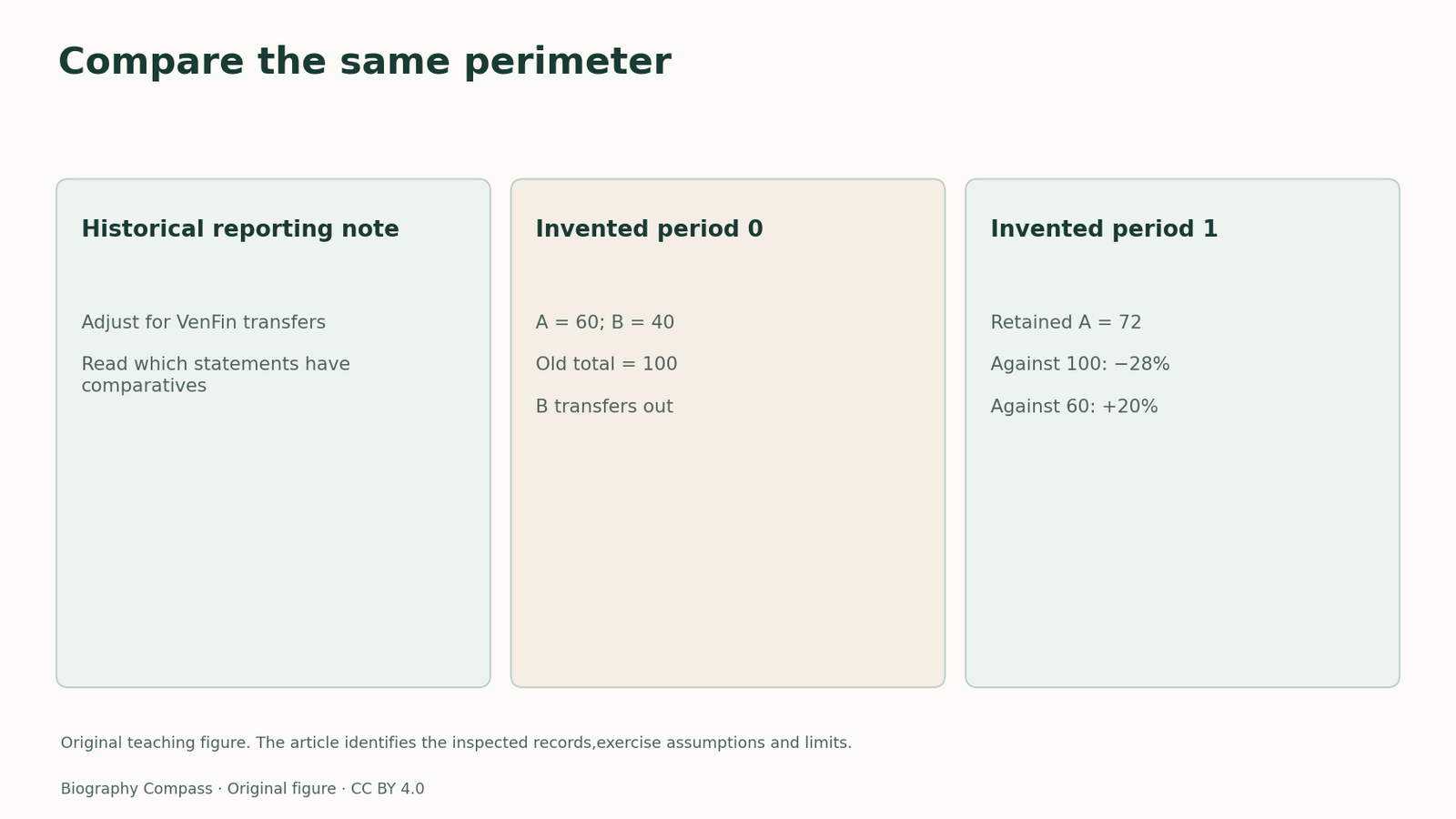
Invented example in arbitrary units: an old group has A=60 and B=40 in period 0. B transfers out. The retained A has 72 in period 1. Assume these component values are measured on a consistent basis and no other changes occur. Calculate the change against the old total and against the retained-component baseline. Which comparison answers how A changed?
Reference answer
The old total is 100, so 72/100−1 = −28%. The comparable A baseline is 60, so 72/60−1 = +20%. The latter answers the stipulated question about A. The two calculations are both arithmetically valid but answer different questions.
These are invented values, not the historical group’s results or an estimate of the transaction’s success. A real comparison also needs the stated measurement policies and adjustments. The lesson is to identify the perimeter before interpreting the direction of a change; it does not supply investment advice.
Continue the chronology
Related history guides
Biography context
Explore South Africa through connected lives
Connected biographies
The working life
1916–2006
Anton Rupert
Industrialist and philanthropistEnterprise carried political consequences.Read biographyQuick answers
Common questions
- Does a falling total prove the retained business shrank?
- No. First check whether the set of activities and measurement basis are comparable.
Primary and institutional sources
How this history was checked
Compare the selected accounts and objects below; each has a stated date and scope, and the learning task supplies its own instructions. This article was reviewed on 31 October 2026.