
The short answer
A brand can reach customers through several legal entities. Honda’s July 2008 announcement describes that division of work. Reading its functions first makes the reorganisation intelligible: a shareholder change and a transfer of work are related events, but they are not the same operation.
Evidence and interpretation
Keep the claim attached to the record
Each row answers a different part of the question.
| Record | Supported reading | Limit |
|---|---|---|
| Wholesaling | Boon Siew Sdn. Bhd. | An operating function, not a shareholding percentage. |
| Final assembly | Kah Assemblers | A distinct entity in the starting structure. |
| Consolidation | Described retrospectively in 2011 | No proof of every forecast outcome. |
Chronology
A timeline of the turning points
Announcement
Read the stated starting structure and proposed change.
Later account
Separate retrospective organisation from prospective facilities.
Start with the existing work
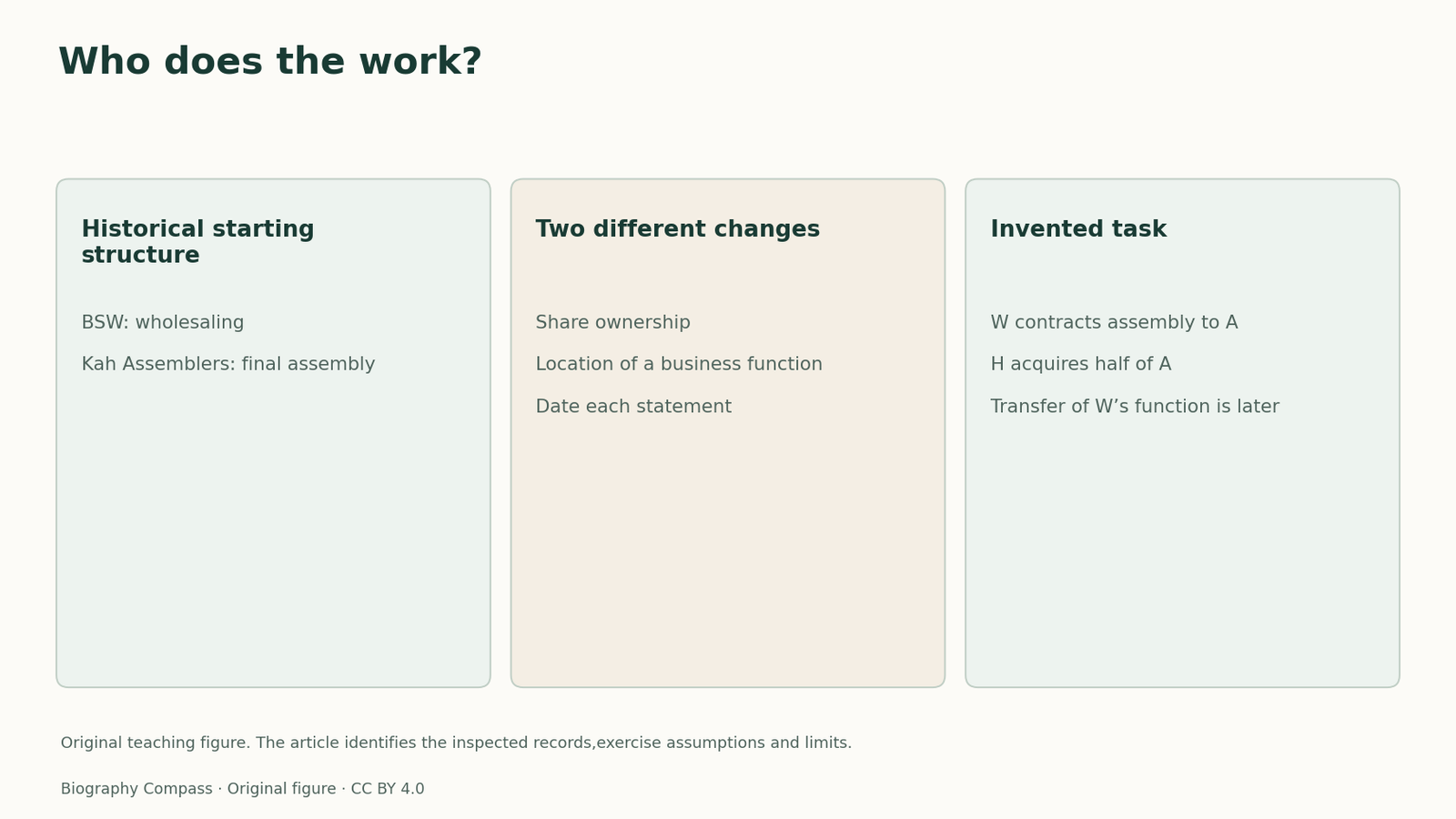
The announcement identifies Boon Siew Sdn. Bhd. as wholesaler. It contracted final assembly to Kah Assemblers, then wholly owned by Oriental Holdings. Honda would acquire half of the assembler’s shares, with wholesaling scheduled to move in January 2009.
This is more specific than saying the brand entered the country. The existing companies already had jobs. To draw the change, put activities inside boxes and contractual relationships on arrows; write the shareholder transaction beside the box rather than treating it as a shipment of motorcycles.
Sources for this section: [1]
Use the later record for a different question
Honda’s September 2011 release described the business as consolidated and operating in production, sales and service. It separately announced a planned replacement plant.
The later account supports a retrospective statement about organisation. Its prospective plant details do not, by themselves, establish later output or realised efficiency. A diagram should therefore label its date and avoid silently importing a later facility into an earlier operating structure.
Original routing task
Invented case: W wholesales a product and contracts final assembly to A. Owner O holds all of A. A plan gives H half of A; the wholesale function will transfer later. At the first stage, can a diagram move both functions into A? At the second stage, if a dated record expressly confirms the transfer, which arrow disappears? Does either stage prove a change in the product’s design?
Reference answer
At the first stage, keep W’s wholesale function and its assembly contract distinct from the ownership change. At the stipulated second stage, the external W-to-A contracting arrangement can be replaced by internal functions within the combined operator. Neither statement supplies design-change evidence. The answer follows the invented facts; it is not a reconstruction of the signed historical contract.
This method preserves the useful business distinction: who owns an entity, who performs a function and who contracts with whom are separate questions. The records answer them with different kinds of statements.
Continue the chronology
Related history guides
Biography context
Explore Malaysia through connected lives
Connected biographies
The working life
Quick answers
Common questions
- Does owning half an assembler automatically transfer wholesaling?
- No. Ownership and the assignment of operating functions need separate evidence.
Primary and institutional sources
How this history was checked
Compare the selected accounts and objects below; each has a stated date and scope, and the learning task supplies its own instructions. This article was reviewed on 31 October 2026.