
The short answer
How does the arrangement of Nga Morehu place a viewer among the figures?
Compare the records
What the sources allow us to say
Read the object record alongside the contextual account.
| Record | Evidence | Reading limit |
|---|---|---|
| Te Papa object record | Life-sized figures stand without conventional pedestals. | Interpretation depends on the complete arrangement. |
| Archive biography | Preserves education, public works and working documents. | An archive description is not the whole making history. |
A call passes beyond the child
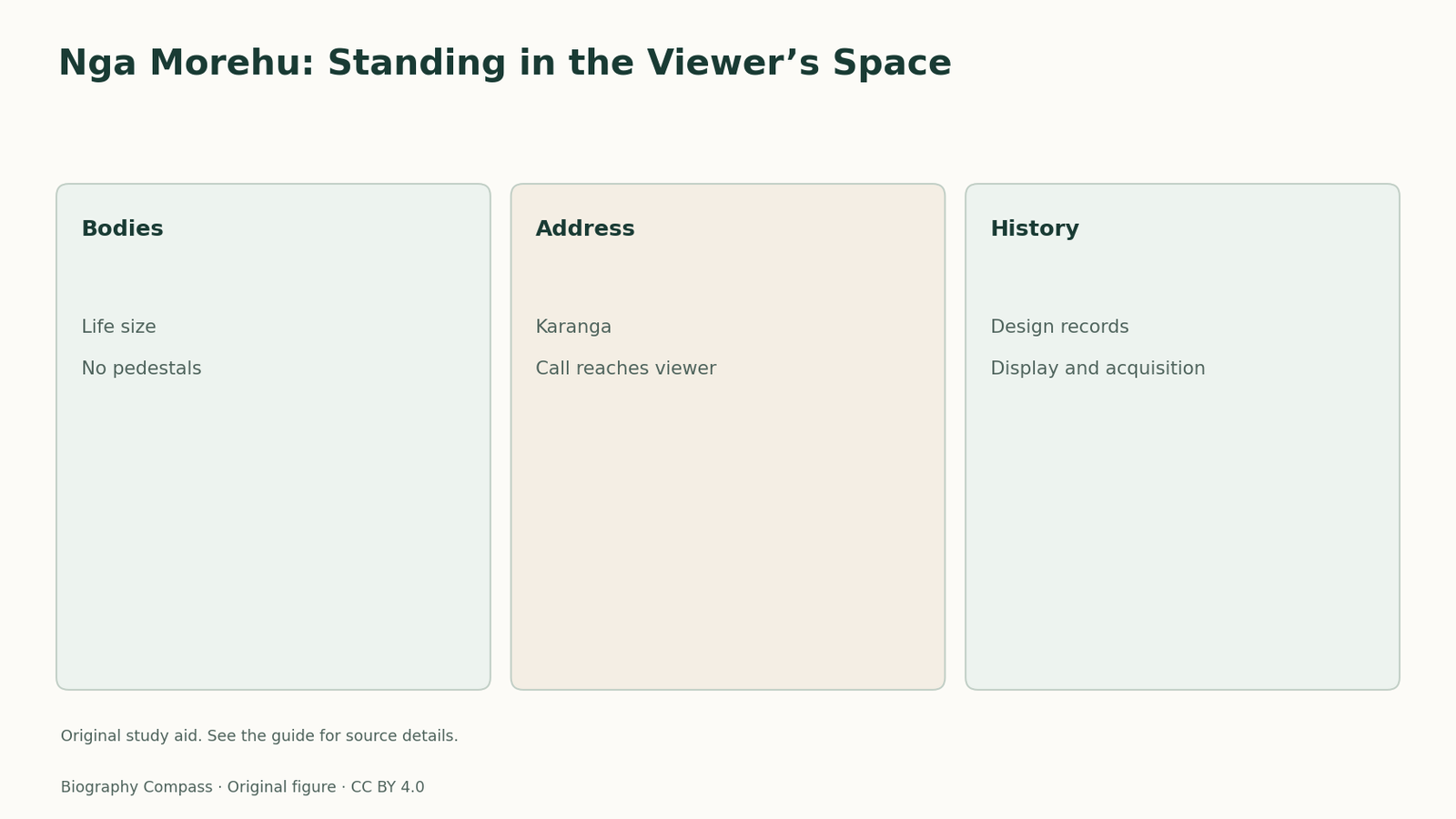
The museum’s interpretation identifies karanga, the ceremonial call, and explains that the exchange reaches across an imagined marae space toward the viewer. Text and song on the bodies add another layer to the figures’ presence. The small child participates in an arrangement concerned with histories and futures of Māori women. These elements allow the work to carry an address. The audience is asked to respond to an encounter whose social and historical setting the museum explains, rather than to admire an anonymous grouping of bodies.
Sources for this section: [2]
Follow making into display
National Library records preserve drawings and photographs associated with the project, while Te Papa records its 1988 exhibition and 1992 purchase. Put design, first display and collection acquisition on separate points of a timeline. A useful answer explains how the sculpture can have a history of development before it enters a permanent collection. It should then connect that history with the floor-level encounter, identifying why an installation photograph and an early drawing answer different questions. One records a realised arrangement; the other can reveal a proposal or an earlier decision still being worked through.
Continue the chronology
Related history guides
Biography context
Explore New Zealand through connected lives
Connected biographies
Read the artist’s biography
b. 1951
Shona Rapira Davies
Sculptor and installation artistA Ngātiwai artist whose sculpture and public works confront history through figures, material and the viewer’s position.Read biographyQuick answers
Common questions
- Why does the lack of pedestals matter?
- It places the figures in the viewer’s space and strengthens the sense that the group addresses the audience directly.
Primary and institutional sources
How this history was checked
The listed records support the facts. Observation exercises and arguments are Biography Compass editorial interpretations. This article was reviewed on 7 November 2026.