
The short answer
Why did Prasad distinguish making a constitution from administering it?
Evidence comparison
Read the records together
The records were created for different purposes and support different kinds of claims.
| Record | What it establishes | Question to keep open |
|---|---|---|
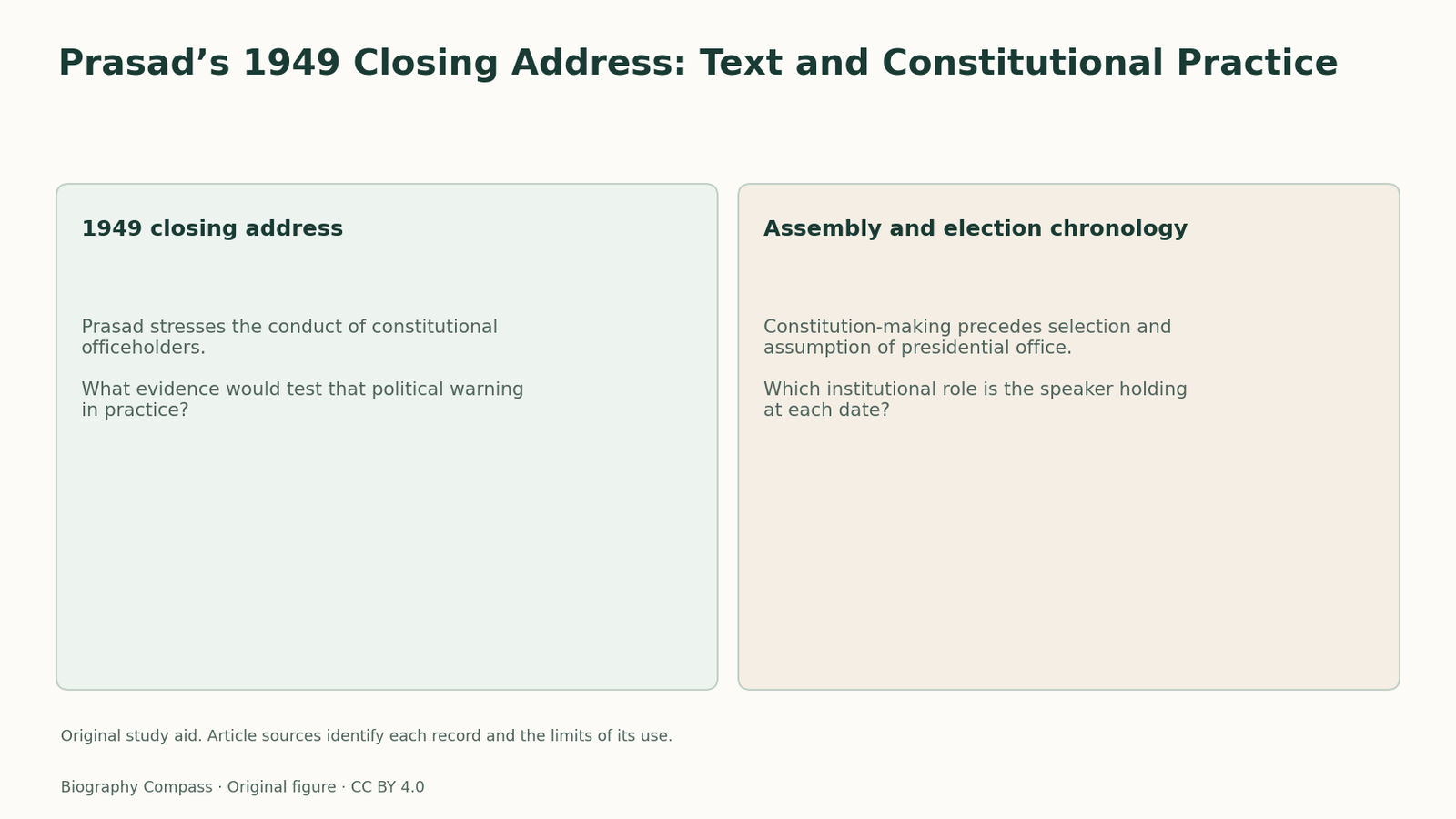
| 1949 closing address | Prasad stresses the conduct of constitutional officeholders. | What evidence would test that political warning in practice? |
| Assembly and election chronology | Constitution-making precedes selection and assumption of presidential office. | Which institutional role is the speaker holding at each date? |
Chronology
A timeline of the turning points
Assembly chair
Prasad becomes permanent presiding officer.
Closing address
He reflects on constitutional text and administration.
Republican presidency
Selection and assumption of office follow in January.
Locate the address in the proceedings
Prasad spoke on 26 November 1949 as the Assembly concluded its constitution-making work. His role was different from that of a commentator writing decades later: he had presided over the institution producing the framework. The date also precedes his election as president of the republic. Keeping those positions distinct helps identify the authority and audience of the address without confusing the Assembly presidency with the later head-of-state office.
Separate a provision from a warning
The address argues that the results of a constitution depend heavily on those who administer it. That is a judgment about political practice. It should be compared with the legal text rather than treated as if it created another power or qualification. A constitutional provision can assign a duty, while the address asks whether the people exercising public responsibility will do so with the capacity and integrity needed to make the framework function.
Sources for this section: [2]
Keep the later dates in order
Prasad’s selection on 24 January 1950 and assumption of office on 26 January belong to the next stage. The chronology demonstrates the transition from making the framework to staffing an institution it created. It does not itself prove that every later decision fulfilled his warning. Testing that question requires examination of particular appointments, proceedings and actions, rather than inferring successful practice from the completion of the constitution alone.
Compare a rule and a decision
Choose one constitutional institution and create columns for the text’s assigned task, the person holding office and an observed decision. Use the closing address to frame a question about the relationship between those columns. A strong answer does not claim that character replaces legal rules. It explains why rules and conduct are different evidence, and why evaluating constitutional practice requires a record of how people actually exercised the responsibilities assigned to them.
Continue the chronology
Related history guides
Biography context
Explore India through connected lives
Connected biographies
People behind the records
1884–1963
Rajendra Prasad
Constituent Assembly president and head of statePrasad moved from law and the independence movement to the Constituent Assembly, then served as India’s first president from 1950 to 1962.Read biographyQuick answers
Common questions
- Was Prasad already president of the republic when he spoke in November 1949?
- He was presiding over the Constituent Assembly. His election as the republic’s president followed in January 1950.
Primary and institutional sources
How this history was checked
Sources support the chronology and the record comparison. The reading exercise is original. This article was reviewed on 7 November 2026.