
The short answer
Why was Vajpayee’s 1996 confidence motion not decided by a vote?
Evidence comparison
Read the records together
The records were created for different purposes and support different kinds of claims.
| Record | What it establishes | Question to keep open |
|---|---|---|
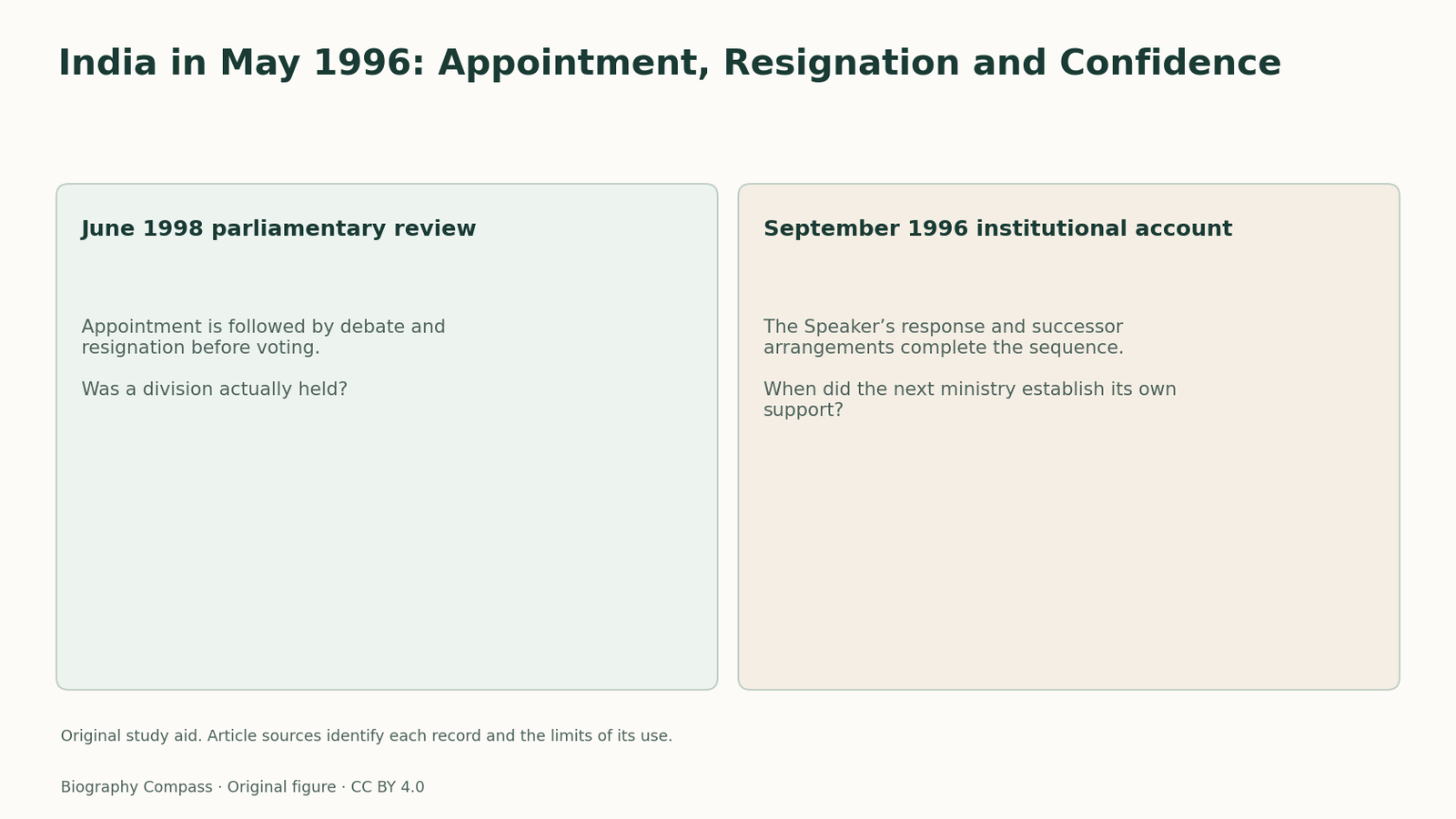
| June 1998 parliamentary review | Appointment is followed by debate and resignation before voting. | Was a division actually held? |
| September 1996 institutional account | The Speaker’s response and successor arrangements complete the sequence. | When did the next ministry establish its own support? |
Chronology
A timeline of the turning points
Appointment
Vajpayee becomes prime minister.
Resignation announced
The confidence motion is not put to a division.
Successor confidence
Deve Gowda’s motion is adopted.
Identify the appointment and its condition
The parliamentary account records Vajpayee’s appointment on 16 May and a requirement to establish majority support. Appointment allowed a ministry to take office, but it was not a substitute for demonstrating support in the Lok Sabha. The distinction is especially important after an election that does not produce a clear governing majority. A list of prime ministers supplies the officeholder and date, while the confidence proceedings explain the government’s parliamentary position.
Sources for this section: [2]
Read what happened before a division
The motion was debated on 27 and 28 May. Vajpayee announced that he would resign before the House voted. The Speaker then treated putting the confidence motion to a vote as unnecessary. An account saying the government lost a recorded confidence division would therefore describe an event that did not occur. The debate and resignation established the immediate outcome through a different procedural route.
Follow the next government separately
Sharma asked Vajpayee to continue pending alternative arrangements and invited Deve Gowda to form a ministry. The later government’s confidence motion was adopted in June by a voice vote. These are distinct stages: continuity while a successor is arranged, appointment of that successor and demonstration of support. The first ministry’s resignation does not itself establish the next ministry’s majority, which required its own parliamentary proceeding.
Repair a misleading timeline
Replace the phrase lost a confidence vote with separate entries for debate, announced resignation and no division. Add the invitation to Deve Gowda and the later confidence proceeding below them. A correct answer preserves both the political weakness of the first government and the procedural fact that no numerical division decided its motion. The repaired timeline shows how a constitutional transition can be explained accurately without inventing a vote count.
Continue the chronology
Related history guides
Biography context
Explore India through connected lives
Connected biographies
People behind the records
1918–1999
Shankar Dayal Sharma
Lawyer, vice president and presidentSharma’s career passed through Bhopal government, Union communications, governorships and the vice presidency before the constitutional transitions of 1996.Read biographyQuick answers
Common questions
- Did Vajpayee lose a recorded confidence division in May 1996?
- The parliamentary account states that he announced resignation before the motion was put to a vote.
Primary and institutional sources
How this history was checked
Sources support the chronology and the record comparison. The reading exercise is original. This article was reviewed on 7 November 2026.