
The short answer
Rainhill was a public comparison of competing machines for a railway approaching operation. Its most useful question was not simply which engine could make a spectacular dash, but which could keep doing useful work with acceptable fuel and water consumption.
Chronology
A timeline of the turning points
Newcastle manufacturing business
Robert Stephenson & Co. begins producing engines before the competition.
Competition announced
The Liverpool and Manchester Railway seeks a proven locomotive design.
Tests at Rainhill
Competing designs face repeated runs, measured loads and fuel-and-water recording.
Railway opens
The Liverpool and Manchester Railway begins its next stage, distinct from the trials.
A railway company needed evidence for a purchase
The Liverpool and Manchester Railway was under construction when the trials were arranged. Its promoters needed a workable way to move traffic between the two commercial towns. Arguments over locomotives, stationary engines and other forms of traction had preceded the contest; Rainhill supplied a direct comparison among designs offered for locomotive use.
The prize was £500. The trials held near Liverpool in October 1829 became a public event as well as an engineering assessment. This commercial setting matters: a locomotive was being considered for repeated work on a railway, not merely as a novel demonstration. A spectacular machine still had to make sense to the company that would buy and operate it.
Reliability and economy mattered alongside speed
Judges John Rastrick, Nicholas Wood and John Kennedy supervised repeated runs with measured loads. Fuel, water and journey times were recorded. The National Railway Museum describes procedures issued as the trials began, turning a general challenge into a more detailed test. Rastrick’s surviving notebook preserves evidence of that measuring process.
The reason for repetition was practical. An engine that consumed excessive fuel, needed frequent water stops or broke down could lose the advantage of a fast individual run. The trial therefore linked performance with operating cost and dependable work. This is why a later maximum-speed figure, detached from load and test conditions, cannot adequately explain the result.
The rival machines offered different answers
Five contestants arrived: Rocket, Novelty, Sans Pareil, Perseverance and Cycloped. They were not five equivalent production locomotives. Novelty came from John Braithwaite and John Ericsson; Timothy Hackworth built Sans Pareil. The entries also included an adapted road-engine design and a horse-powered platform, illustrating how open the technical problem still appeared.
Rocket’s success should not make the alternatives disappear. Hackworth’s locomotive continued in railway use after Rainhill, as the National Railway Museum’s archive introduction records. The competition exposed strengths and weaknesses in particular machines under particular conditions. It did not establish that every idea outside Rocket was useless or that progress thereafter belonged to only one manufacturer.
Rocket combined improvements in an effective machine
Robert Stephenson led Rocket’s design at the Newcastle works. Henry Booth suggested the multiple narrow fire-tube arrangement, and George Stephenson remained closely involved in the wider enterprise while building the railway. The division of work is more informative than the shorthand “George Stephenson’s Rocket”, which can conceal the son’s responsibility and Booth’s contribution.
The boiler used many small tubes to transfer heat from the fire’s gases to the water. Combined with its firebox and exhaust arrangements, this supported sustained steam production. Its importance lay in an effective combination of developments, not the invention of every component from nothing. Skilled construction and adjustments were necessary to make the design perform as a complete locomotive.
A successful prototype was the beginning of further work
Rocket won, helping strengthen confidence in locomotive power. But a trial-winning prototype was not a final standard product. The surviving museum object was substantially rebuilt early in its working life, and later production engines developed the design further. Preservation history is therefore part of understanding what visitors see today.
Rainhill also changed the public visibility of engineering. Crowds and newspaper reports turned competing machines into personalities and commercial symbols. The next challenge was operating the railway itself: moving passengers and goods through stations, infrastructure and schedules. That stage began with the 1830 opening, and requires a different history from the contest that preceded it.
Continue the chronology
Related history guides
Biography context
Explore United Kingdom through connected lives
Connected biographies
A railway enterprise in context
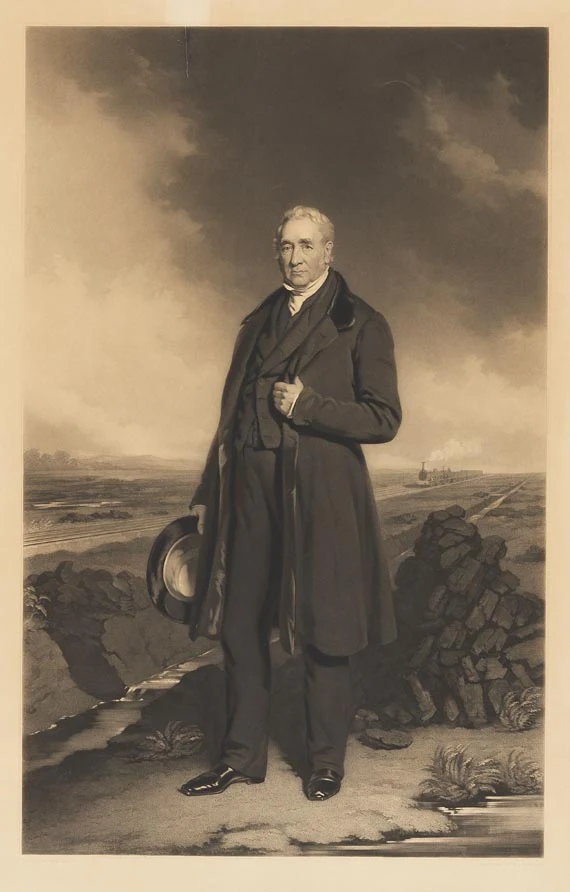
1781–1848
George Stephenson
Colliery engineer, railway engineer and locomotive manufacturerGeorge Stephenson moved from colliery work into engineering, locomotive manufacture and major railway construction. His work on the Stockton and Darlington and Liverpool and Manchester railways helped establish steam transport as a commercial system.Read biographyQuick answers
Common questions
- Was Rocket the first steam locomotive?
- No. Steam locomotives existed before 1829. Rocket’s importance lay in its successful combination of features and its performance at Rainhill.
- Were the trials a race between trains?
- They compared locomotives under test conditions, including repeated runs and measured consumption. This was more than a single head-to-head race.
- Did Rainhill open the railway to passengers?
- No. The trials took place in October 1829, while the Liverpool and Manchester Railway opened on 15 September 1830.
Primary and institutional sources
How this history was checked
Read the National Railway Museum’s account, its displayed notebook descriptions, the Science and Industry Museum’s engineering explanation and the Hackworth archive introduction. No complete Rastrick notebook, test ledger or original archive series was examined. Published speed figures vary with source and conditions, so unsupported comparisons and present-value prize conversions are omitted. This article was reviewed on 23 October 2026.
- Science and Industry MuseumThe making of the Liverpool and Manchester Railway: planning, Rainhill, stations and services
- Science and Industry MuseumRocket’s engineering excellence: Robert Stephenson’s prototype and its boiler
- National Railway MuseumStephenson’s Rocket, Rainhill and the rise of the locomotive: trials, competitors and design
- Science MuseumStephenson’s Rocket returns to Newcastle: the 1829 trials and later preservation
- Science and Industry MuseumRocket in the collection: surviving remains, rebuilding and preservation
- Science Museum GroupHenry Booth bust plinth: commemorated share in Rocket’s prize
- National Railway MuseumHackworth Family Archive: introductory Sans Pareil and Rainhill account
- Wikimedia Commons / Ketterer KunstGeorge Stephenson: complete 1849 Atkinson-after-Lucas engraving and public-domain record
- National Portrait GalleryThomas Lewis Atkinson, 1817–circa 1890: artist authority record
- Creative CommonsPublic Domain Mark 1.0