
The short answer
What happened when wages fell but rent did not?
A worked comparison
What each part contributes
Use the specific distinctions developed in the study.
| Part or record | What it establishes | Why the distinction matters |
|---|---|---|
| Company categories | Wages and rents treated separately | One household paid both |
| Formal choice | Company witness described voluntary payment | Pressure requires additional evidence |
| Budget effect | Unchanged rent takes a larger wage share | Nominal and relative cost differ |
What happened when wages fell but rent did not?
The Pullman dispute of 1894 exposes a practical conflict between two accounts held by the same company. As an employer, the business reduced wages during a depression; as a landlord, it retained the rents on its housing. The United States Strike Commission’s report examined the consequences for workers who depended on those wages. The company argued that the two matters were distinct. The commission treated their combination as central to understanding the grievance. The question is therefore how separate business categories interacted within the same household budget.
Sources for this section: [4]
The commission reported an asymmetric reduction
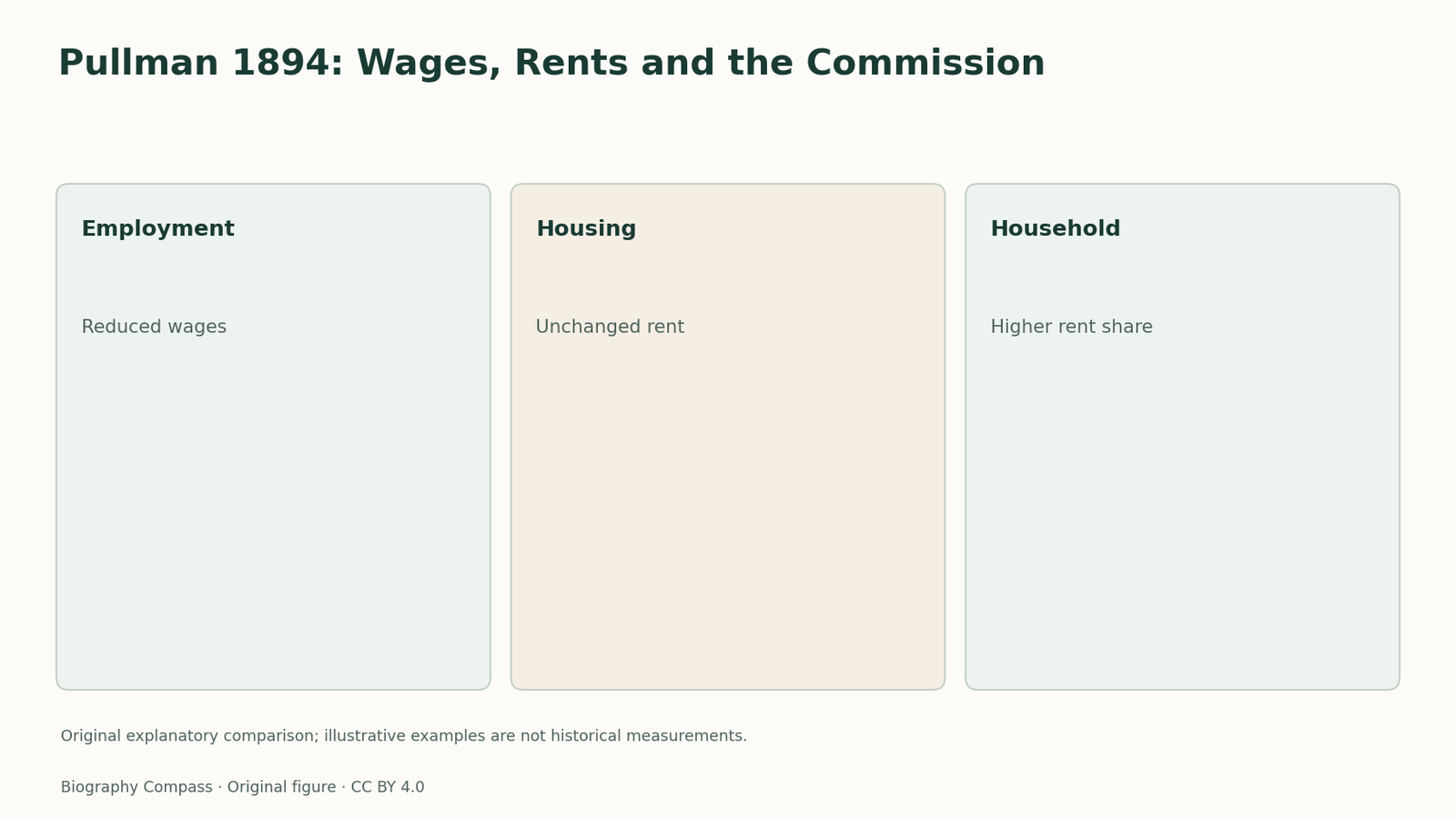
The inspected report excerpt states that wage cuts averaged about one quarter during the period it examined, while rents were not reduced. It also distinguishes workers’ pay from the salaries of officers and managers. These are the commission’s findings, not a new reconstruction of every employee’s earnings. The source connects company policy to a change in employees’ purchasing power. A nominal rent can remain unchanged while becoming a larger share of a reduced wage, which is why the company’s separation of wage and property accounts did not settle the workers’ practical problem.
Sources for this section: [4]
Company testimony described the payment arrangement differently
A contemporary newspaper account of testimony records the company’s explanation that separate checks for rent and the balance of wages were a convenience and that returning the rent check was voluntary. This is evidence of how company witnesses defended the procedure. It should be read beside the commission’s discussion of workers’ dependence and the perceived advantage of being company tenants when employment was scarce. The two records do not ask the same question: a witness’s description of formal choice differs from an investigation of the pressures surrounding that choice.
Arbitration was a separate disputed decision
The commission excerpt records approaches by the Chicago Civic Federation seeking conciliation and arbitration. The company maintained that there was nothing appropriate to arbitrate. That refusal mattered because it concerned the process for resolving a dispute, not only the initial level of wages or rent. A reader can therefore separate three issues: the economic policy, the household effect and the availability of a negotiated remedy. Keeping those questions distinct gives a more concrete account of the conflict than using the town’s landscaped appearance as an answer to all criticism.
Sources for this section: [4]
Household-budget exercise and checked answer
Take a fictional household earning 100 units and paying 20 in rent. If earnings fall by one quarter while rent stays unchanged, what happens to the rent share? Earnings become 75, and rent rises from twenty percent to about twenty-seven percent of earnings. The calculation does not reconstruct an actual Pullman family. It demonstrates the arithmetic behind the grievance: the same nominal payment can impose a heavier burden after a wage cut. Whether a particular household could move or replace lost earnings would require additional evidence. The exercise explains why two formally separate company accounts could have a combined effect on workers.
Sources for this section: [4]
Continue the chronology
Related history guides
Biography context
Explore United States through connected lives
Connected biographies
People and wider context
1831–1897
George Pullman
railway-car manufacturer and company-town developerGeorge Pullman was a railway-car manufacturer and company-town developer, known for the Pullman sleeping-car business and the labour conflict over wages and company housing in 1894.Read biographyQuick answers
Common questions
- Why did unchanged rent matter after wages were reduced?
- It consumed a larger share of reduced earnings, even though the nominal rent had not changed.
Primary and institutional sources
How this history was checked
The source notes distinguish original records, institutional descriptions and later historical interpretation. Exercises and comparisons are original editorial analysis. This article was reviewed on 8 November 2026.
- John F. Stover, American National BiographyPullman, George Mortimer: accessible extract
- United States National Park ServiceGeorge M. Pullman
- Smithsonian National Museum of American HistoryPullman Palace Car Company Collection
- United States Strike Commission, transcribed by Illinois State MuseumThe Pullman Strike: report excerpt, pages xxxii–xxxix
- Railroads and the Making of Modern America, University of Nebraska–LincolnPullman’s Pay Was Not Cut, 28 August 1894