
The short answer
What had to happen before a new bank could open?
A worked comparison
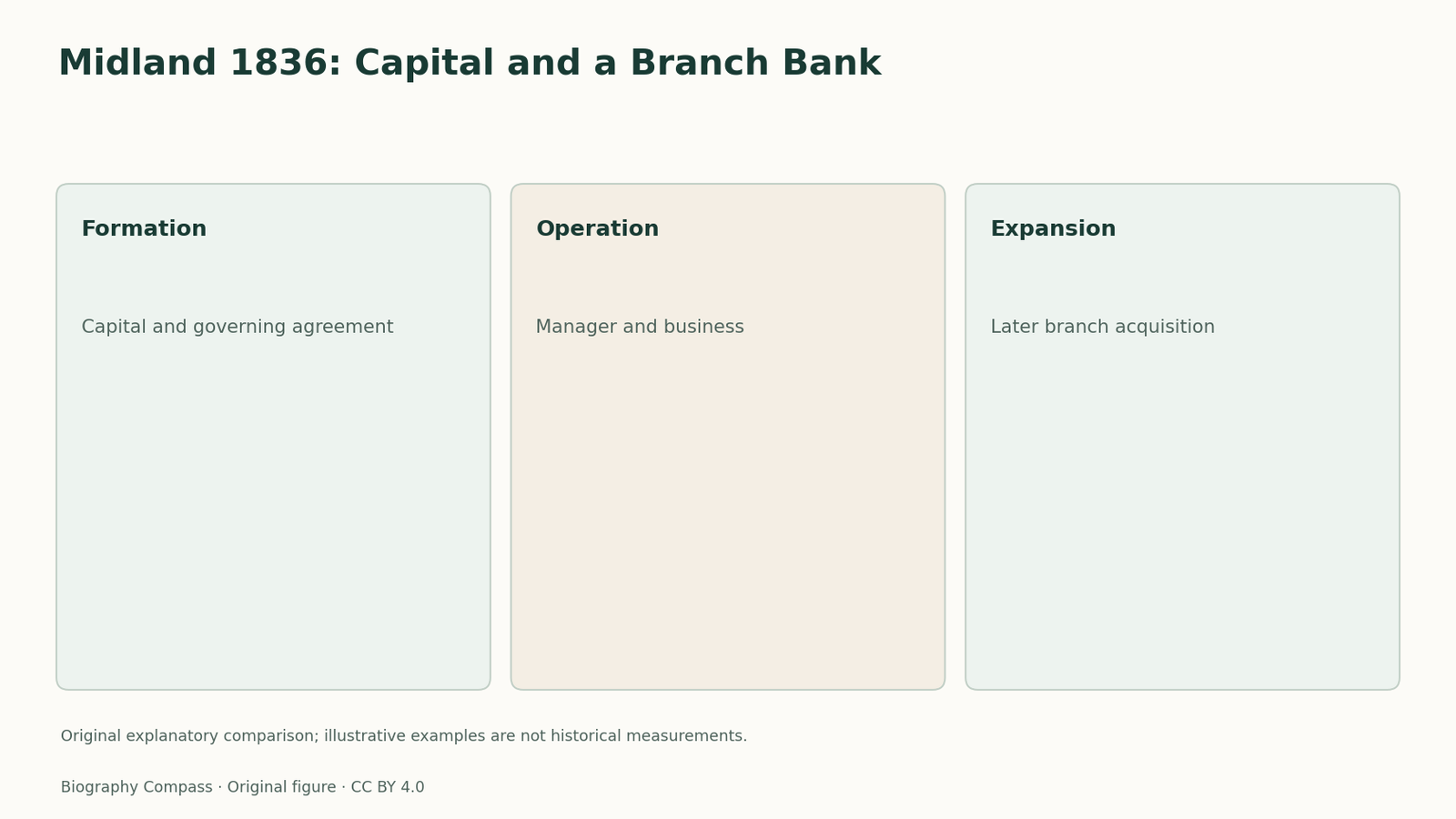
What each part contributes
Use the specific distinctions developed in the study.
| Part or record | What it establishes | Why the distinction matters |
|---|---|---|
| Prospectus | Proposition to participants | Different from accepted rules |
| Settlement deed | Governing arrangement | Different from daily management |
| 1851 branch | Later expansion | Not part of the 1836 opening |
What had to happen before a new bank could open?
The Birmingham and Midland Bank opened in August 1836, but the preceding committee record reveals several different tasks. The archive’s description of June-to-August meetings names a prospectus, the number of directors, execution of a deed of settlement, the appointment of Charles Geach as manager and a change from the proposed Birmingham Exchange Bank name. The question is how these actions fitted together. They concerned attracting support, defining authority and arranging operation, rather than being interchangeable labels for one moment of founding.
A prospectus and a settlement deed served different purposes
A prospectus presented the proposed undertaking to potential participants. A deed of settlement established agreed arrangements among those involved. The archive catalogue identifies both within the committee’s business, but the present study does not claim to reproduce the full volume or every clause. The distinction remains useful at the level actually documented. An institution needed a public proposition and a governing agreement, while evidence that one existed would not by itself prove that every provision in the other was fulfilled. This makes the formation sequence more precise than a founder story alone.
Sources for this section: [3]
Directors and manager occupied different positions
The committee’s discussion of directors and its appointment of Geach as manager identify separate organisational roles. Governance set authority over the undertaking, while management concerned its continuing business. Geach’s experience and local contacts helped connect the two, but the record does not turn all investors into daily bank officers. This separation matters when assigning credit: supplying capital, agreeing rules and conducting operations all contributed to the new bank, yet they required different work. A joint-stock institution could therefore depend on a prominent founder while still being a collaboration.
The first branch belonged to a later phase
The institutional history dates the purchase of Stourbridge Old Bank to 1851 and describes it as the first branch. That event came fifteen years after the Birmingham opening. It demonstrates a change in geographical organisation rather than a missing detail from the original day of business. A local bank could develop customers and practices before extending its network through acquisition. Comparing the two dates helps separate formation from expansion and avoids projecting the later size of Midland or HSBC backwards onto the small institution Geach and his associates first established.
Sources for this section: [2]
Formation-record exercise and checked answer
Match three fictional questions with the most relevant document: what was offered to prospective shareholders, what governing terms participants accepted, and who was appointed to run daily business. The checked answer is the prospectus, settlement deed and appointment record respectively. Would a later branch-acquisition notice answer all three? No: it concerns a different transaction and period. This original exercise gives readers a practical way to use the specific record categories named in the archive. It also explains why a sound institutional history follows documents through successive decisions instead of assuming that every later feature was already present at the beginning.
Sources for this section: [3]
Continue the chronology
Related history guides
Biography context
Explore United Kingdom through connected lives
Connected biographies
People and wider context
1808–1854
Charles Geach
banker, industrial investor and parliamentarianCharles Geach was a banker, industrial investor and parliamentarian, known for the formation of Birmingham and Midland Bank in 1836.Read biographyQuick answers
Common questions
- Was Midland’s first branch part of the bank’s 1836 opening?
- No. The institutional history dates the Stourbridge acquisition to 1851.
Primary and institutional sources
How this history was checked
The source notes distinguish original records, institutional descriptions and later historical interpretation. Exercises and comparisons are original editorial analysis. This article was reviewed on 8 November 2026.
- Sara Kinsey, Oxford Dictionary of National BiographyGeach, Charles: accessible extract
- HSBC UKHistory timeline and Midland origins
- HSBC Group ArchivesProvisional committee proceedings, UK AA 0084-0002
- The Leader, Nineteenth-Century Serials EditionThe Late Mr Geach, 4 November 1854
- Historic HansardCharles Geach: parliamentary service