
The short answer
Why did Du Bois distinguish a citywide aim from a house-to-house ward survey?
Evidence comparison
Read the records together
The records were created for different purposes and support different kinds of claims.
| Record | What it establishes | Question to keep open |
|---|---|---|
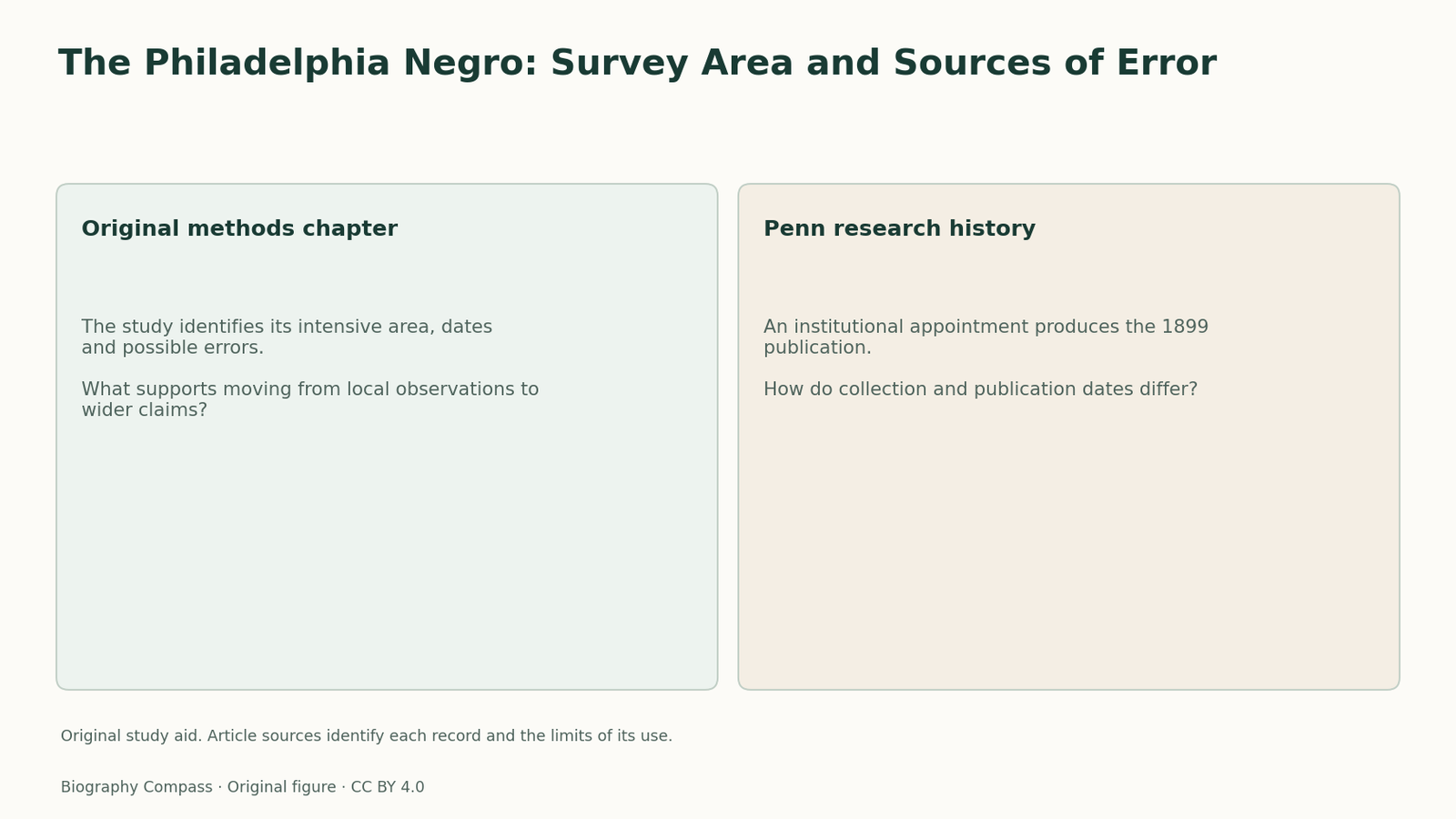
| Original methods chapter | The study identifies its intensive area, dates and possible errors. | What supports moving from local observations to wider claims? |
| Penn research history | An institutional appointment produces the 1899 publication. | How do collection and publication dates differ? |
Chronology
A timeline of the turning points
Fieldwork
Du Bois conducts the Philadelphia investigation.
Study published
The Philadelphia Negro presents the research.
Separate aim and intensive study area
Du Bois framed a broad inquiry into Philadelphia’s Black population while beginning intensive house-to-house work in the Seventh Ward. Those geographical levels must remain distinct. Evidence collected closely in one district can inform a wider study, but the reader needs to know what additional material supports generalisation. A citywide title should not silently convert every observation into a representative sample of all neighbourhoods and residents.
Keep the fieldwork dates visible
The methods section dates the investigation from August 1896 to December 1897, with an interruption. Publication followed in 1899. Those dates identify when observations were made and when findings reached readers. They are especially useful when comparing the study with a census or later account. An apparent discrepancy may reflect a changed population or different measurement period rather than an error that can be settled simply by choosing the newest publication date.
Sources for this section: [3]
Read the author’s own cautions
Du Bois discusses misapprehension, uncertain memory and deliberate deception in interviews, as well as the investigator’s bias and the limits of general observation. These are part of the method, not a reason to discard the study. They identify where further checking is needed. Penn’s account of the project places the work within an institutional research appointment, while the original chapter explains why institutional sponsorship did not make the resulting evidence immune from error.
Write a claim at the right scale
Draft a statement based on a hypothetical household interview, then revise it so the place, period and type of evidence remain visible. Add one corroborating record you would seek before extending the statement to the whole city. A strong answer follows Du Bois’s cautions by marking the step from observation to inference. The exercise makes the survey useful both as evidence about a historical community and as a transparent example of the limits of social investigation.
Continue the chronology
Related history guides
Biography context
Explore United States through connected lives
Connected biographies
People behind the records
1868–1963
W. E. B. Du Bois
Sociologist and civil rights intellectualDu Bois joined social research with civil rights organisation, moving from the Philadelphia survey to Atlanta scholarship, The Crisis and Pan-African work.Read biographyQuick answers
Common questions
- Did the book’s title mean every resident of the city was interviewed?
- No. The method identifies intensive Seventh Ward work and distinguishes it from the study’s wider aims.
Primary and institutional sources
How this history was checked
Sources support the chronology and the record comparison. The reading exercise is original. This article was reviewed on 7 November 2026.