
The short answer
How did Wells use reported incidents to challenge the explanations offered for racial violence?
Evidence comparison
Read the records together
The records were created for different purposes and support different kinds of claims.
| Record | What it establishes | Question to keep open |
|---|---|---|
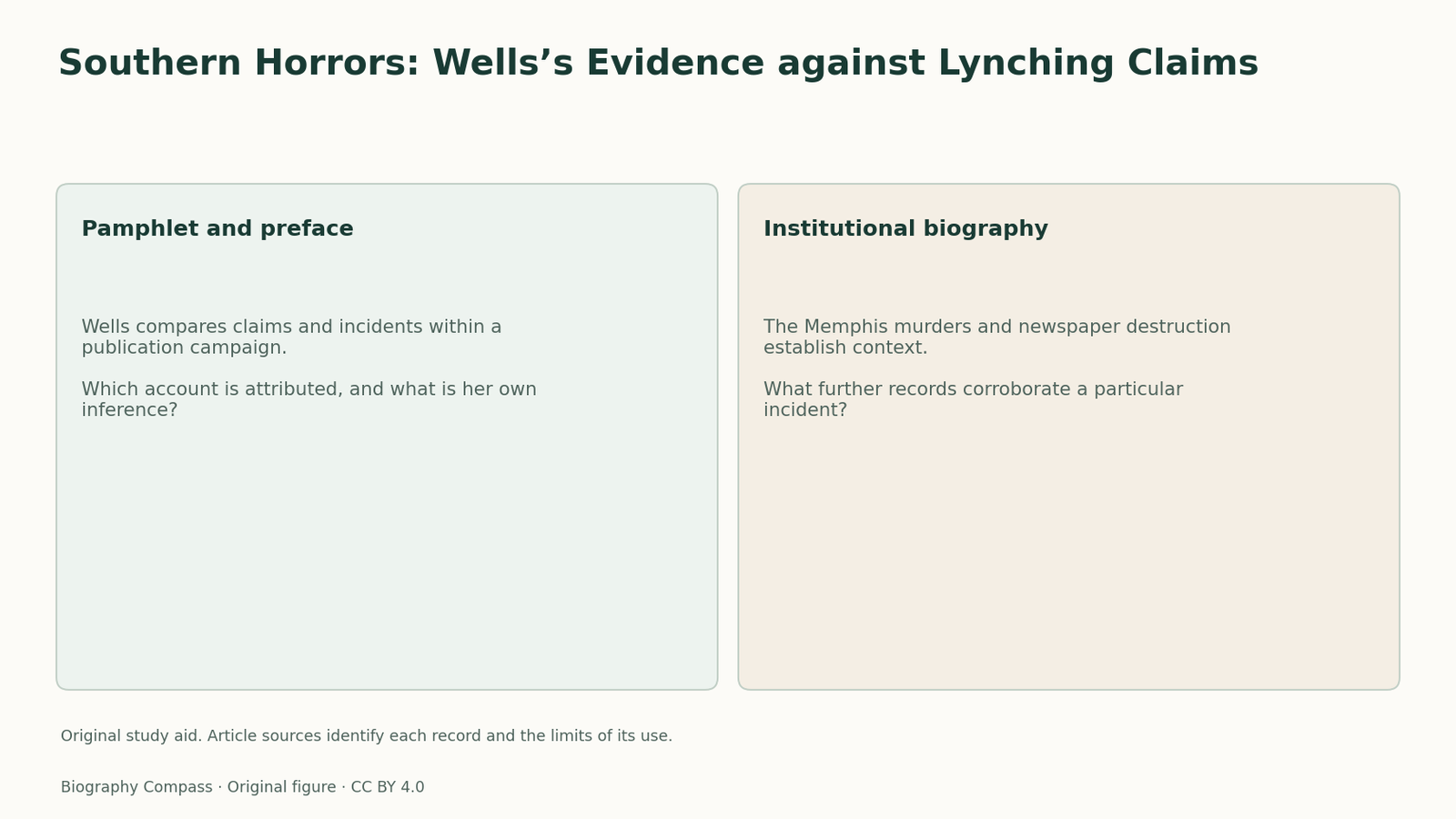
| Pamphlet and preface | Wells compares claims and incidents within a publication campaign. | Which account is attributed, and what is her own inference? |
| Institutional biography | The Memphis murders and newspaper destruction establish context. | What further records corroborate a particular incident? |
Chronology
A timeline of the turning points
Memphis murders
The killings intensify Wells’s campaign.
Pamphlet published
Material circulates through the New York press and Southern Horrors.
Begin with the publication sequence
The preface identifies earlier publication in the New York Age and explains the effort that made pamphlet publication possible. The sequence shows that the text was part of a campaign carried across formats. A newspaper statement and a later pamphlet could reach different audiences and support repeated use. The fundraising network belongs to the evidence’s history, because collecting information did not by itself guarantee that it would be printed or widely read.
Distinguish a report and its interpretation
Wells places reported incidents alongside the rationales offered for lynching and argues that the pattern contradicts those justifications. A reader should preserve attribution when following the method. An account quoted from another newspaper and Wells’s conclusion about it have different authors and purposes. Their juxtaposition is the argumentative work. Treating every passage as her eyewitness observation would erase the comparison on which much of the pamphlet depends.
Sources for this section: [3]
Keep violence and legal guilt separate
The pamphlet challenges the assumption that an accusation could justify a killing outside legal process. A claim circulating in a newspaper is not a judicial determination. The NPS account places the campaign after the murder of the Memphis grocers, making the danger and urgency clear. Historical analysis can describe the arguments without accepting the racist categories and stereotypes through which advocates of violence tried to make their actions appear legitimate.
Annotate one incident carefully
Create four fields for the reported event, source named in the pamphlet, justification being challenged and Wells’s inference. Leave a fifth for independent corroboration. A strong answer retains the distinction between an attributed report and a completed verification of every detail. It also notices that the transcription identifies reprint uncertainties. The exercise makes the pamphlet useful as both a historical intervention and a lesson in how evidence can be assembled against a dominant public narrative.
Continue the chronology
Related history guides
Biography context
Explore United States through connected lives
Connected biographies
People behind the records
1862–1931
Ida B. Wells
Investigative journalist and civil rights organiserWells used investigative journalism and public campaigning to challenge lynching, then continued civil rights and suffrage work from Chicago.Read biographyQuick answers
Common questions
- Was every incident Wells described her own eyewitness observation?
- No. Her method also used attributed press accounts, which must be distinguished from her interpretation and direct knowledge.
Primary and institutional sources
How this history was checked
Sources support the chronology and the record comparison. The reading exercise is original. This article was reviewed on 7 November 2026.