
The short answer
Which event deserves which date when a picture letter becomes a privately printed book and then a commercial edition?
Compare the evidence
What can each record establish?
Separate the historical object or event from the conclusion being drawn about it.
| Record | What it identifies | What follows |
|---|---|---|
| NT 242253 | A copy made after the original letter was borrowed back | Its identity differs from the first letter sent to Noel. |
| V&A publishing history | Initial private and trade printings | A 32:1 production-quantity ratio is calculable. |
| Invented caption | A mixture of object, sales and profit claims | Its unsupported inferences must be removed. |
Chronology
A timeline of the turning points
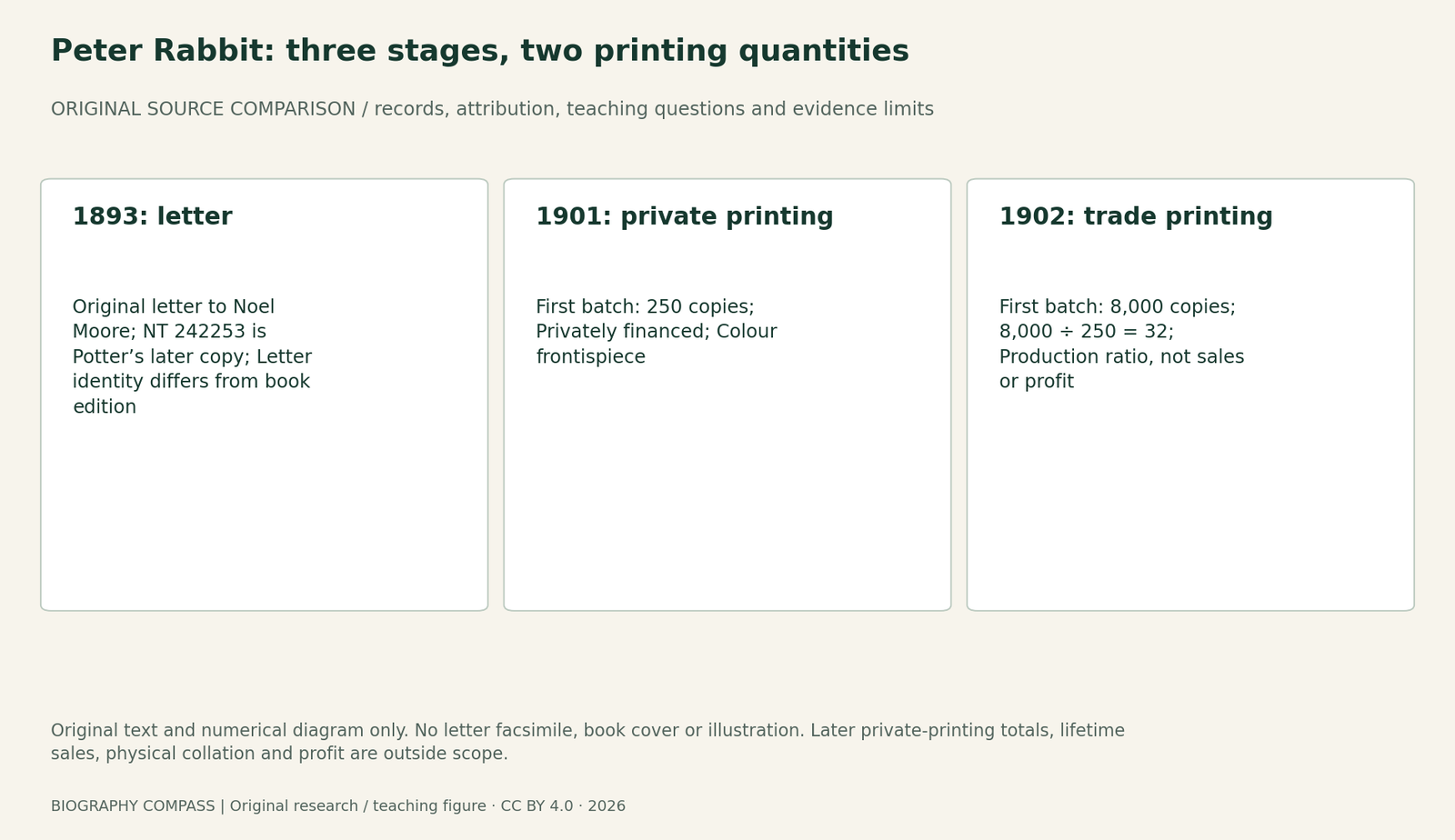
Letter to Noel Moore
The original illustrated letter preceded the book project.
Private printing
Potter’s first privately financed batch comprised 250 copies.
Warne edition
The first trade printing comprised 8,000 copies.
Begin with three different kinds of event
The first trade publication dates to 1902; the original picture letter and first private printing belong to earlier stages. A “first” needs an event attached to it. Ask separately when a recipient received the story, when Potter financed a book, and when Warne issued it commercially. These questions describe a creative project becoming a publishing business. They also prevent a familiar date from being used indiscriminately for correspondence, private production and trade publication.
A catalogue object is not automatically the original letter
NT 242253 is Potter’s copy of the letter she borrowed back, not the sheet originally sent to Noel Moore. The National Trust description explicitly preserves that distinction. Its object connects correspondence with preparation for the book, but a later copy remains a different physical object. A caption should identify that object before assigning the story’s origin date to it.
Sources for this section: [2]
Private printing involved choices about format and cost
The V&A dates the initial private printing to 16 December 1901. It identifies a colour frontispiece alongside the monochrome illustrations, so “entirely black and white” would be inaccurate. The National Trust independently records the initial quantity of 250. Format, quantity and financing are different production fields. An overall impression of a book cannot replace the part-by-part description when one colour illustration makes a blanket claim false.
A trade edition was a revised production project
The National Trust records Warne’s initial quantity of 8,000 in 1902; the V&A supplies the October date and describes revisions during commercial preparation. Comparing initial quantities gives 8,000 ÷ 250 = 32. The calculation compares production batches. It cannot measure sales, income or profit, because none of those quantities is supplied. The larger printing also does not imply an unchanged object: the curatorial account distinguishes the preparation of the trade edition from the earlier private book.
Exercise: repair a museum caption
Consider this invented caption: “Original 1893 Peter Rabbit letter, NT 242253; Potter’s first commercial edition, privately printed in 1901 in 250 entirely black-and-white copies. Warne then sold 8,000 copies in 1902, proving profits rose thirty-twofold.” Identify the object error, the publication-category error, the colour error and the unsupported business inference. Write a replacement of two or three sentences. Then state which one numerical comparison can safely be retained. Treat the figures as quantities printed in the named initial batches, and do not add a later private-printing total from another account.
Worked answer: preserve the useful connections
A defensible replacement is: “NT 242253 is Potter’s later copy of the picture letter she originally sent in 1893. She financed an initial private printing of 250 books in 1901, with a colour frontispiece; Warne’s first trade printing followed in 1902 at 8,000 copies.” The retained calculation is 32 times as many copies in the selected trade printing as in the initial private printing. Nothing in those two quantities establishes a profit ratio or a sales total. The corrected caption still tells a connected creative story, but now each date, object and number does a defined job.
Continue the chronology
Related history guides
Angela Carter: Translation, New Stories and Edition Dates
Separate Angela Carter’s Perrault translation from The Bloody Chamber, then distinguish authorial roles, first publication and the dates of later editions.
Read the timeline1961–1964Single Form: Who Made, Commissioned and Gave the Work?
Use Hepworth’s estate history and UN press releases to distinguish the artist, commissioning foundation, donor, memorial subject and institutional recipient.
Read the timelineBiography context
Explore United Kingdom through connected lives
Connected biographies
The creative lives behind the records
1866–1943
Beatrix Potter
Author, illustrator and conservationistBeatrix Potter turned closely observed animals into illustrated books and used a successful publishing career to build a second life in Lake District farming and conservation.Read biographyQuick answers
Common questions
- Is 1902 the first appearance of the Peter Rabbit story?
- It is the first trade-publication date in these records. The original letter dates to 1893 and a private printing to 1901.
- Does a larger printing prove a proportionate increase in profit?
- No. A printing quantity alone does not establish sales, costs or profit.
Primary and institutional sources
How this history was checked
Compare these records by their objects, credited roles and dates, then use the worked examples to test what each one establishes. This article was reviewed on 29 October 2026.