
The short answer
How can a public-art caption credit the artist, patron, donor, memorial subject and recipient without turning those distinct roles into one attribution?
Compare the evidence
What can each record establish?
Separate the historical object or event from the conclusion being drawn about it.
| Record | What it identifies | What follows |
|---|---|---|
| Estate commission history | Artist, foundation and production | Explains development before the ceremony. |
| UN HQ/215 | Donor and unveiling participants | Identifies Jacob Blaustein’s gift on 11 June 1964. |
| UN HQ/210, closing page | U Thant’s acceptance | Connects the gift with the institutional recipient. |
Chronology
A timeline of the turning points
Memorial context
Hammarskjöld’s death preceded the commission.
Public presentation
The sculpture was unveiled on 11 June.
Institutional acceptance
U Thant accepted the gift for the United Nations.
A public commission has more than one relationship
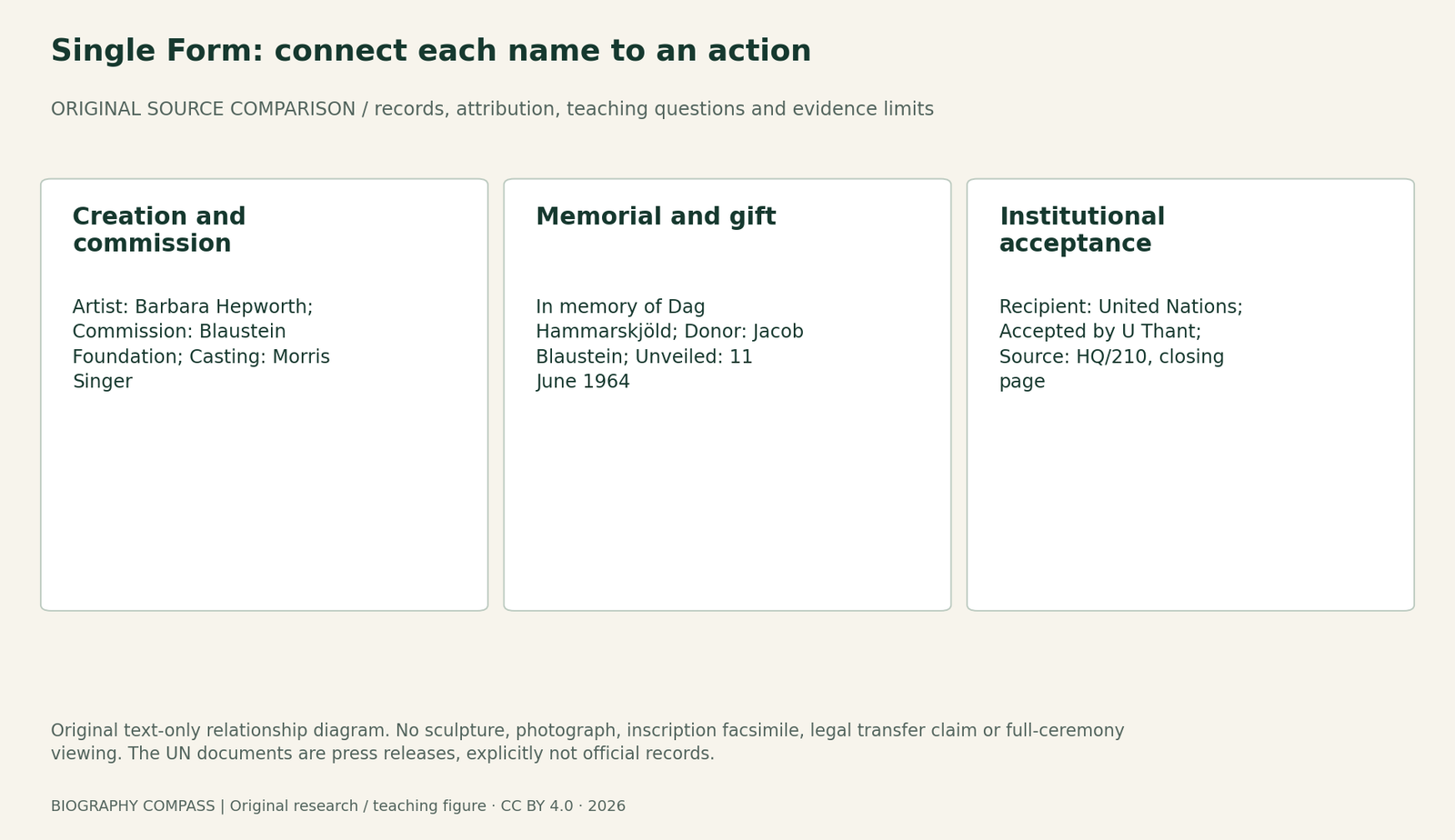
Single Form was unveiled at United Nations headquarters in New York on 11 June 1964. The estate’s commission history and the UN’s contemporary press releases describe the same work from different institutional positions. The estate explains its development and production; the UN describes the gift and ceremony. Combining them gives a richer account than either “Hepworth made it” or “the UN received it”. The research question concerns how those statements fit together: who created the sculpture, who organised its commission, who gave it, whom it commemorated and who accepted it.
The artist’s relationship preceded the memorial commission
The estate connects Hepworth and Hammarskjöld through friendship and his ownership of an earlier Single Form. After his death in 1961, the Blaustein Foundation commissioned the large memorial. The earlier sculpture and later commission are different objects; the memorial subject is not the donor at the unveiling.
Sources for this section: [1]
Production and presentation belong to different stages
The estate records workshop production in January 1963, completion in April 1964 and installation in May. Morris Singer cast the bronze. The unveiling was a separate milestone after these operations. Recording the stages preserves artistic authorship while making practical collaboration visible.
Sources for this section: [1]
The UN releases distinguish donor and acceptance
Press release HQ/215 identifies Jacob Blaustein as the donor and Hepworth as sculptor. U Thant presided over the ceremony. The closing page of HQ/210 prints his thanks to Blaustein, congratulations to Hepworth and acceptance of the gift for the United Nations. The roles are related but not equivalent: making, financing, donating, commemorating and accepting describe different actions. The documents are contemporary UN press releases whose header says they are not an official record. They support an account of the ceremony, rather than constituting a resolution, legal gift instrument or transcript checked against an audio recording.
Exercise: correct a confused dedication notice
An invented notice says: “The British government gave its own sculpture by Dag Hammarskjöld to Barbara Hepworth at the UN in 1961. Jacob Blaustein accepted it there in 1964.” Replace the statement with three short sentences. Your answer must identify the artist, commissioning foundation, memorial subject, donor and recipient, and attach the unveiling date to the correct event. Then explain why nationality does not establish the donor. Finally, identify which source best supports the acceptance and which one supplies the production sequence. Do not reproduce the sculpture, inscription or any photograph to complete the exercise.
Worked answer: use a map of actions
Barbara Hepworth created Single Form, commissioned by the Jacob and Hilda Blaustein Foundation in memory of Dag Hammarskjöld. Jacob Blaustein gave the sculpture to the United Nations. U Thant accepted it at the unveiling on 11 June 1964. The artist’s British nationality does not turn the gift into a British-government donation; the cited release names a different donor. HQ/210’s closing acceptance supports the recipient relationship, while the estate supplies workshop, casting and installation stages. A credit map should connect each person or institution to an action, rather than merely place all the names beside the object.
Continue the chronology
Related history guides
Peter Rabbit: From a Picture Letter to a Trade Edition
Distinguish Peter Rabbit’s 1893 letter, 1901 private printing and 1902 trade edition, then correct a caption and compare two documented printing quantities.
Read the timeline1977–2025Angela Carter: Translation, New Stories and Edition Dates
Separate Angela Carter’s Perrault translation from The Bloody Chamber, then distinguish authorial roles, first publication and the dates of later editions.
Read the timelineBiography context
Explore United States through connected lives
Connected biographies
The creative lives behind the records
1903–1975
Barbara Hepworth
SculptorBarbara Hepworth developed an abstract sculpture practice and a major public career. Single Form was unveiled at the United Nations in 1964, with artist and donor separately credited.Read biographyQuick answers
Common questions
- Was the gift made by the British government?
- The cited contemporary release names Jacob Blaustein as donor; the sculptor’s nationality does not establish a governmental gift.
- Are the releases the legal deed transferring the sculpture?
- No. They are contemporary press material and are explicitly labelled as not an official record.
Primary and institutional sources
How this history was checked
Compare these records by their objects, credited roles and dates, then use the worked examples to test what each one establishes. This article was reviewed on 29 October 2026.