
The short answer
How does a houseboat setting organise precarious community rather than merely provide scenery?
Read the evidence
Sources, interpretation and production roles
The records answer different questions about this work. The final exercise is an original teaching model.
| Record or question | Supported reading | Boundary or contrast |
|---|---|---|
| Setting | Boats share Battersea Reach and a changing tide. | A common location does not guarantee equal security. |
| Life and fiction | The barge years supply a documented context. | A character is not a complete biographical transcript. |
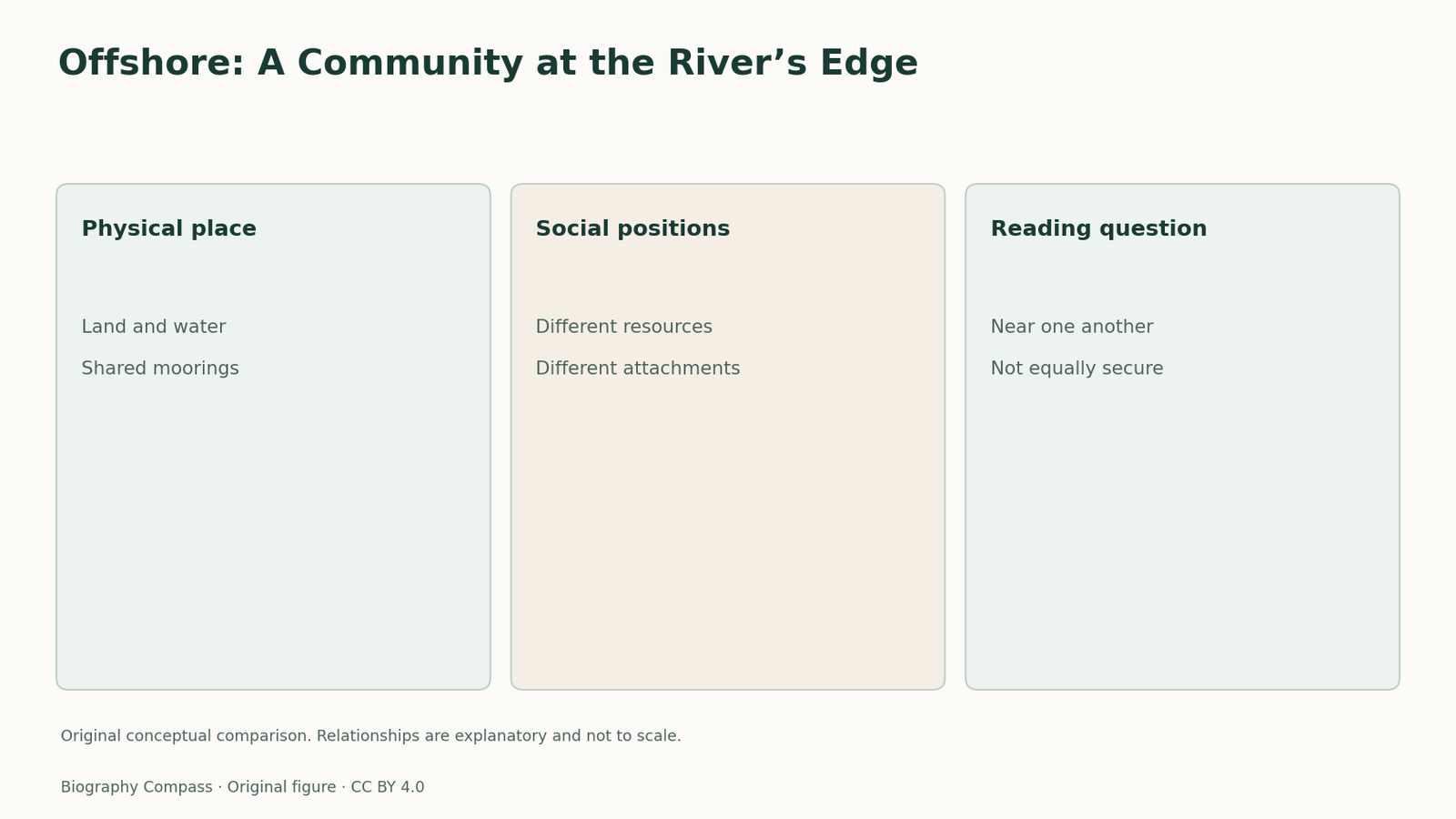
| Original dependence map | Distinguishes proximity from the capacity to help or leave. | A short cast can still create complex relations. |
A community is situated between land and water
Offshore was published in 1979 and won that year’s Booker Prize. Its houseboat community lives on Battersea Reach, subject to the Thames’s changing tide. The prize’s synopsis identifies several distinct residents rather than an undifferentiated group. The setting consequently provides more than unusual scenery. It offers a material relation to the city: people can be close to urban life while occupying an uncertain edge of it, connected through moorings without sharing the same resources or hopes.
The same tide does not produce the same security
The synopsis contrasts Nenna’s troubled family circumstances, Maurice’s availability to others and Richard’s more ordered naval background. In this guide’s interpretation, those differences prevent the boats from becoming a simple emblem of freedom from ordinary society. A resident’s practical competence, relationships and resources affect what living there means. A common setting can bring people into repeated contact without giving each an equal ability to leave, help or decide. That is a more useful account of community than assuming physical proximity guarantees belonging.
Experience becomes a structure rather than a transcript
Fitzgerald’s own barge years provide a documented context. Adlington’s selected discussion connects that difficult period with the fiction while identifying the central character as a made figure. The distinction lets a reader ask how instability becomes narrative organisation. In this reading, a shifting physical boundary can place emotional and social uncertainty in a tangible setting. The argument does not require every incident to have happened to Fitzgerald. Nor does a remembered source make the later work only a private record with the names changed. A boat can belong to its owner while its position depends on neighbours, tides and access from shore. That combination makes the community’s precariousness material before it becomes a judgement about anyone’s character.
Original exercise: map proximity and dependence
Invent three homes beside a small canal. Give each a different kind of security: savings, practical skill or a reliable relative elsewhere. Write one shared problem, such as a closed access path, and describe which resident can respond most easily. A reference answer explains that neighbours may face the same obstacle through unequal capacities. Now draw a simple relationship map using three labelled circles and arrows for help offered or needed, without copying any boat or plot event from the novel. Ask whether the most useful person must also be the most secure. Return to Offshore through the named residents and tidal setting in the inspected synopsis, clearly marking the social consequence as your interpretation. The task makes a specific feature of the novel usable: a community’s physical arrangement and its distribution of dependence need not be the same map. It also shows why a concise account of a few residents can sustain a substantial argument. Complexity can come from changing relationships, not only from adding more people or events.
Continue the chronology
Related history guides
Biography context
Explore United Kingdom through connected lives
Connected biographies
People and related creative practices
1916–2000
Penelope Fitzgerald
British novelist, biographer and teacherPenelope Fitzgerald moved through broadcasting, editing and teaching before a late published career spanning biographies, contemporary settings and historical novels.Read biography
1882–1941
Virginia Woolf
Novelist, essayist, critic and publisherVirginia Woolf was an English novelist, critic and publisher whose experiments with consciousness and time changed modern fiction and feminist literary argument.Read biography1913–1980
Barbara Pym
British novelist and journal editorBarbara Pym wrote novels alongside editorial work, experiencing early publication, a long period of rejection and a late return to public attention.Read biographyQuick answers
Common questions
- Was the Booker win in 1975?
- No. Offshore won in 1979.
- Why is a houseboat more than background?
- Its relationship to water, neighbours and the shore makes dependence and uncertain belonging part of the setting itself.
Primary and institutional sources
How this history was checked
The discussion uses the prize institution’s synopsis, selected scholarship and archival catalogue descriptions. The original drafts and recorded introduction were not inspected. The reading exercises and comparisons are original analytical models. This article was reviewed on 8 November 2026.