
The short answer
How does an observant first-person narrator expose unequal demands on everyday care?
Read the evidence
Sources, interpretation and production roles
The records answer different questions about this work. The final exercise is an original teaching model.
| Record or question | Supported reading | Boundary or contrast |
|---|---|---|
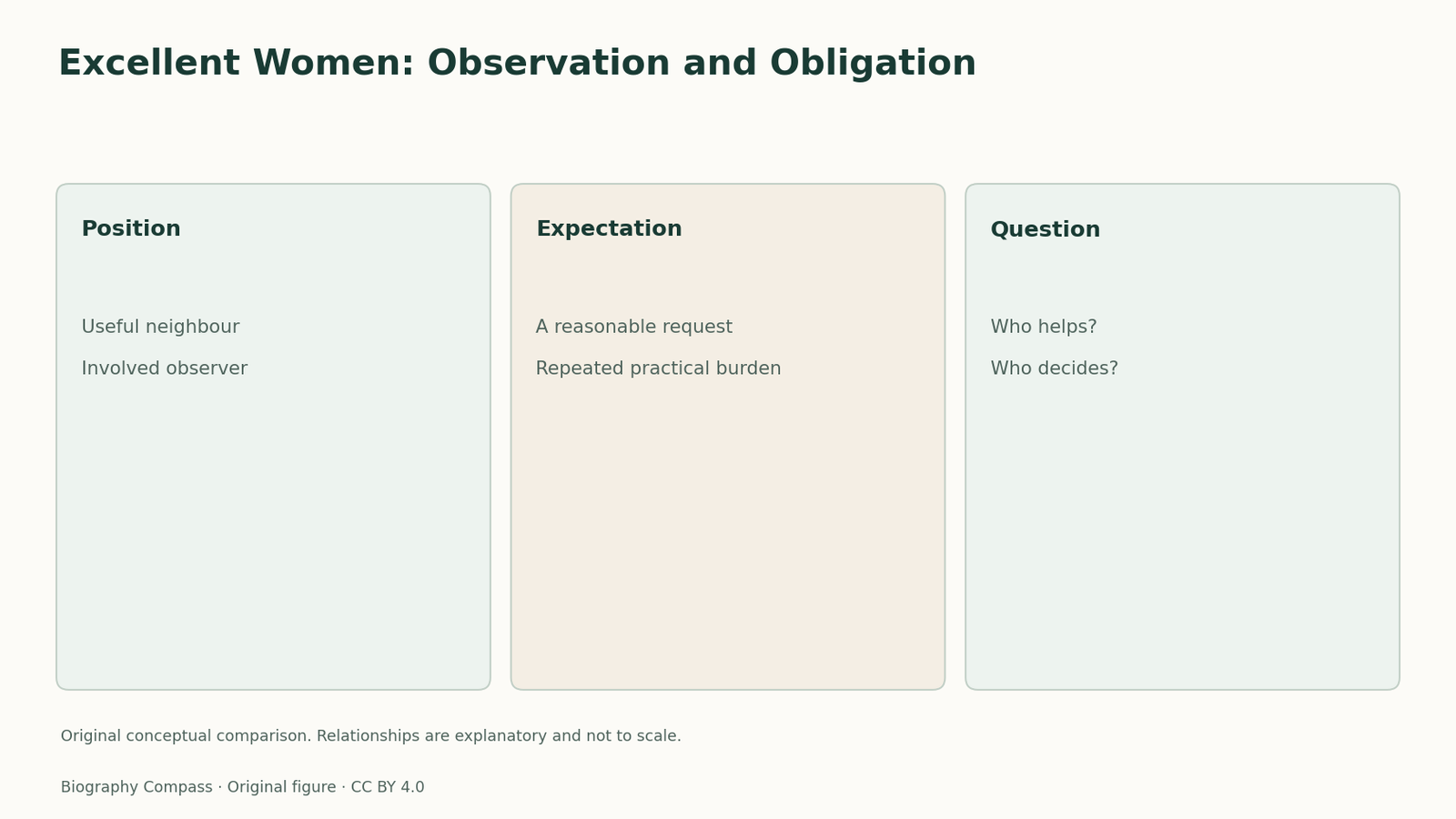
| First-person position | Mildred observes while remaining involved. | Noticing does not make her all-knowing. |
| Social usefulness | Dependability can lead to repeated demands. | Praise and decision-making power are not the same. |
| Original favour task | Changes both the practical burden and its telling. | Gratitude alone need not redistribute authority. |
A particular narrator stands inside the social work
Excellent Women was first published in 1952. Its first-person narrator, Mildred Lathbury, is repeatedly useful to other people. The publisher introduces neighbours, marital uncertainty and her own divided sympathies. These premises make the work more specific than a comedy about people with small concerns. Mildred occupies a position from which she can be asked to help and can also notice the assumptions behind the request. Those two activities need not be identical.
Usefulness can conceal an unequal expectation
English Heritage connects the novel with women expected to undertake tasks others avoid. In this guide’s interpretation, the title can therefore be heard as praise whose social cost deserves attention. To be competent and dependable may invite more work without a corresponding right to decide. The argument does not require every person making a request to be consciously malicious. Ordinary courtesy and habit can preserve a pattern that becomes clearer to the narrator or reader than to those benefiting from it.
Observation does not require an outside judge
The first-person position makes Mildred’s sympathies and possible attachments part of the situation. The publisher’s account of her response to the Napiers supplies a concrete example: someone trying to avoid taking sides can still have a preference. In this reading, the comedy gains force from that gap. The narrator is neither an all-knowing sociologist nor merely a passive person on whom things happen. Her capacity to notice a pattern coexists with involvement in it. That relationship helps explain why a familiar social world can remain narratively unsettled. The practical question is who has the freedom to decline. A request that sounds friendly can reveal an unequal distribution of time, especially when a woman’s availability is treated as a permanent social resource.
Original exercise: a favour and a point of view
Invent a shared building in which one resident is regularly asked to organise deliveries. Write a polite request and then a first-person account by the resident receiving it. Include one practical difficulty and one sympathy the person would prefer not to admit. A reference answer explains that the same request can look efficient from the neighbours’ perspective and unequal from the organiser’s, while the narrator’s own preference may complicate both accounts. Now change who makes the next decision about the work. Ask whether gratitude alone would produce the same change. Return to Mildred by separating the publisher’s named relationship from your interpretation of how usefulness operates. The task borrows no historical dialogue or Pym sentence. It makes a specific relation between viewpoint and obligation available for discussion: the person doing the work can also narrate the world that makes that work seem natural. A strong answer preserves both the social pattern and the narrator’s involvement, avoiding a flat division between a perfectly perceptive observer and uniformly foolish people around her.
Continue the chronology
Related history guides
Biography context
Explore United Kingdom through connected lives
Connected biographies
People and related creative practices
1913–1980
Barbara Pym
British novelist and journal editorBarbara Pym wrote novels alongside editorial work, experiencing early publication, a long period of rejection and a late return to public attention.Read biography1899–1973
Elizabeth Bowen
Novelist, short-story writer, essayist and broadcasterElizabeth Bowen was an Irish novelist and short-story writer whose life moved between Ireland and England. Stories, novels, reviews and broadcasts formed a varied career that cannot be represented by one house or one literary circle.Read biography1873–1957
Dorothy Richardson
British novelist, essayist and translatorDorothy Richardson developed Pilgrimage through a working life in teaching, London employment, journalism and literary exchange, making perception central to narrative form.Read biographyQuick answers
Common questions
- Is Mildred an outside observer?
- No. She is involved in the relationships she narrates.
- Does usefulness guarantee authority?
- The guide asks readers to distinguish doing needed work from deciding how that work is assigned.
Primary and institutional sources
How this history was checked
The reading question uses the publisher’s synopsis and edition record, alongside institutional biography; the complete novel and modern introduction were not read. The reading exercises and comparisons are original analytical models. This article was reviewed on 8 November 2026.