
The short answer
A photographer can enter filmmaking with several responsibilities while still working through other people’s skills. A concrete credit record makes the distinction visible before we design a small scene of our own.
Compare practice and evidence
Keep the decisions distinct
The comparison separates documented premises from the original task.
| Question | Catalogue credit | Original scene decision |
|---|---|---|
| Direction | Parks is named as director. | Give a performance an intention. |
| Cinematography | Guffey is separately credited. | Propose framing and camera position. |
| Editing and music | Rohrs edits; Parks composes. | Decide duration, cut and sound relationship. |
Chronology
A timeline of the turning points
Novel
Publication date in the Smithsonian account.
Film
The consulted catalogue separates creative credits.
A new scene
Plan image, cut and sound independently.
The credited work
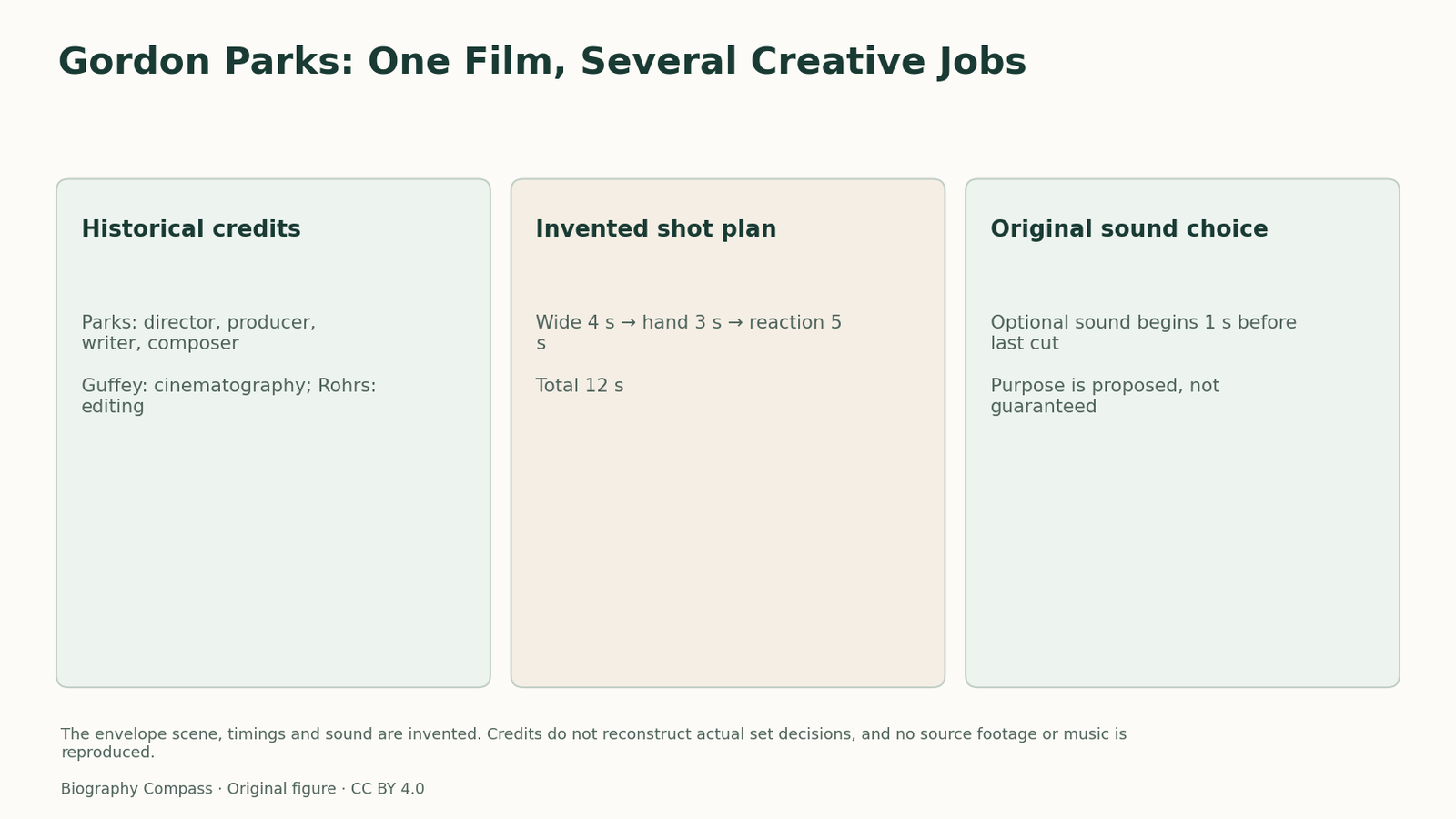
The Library of Congress catalogue for The Learning Tree (1969) lists Parks as director, producer, screenwriter and composer. Burnett Guffey is credited for cinematography and George R. Rohrs for editing. The film is based on Parks’s novel.
The Smithsonian dates publication of that novel to 1963.
One person’s four credits do not absorb the other credits. Directing a film and determining its cinematography are connected activities, but they are not interchangeable labels. A source that identifies the director does not authorise us to assign every camera decision to him.
A critical account is another kind of evidence
Maurice Berger’s Registry essay interprets the film as an effort to challenge stereotyped Black characters and reach audiences across racial divisions.
That interpretation helps identify an artistic purpose; it is not a transcript of every production decision. We have consulted the catalogue and essay, not watched the complete film or read the complete novel. The following scene is an independent exercise and does not adapt either work.
Sources for this section: [2]
Plan an original twelve-second scene
Invent a scene in which a person receives an envelope, hesitates and opens it. Allocate 4 seconds to a wider view, 3 to the hand holding it and 5 to a reaction. Give the actor an intention, give the camera a position and write one editing instruction. Then choose whether an original sound begins before or after the cut to the reaction.
Reference approach: the actor delays opening because the result matters; the wider view establishes isolation; the hand view withholds the contents; the reaction begins before the contents are revealed. Starting a quiet repeated sound one second before that last cut can bridge the transition. Silence could be equally defensible if the aim is to make the cut feel abrupt.
Credit the proposal accurately
The durations total 12 seconds. The plan does not prove that one choice produces a particular emotion in every audience. Ask a partner what they expect to happen, and revise a gesture or cut if the intended uncertainty is not legible.
Keep a small decision log with intention, camera proposal, cut and sound on separate lines. Several collaborators may influence one line. Crediting a cinematographer or editor does not erase the director; it makes the shared making of a film more exact. No footage, score or screenplay text from The Learning Tree is reproduced.
Continue the chronology
Related history guides
Biography context
Explore United States through connected lives
Connected biographies
The photographer’s working life
1912–2006
Gordon Parks
Photographer, filmmaker and writerAn artist whose camera work, writing, films and music pursued different ways to make a human experience visible.Read biographyQuick answers
Common questions
- Is the envelope scene a scene from the film?
- No. It is invented to separate creative responsibilities without reproducing the film or novel.
Primary and institutional sources
How this history was checked
Selected records support the historical comparison; the exercise and reference response are original. This article was reviewed on 31 October 2026.