
The short answer
How does a veteran portrait series construct public recognition through staging?
Compare the records
What the sources allow us to say
Read the object record alongside the contextual account.
| Record | Evidence | Reading limit |
|---|---|---|
| Museum exhibition | Attention uses formal portraits of Hmong veterans. | Portrait conventions do not establish official recognition. |
| Artist career account | Places the work within migration and community history. | One project cannot speak for every Hmong experience. |
A portrait can claim a place in history
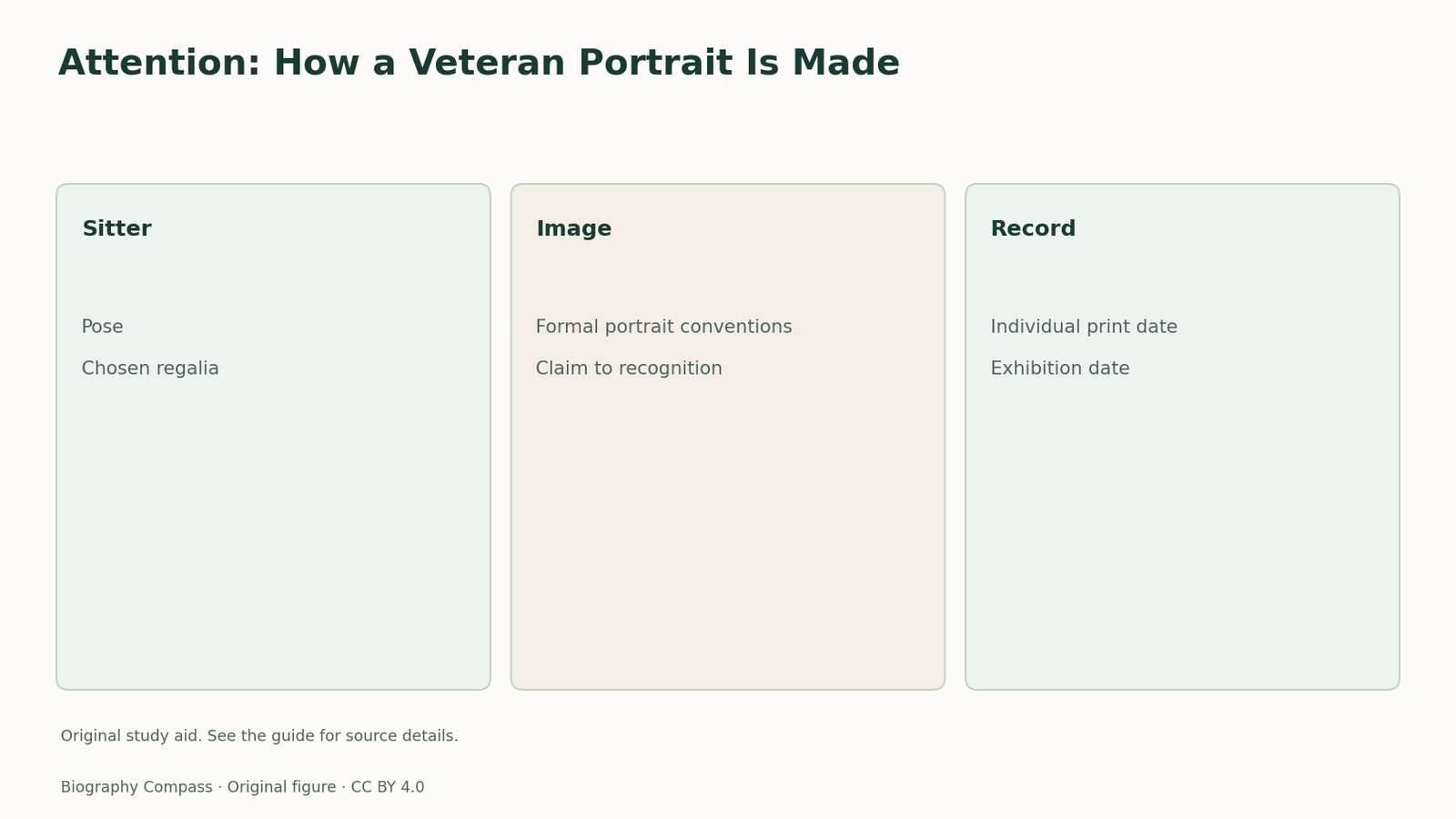
Attention places Hmong veterans within visual conventions associated with official military portraits. Formal poses and uniforms make a recognisable claim to public dignity. The Smithsonian’s account explains that the men assembled their own regalia and practised commemorative rites. The photographs register that self-fashioning. Their power arises partly from the gap between a familiar visual language of recognised service and the sitters’ complicated relationship with the institutions that normally authorise such an image.
Sources for this section: [2]
Compare a print with an exhibition
The Smithsonian object used here is dated 2012. The Minneapolis museum’s 2015 account concerns an exhibition of ten portraits and illustrates examples with different dates. These records give access to different scales of the project. The individual print has a date, medium and collection number. The exhibition produces a group encounter in which similarities and differences among uniforms and poses become legible. Keeping those scales separate allows comparison without giving every photograph the date of the later show.
Read the pose without inventing a service file
Choose three categories for observation: posture, uniform and presentation. Explain how each contributes to the authority of a formal portrait. A supported answer might connect upright posture with ceremony and the display of medals with a claim to service. It should then state what the picture cannot establish on its own, such as an individual’s complete military record. The exercise recognises the sitters’ purposeful public images while preserving the need for separate evidence whenever a precise institutional or biographical claim is made.
Continue the chronology
Related history guides
Biography context
Explore Laos through connected lives
Connected biographies
Read the artist’s biography
b. 1982
Pao Houa Her
PhotographerA Laos-born Hmong American photographer whose work investigates portraiture, migration and constructed images.Read biographyQuick answers
Common questions
- Is Attention a single portrait?
- It is a series. The Smithsonian record identifies an individual print, while Minneapolis exhibited a group of ten portraits in 2015.
Primary and institutional sources
How this history was checked
The listed records support the facts. Observation exercises and arguments are Biography Compass editorial interpretations. This article was reviewed on 7 November 2026.