
The short answer
How do self-portraits use ordinary objects to construct a public visual language?
Compare the records
What the sources allow us to say
Read the object record alongside the contextual account.
| Record | Evidence | Reading limit |
|---|---|---|
| SFMOMA, 2024 | Names props, lighting decisions and participant choices. | The meanings of particular props require their own context. |
| Art 21 biography | Places both series within visual activism and self-representation. | A biography does not document every portrait session. |
An ordinary object changes its role
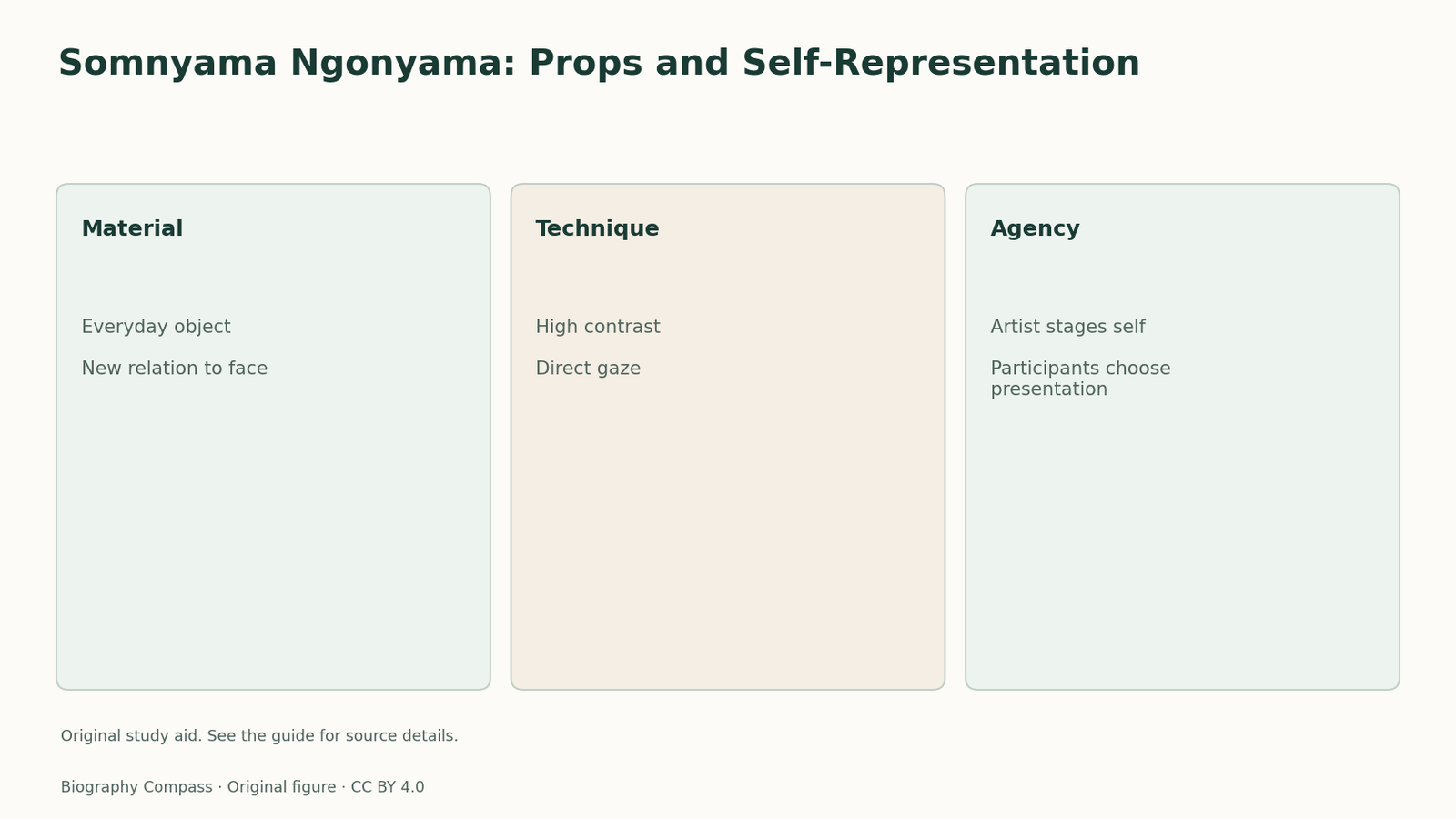
SFMOMA’s account of Somnyama Ngonyama identifies props including cowrie shells, rubber tyres and plastic. These materials are arranged around Muholi’s body rather than appearing as incidental background. Their ordinary uses do not disappear, but the portrait places them in new relations with the face. A viewer can begin with a concrete inventory: what is worn, where is it placed and how does it alter the outline of the body? These observations establish a foundation for interpretation without pretending that a prop has one universal meaning.
Sources for this section: [2]
Lighting and gaze make an encounter
The museum describes makeup and high-contrast lighting as ways Muholi emphasises Blackness. Art 21 places the series within a self-defining examination of South African histories and identities. Read these accounts together: technique shapes what the viewer sees, while the broader project explains why self-presentation matters. The direct encounter with the camera makes looking reciprocal. The face addresses the viewer rather than remaining a passive surface to classify. That is an interpretive reading of the documented arrangement, not a diagnosis of the artist’s private emotions.
Compare two distributions of agency
Faces and Phases gives participants choices over pose, clothing and place. In Somnyama Ngonyama the artist directs their own staged appearance. Draw two camera relationships and label who makes each decision. A supported answer recognises agency in both projects but locates it differently. It should not collapse the self-portraits into documentary pictures of someone else’s daily life, or assume that every participant in the other series was directed to imitate Muholi. The distinction helps explain how an archive can accommodate collaboration and self-performance without making them identical.
Continue the chronology
Related history guides
Biography context
Explore South Africa through connected lives
Connected biographies
Read the artist’s biography
b. 1972
Zanele Muholi
Photographer and visual activistA South African visual activist building an archive of Black LGBTQIA lives through photography and other media.Read biographyQuick answers
Common questions
- Are all Muholi’s portraits self-portraits?
- No. Somnyama Ngonyama uses self-portraiture, while Faces and Phases develops portraits through relationships with participants.
Primary and institutional sources
How this history was checked
The listed records support the facts. Observation exercises and arguments are Biography Compass editorial interpretations. This article was reviewed on 7 November 2026.