
The short answer
How do family relationships and the arrangement of encounters shape the story beyond a list of events?
Read the evidence
Sources, interpretation and production roles
The records answer different questions about this work. The final exercise is an original teaching model.
| Record or question | Supported reading | Boundary or contrast |
|---|---|---|
| Film credits | Name the writers and performers. | Do not allocate unseen individual writing tasks. |
| Family synopsis | Identifies a visit and different relationships. | A recurring actor/name does not prove continuity between films. |
| Bordwell’s criticism | Offers a reading of preoccupation and emotional complexity. | A critical interpretation is not a private statement of authorial intent. |
Family relationship is more informative than a cast list
Tokyo Story follows an older couple’s visit to their adult children in postwar Tokyo. Setsuko Hara plays Noriko, a widowed daughter-in-law; Chishū Ryū and Chieko Higashiyama play the parents. A list of performers identifies casting, but a map of kinship reveals a different structure. Noriko’s position is especially useful because care does not line up neatly with biological descent. The BFI synopsis and its discussion of Hara’s recurring character name should be kept distinct: the Norikos in separate Ozu films are not automatically one continuing person.
The screenplay and the director are separately credited
BFI identifies Kōgo Noda and Ozu as writers. That production fact supports a discussion of screenplay collaboration without assigning an undocumented scene to either individual. The completed film’s organisation is not evidence that one writer supplied all dialogue or another supplied every pause. Credits answer who was responsible in named capacities. An analysis of how encounters are arranged answers a different question. A useful article can preserve both without inventing a private division of labour that the consulted records do not describe.
Sources for this section: [3]
A critical reading resists turning the children into a single villain
Bordwell’s essay stresses that the siblings’ preoccupations and individual responses complicate a simple opposition between virtuous parents and heartless children. It also discusses ordinary acts and objects as carriers of feeling. This is an identified critical interpretation, not a transcription of the filmmakers’ intentions. Place it alongside the BFI overview and the account gains specificity: family obligation operates through people with different positions, circumstances and capacities. The distinction helps a reader formulate a question about an encounter rather than deciding in advance that every child performs the same narrative function.
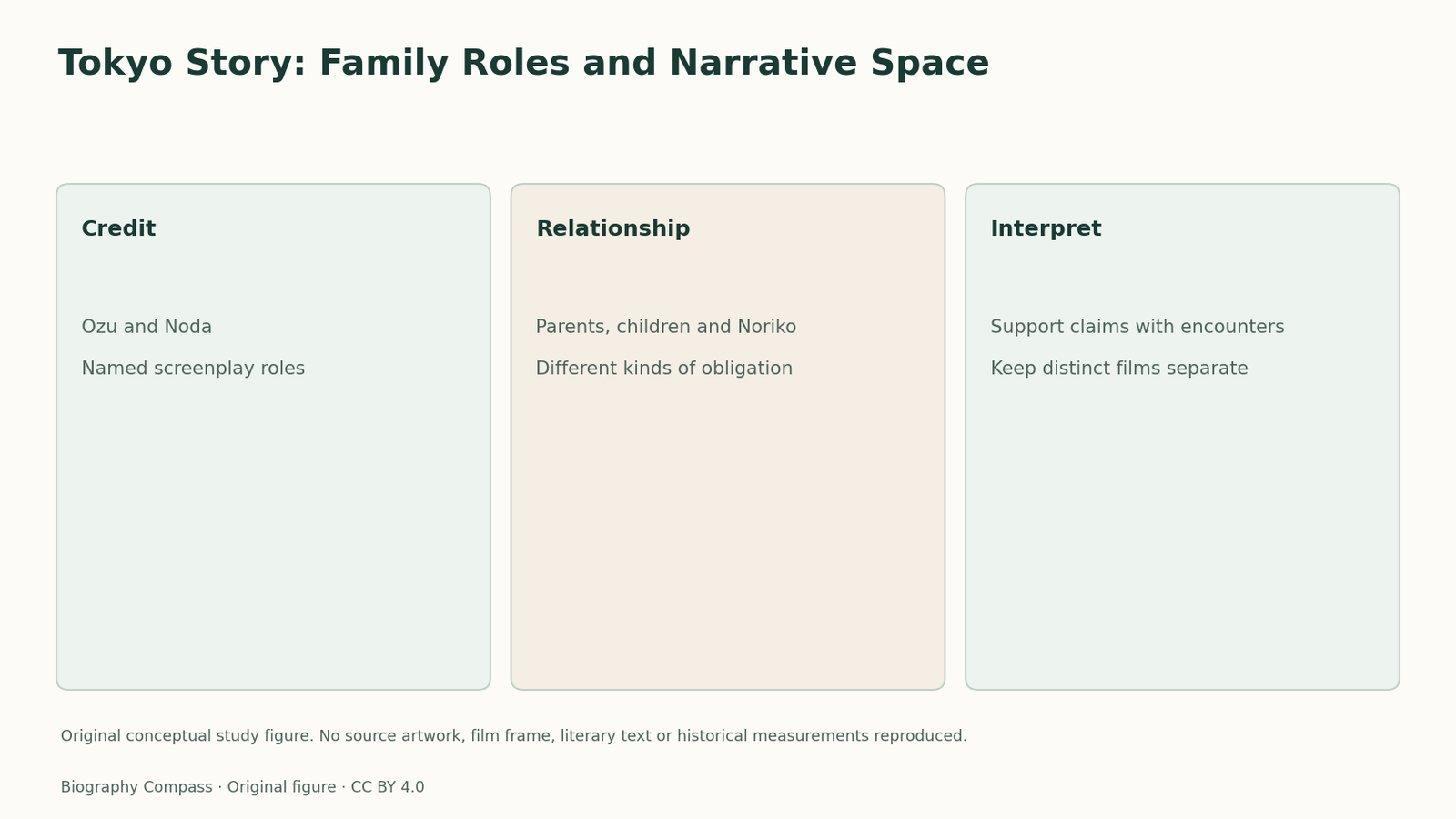
Original relationship-map exercise and reference answer
Draw five plain boxes: parents, adult children, widowed daughter-in-law, work obligations and available time. Connect the boxes only where a supplied synopsis supports a relationship; use a separate colour for an interpretation such as “care exceeds formal obligation”. Which line records a fictional family fact, and which proposes an analytical claim? The kinship lines belong to the first group; the care statement belongs to the second and requires support from the relevant interactions. Now ask whether a character’s name recurring in another film creates a line of continuity between the stories. It does not by itself. This is an original reading tool, not Ozu’s production plan or a reconstruction of a particular shot. The checked answer separates kinship, credit, evidence and interpretation. If a viewer later adds observations from the film, those should be labelled with the version and scene actually viewed rather than attributed to this source-limited guide.
Continue the chronology
Related history guides
Biography context
Explore Japan through connected lives
Connected biographies
People and related creative practices
1903–1963
Yasujirō Ozu
Film director and screenwriterYasujirō Ozu moved from silent comedy to carefully organised family dramas, developing long collaborations and a visual style recognised beyond Japan.Read biography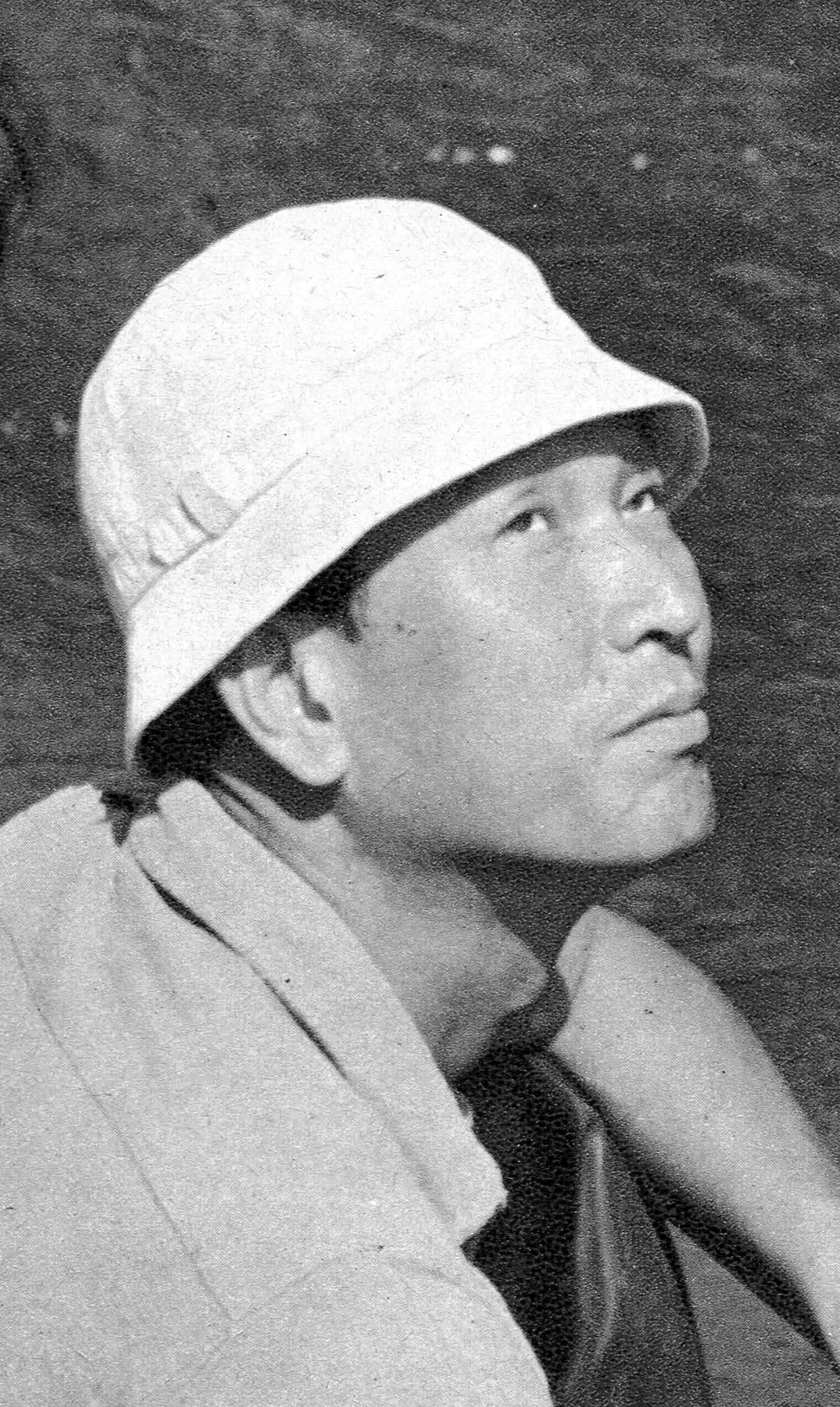
1910–1998
Akira Kurosawa
Film director and screenwriterAkira Kurosawa directed films across historical action, contemporary drama and literary adaptation. His work joined forceful visual storytelling with recurring questions about responsibility, social power and the stories people tell about themselves.Read biography1926–2006
Shōhei Imamura
Film director, screenwriter and film educatorShōhei Imamura developed a film career around marginal lives and social contradictions, moving through studio apprenticeships, independent work and film education.Read biographyQuick answers
Common questions
- Are the Norikos played by Hara in separate films one character?
- No. Repeated names and casting do not establish a continuous story.
- Does this guide claim a new full viewing?
- No. It compares identified institutional records and criticism and supplies an original reading exercise.
Primary and institutional sources
How this history was checked
Sources include production records, institutional collections and the specifically identified passages discussed here. Interpretations and teaching models are distinguished from credits and publication facts. This article was reviewed on 8 November 2026.