
The short answer
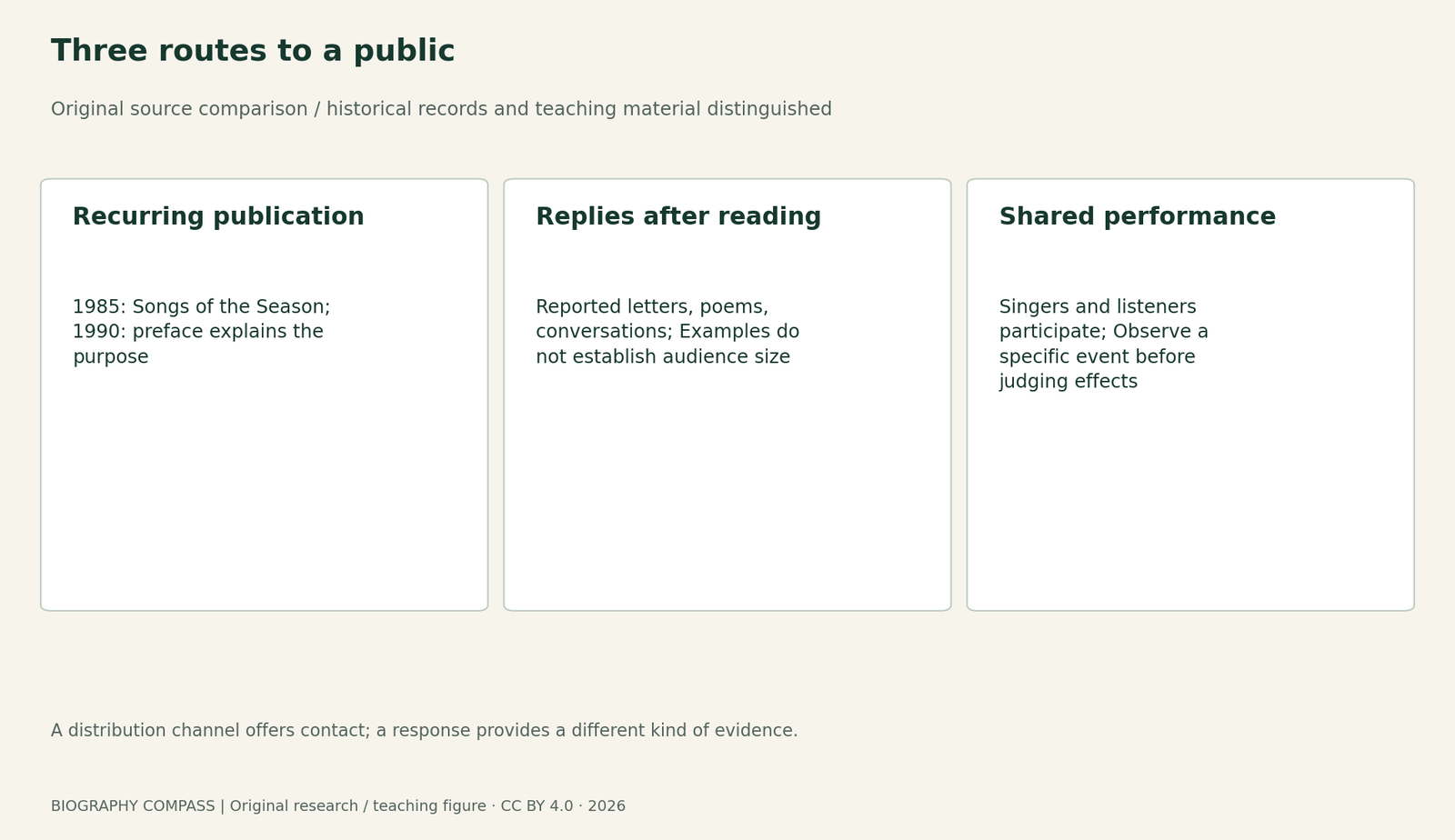
What does it mean for a poem to have a public life? Osundare’s account distinguishes a recurring newspaper slot, a collected selection, readers who answer and listeners who participate. Each creates a different opportunity for connection, and each leaves different evidence.
Original source comparison
What kind of public connection is evidenced?
Compare the purpose and scope of the actual accounts before extending their claims.
| Source or practice | What the source supports | What still needs examination |
|---|---|---|
| 1990 preface | Declared balance of accessibility, topicality and artistic care. | The purpose is not itself a reception study. |
| Interview: reader replies | The poet reports letters, poems and direct approaches. | No denominator, representative sample or causal policy evidence. |
| Performance account | Shared rhythm and participation form part of his stated practice. | An event must be observed or documented before its outcome is claimed. |
Chronology
A timeline of the turning points
Recurring newspaper poetry
Songs of the Season began in the Sunday Tribune.
A collected selection
The preface explains the public and artistic purpose.
Conversation and web page
The resource identifies a 2002 interview; the archive page bears a 2006 date.
Title and platform changes
Lifelines title; later move to The Nation on Sunday.
The author’s purpose was specific enough to investigate
The official-site page reproduces an excerpt from the 1990 Songs of the Season preface. Osundare describes a wish to make topical poetry accessible while retaining aesthetic care and attention to public life. The surrounding page places the column’s start in the Sunday Tribune in 1985. This is evidence of an intended combination, not a choice between artistic form and public concern. It gives a reader concrete questions: how a newspaper context shapes the topic, which language choices invite entry, and what the text asks the reader to notice. A declared purpose remains distinct from a demonstrated effect.
Sources for this section: [1]
A recurring slot and a collected book invite different encounters
The 1990 selection gathered work from the 1985–1990 column. A recurring newspaper contribution arrives among other current material and allows a reader to return over time. A collection can place earlier pieces into a sequence removed from their first news setting. Those are original analytical distinctions drawn from the publication forms, not claims about every reader’s behaviour. The source does not supply complete newspaper pages, circulation records or a reception survey. Establishing the placement, frequency of individual issues and surrounding reports would require those objects; the short preface cannot stand in for the entire newspaper archive.
Sources for this section: [1]
The interview describes response rather than only distribution
In the Poetry International interview, Osundare recalls readers answering the column through letters, poems and conversations in the street. Those are different actions from merely receiving a newspaper. The testimony supports an account of feedback that mattered to the poet. It does not disclose how many readers responded, whether the examples were representative, or whether public decisions changed. The resource The Written World identifies the interview as Martijn Meijer’s 2002 conversation; the archived article page carries a 2006 date. Keeping those two dates distinct avoids inventing a later interview simply because a website migrated or republished material.
Performance creates a different route into participation
Osundare’s interview explains poetry through a community of singers, hearers and composers, and the teacher resource repeats his account of drums and Yoruba rhythm. This makes an immediate participatory event imaginable, whereas a letter to a newspaper creates a reply after the first encounter. Neither is automatically more effective. They distribute attention, timing and opportunity differently. A printed poem can be revisited privately; a live event can permit a shared response but may exclude people unable to attend. These are questions for designing or studying an event, not evidence that a particular unobserved performance achieved all those possibilities.
Original exercise: design a text and a response route
Design a short, original public notice about a fictional neighbourhood water point whose opening hours are unclear. This is a prose communication exercise, not an imitation of Osundare’s poetry. Write no more than 45 words. Add a practical way for a reader to correct the information, a way for a listener to participate at a short meeting, and two items you would record to learn whether either channel worked. Separate distribution evidence from response evidence. Explain why the number of copies printed would not, by itself, show that the notice answered the neighbourhood’s question.
Reference answer: a reply needs somewhere to go
An original 33-word notice could read: “The water point is listed as open until six. Was it open when you arrived? Write the time on the sheet beside the gate, or tell the meeting recorder on Saturday at noon.” A meeting could offer a spoken correction round and a private written alternative. Record verified instances of unclear hours and the number of substantive corrections received. Copies distributed measure an opportunity to encounter the notice; they do not demonstrate comprehension or response. A useful evaluation would also ask whether the corrected hours reached people who could not attend the meeting.
Follow a changing platform without inventing a timeless role
The author site records the Lifelines title from June 2004 and a move to The Nation on Sunday in February 2017. An institutional profile still describing the Sunday Tribune column therefore supplies historical context rather than a secure current employer field. The combined evidence answers the guide’s question with several mechanisms: recurring publication, later selection, delayed reader replies and live participation. It does not give a single national impact score. A further research project could examine dated newspaper pages and preserved correspondence, keeping the poet’s reported experience beside independently observed traces of how particular readers answered.
Continue the chronology
Related history guides
Rotimi and Osofisan: What Does an Adaptation Change?
Explore a different question about language, audiences or creative collaboration.
Read the timeline20 August 2021 EP; May 2024 film; 10 May 2024 soundtrackWater & Garri: One Title, Three Creative Projects
Explore a different question about language, audiences or creative collaboration.
Read the timelineBiography context
Explore Nigeria through connected lives
Connected biographies
Artists and the questions behind their work
1947–
Niyi Osundare
Poet, literary scholar and essayistNiyi Osundare is a Nigerian poet and scholar whose work connects English writing with Yoruba language, performance and public debate. His career includes university teaching, poetry collections and a recurring newspaper column.Read biographyQuick answers
Common questions
- Does this guide reproduce or closely analyse an Osundare poem?
- No. It compares prose statements about publishing, audience and performance; the exercise text is original prose.
- Can reader replies establish a national audience size?
- No. The interview gives examples of response, not a readership count or representative survey.
Primary and institutional sources
How this history was checked
Read the named participant or release record within its stated scope. The underlying plays, poems, recordings and film are not presented as fully consumed. This article was reviewed on 27 October 2026.
- Niyi Osundare official websiteBard of the Tabloid Platform
- Martijn Meijer; Poetry International, interview identified as 2002; page dated 18 January 2006An interview with Nigerian poet Niyi Osundare
- Scottish Poetry Library, BBC-linked educational resourcePoetry 2012: The Written World — Nigeria teacher resource
- Louisiana State University New Orleans faculty profileNiyi Osundare, Distinguished Professor of English