
The short answer
Food aid can enter a development programme as a product, as a source of money, or both. Operation Flood linked these uses to a cooperative dairy network. Read the financing chain and the records that test its results.
Original documentary comparison
Follow the evidence from shipment to result
Different records establish different stages of the financing chain.
| Country | What it can establish | What it cannot establish alone |
|---|---|---|
| Aid commitment | Promised commodities and stated quantities. | Actual delivery, sales revenue or local development impact. |
| Receipt and sales records | What arrived, was transferred and was paid for. | Whether all funded assets were productive. |
| Loan/grant agreement | Who received funds and on what repayment terms. | The recipient’s actual operating performance. |
| Project evaluation | Measured achievements, costs and outcomes within a defined scope. | A causal attribution of all national milk growth to one person or programme. |
Chronology
A timeline of the turning points
Technical institution
NDDB is established in Anand, with Kurien as founding chairman.
Programme and finance
Approval and the 1970 launch connect commodity aid to dairy development; IDC handles finance and commodities.
Infrastructure and collection
Proceeds and other resources support processing, marketing and cooperative networks.
Project audit
The World Bank evaluates four dairy projects, reporting achievements and uneven results.
Institutions combined
The NDDB Act provides for incorporation and the transfer of IDC undertakings.
Programme’s final phase ends
NDDB dates PhaseIII through 1996.
Identify both the physical flow and the money flow
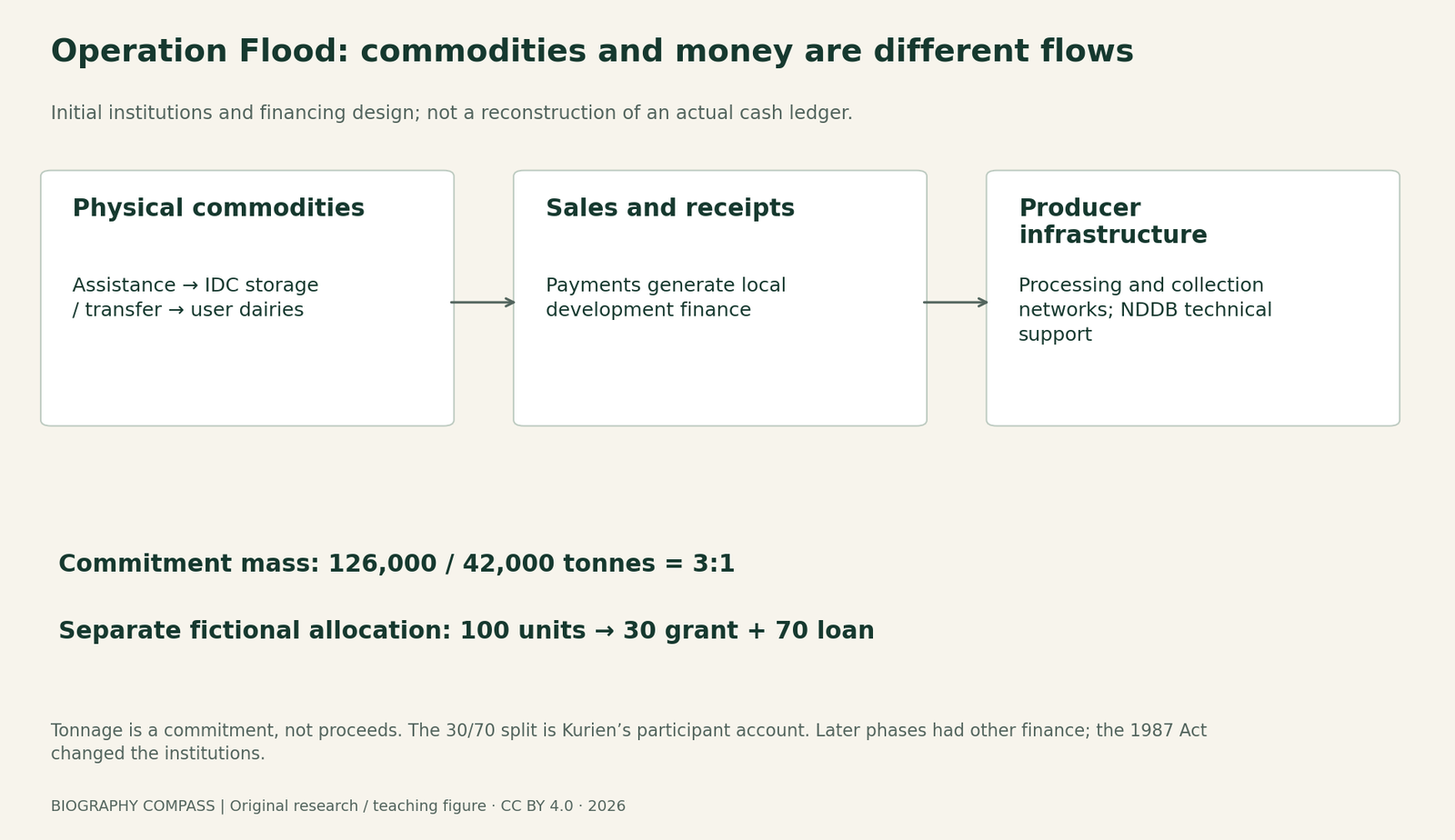
Operation Flood began in 1970 with objectives that included higher milk production, rural incomes and reasonable consumer prices. Its first phase received skimmed milk powder and butter oil through European Economic Community assistance and the World Food Programme. These commodities could supply dairies while generating local funds through sales. Milk products and the money received for them were different resources moving through the system. NDDB’s institutional history explains the programme’s aims; FAO’s account, authored by NDDB executive A. Banerjee, describes the mechanism. Neither should be read as a complete cash ledger. The question is how an aid shipment became investment capacity, not merely how much food entered the country.
Donations were sold to support domestic capacity
The World Bank’s 1987 audit describes donated commodities being used to generate funds and allowing processing and storage infrastructure to be established before the procurement network was fully developed. That sequencing mattered: an urban dairy needed something to process while local collection grew. The intended transition was toward milk supplied by domestic producers. A product donation could therefore act as temporary supply and as a financing source. This was more specific than distributing every shipment free to households. It also carried a balancing problem: imports priced or used poorly could weaken incentives for local production. The financing mechanism had to serve a market-building strategy rather than become a permanent substitute for farmers’ milk.
NDDB and IDC initially performed complementary jobs
The original NDDB was registered as a society. FAO’s account explains that handling government funds required another institutional arrangement, leading to the Indian Dairy Corporation in 1970. IDC received donated commodities, checked quality, managed storage and transfers, and collected payments from dairies. NDDB provided technical support, planning and training. Kurien chaired the institutions, but the work required separate financial, logistical and engineering responsibilities. The 1987 Act’s incorporation and vesting provisions later brought IDC undertakings into the statutory NDDB. That change should not be projected backward as though a single unchanged legal body performed every function throughout the programme. Institution names belong beside the task and date.
Funds reached institutions through different financial forms
Kurien’s 2007 retrospective chapter describes first-phase disbursement to implementing agencies as 30 percent grant and 70 percent loan. This is a participant’s description of a funding design, not an independently reconstructed schedule of every disbursement. A grant and a loan can both finance construction, but they create different obligations. A grant does not require repayment on the same basis as loan principal; interest, maturity and enforcement require the actual agreement. Later phases also combined commodity assistance with World Bank lending and other resources. Calling the programme “financed by donated milk” therefore omits both the on-lending arrangements and the changing mix of resources across phases.
The financed asset was more than a processing plant
The cooperative structure connected village milk collection to district processing and services and to state-level marketing. NDDB’s Anand-pattern description distinguishes these functions and explains that professionals are accountable to producer-elected leaders. The 1987 audit similarly records village societies, district unions and state federations, as well as feed, veterinary and transport services. A factory could create capacity without automatically creating a reliable supply network or accountable ownership. Conversely, a producer society needed processing and paying markets to make collection useful. Following the finance chain therefore means asking which institution received resources, what it built and how that capacity connected to farmers and consumers.
The audit gives a more varied picture than the objective
The 1987 World Bank audit assessed projects in Karnataka, Rajasthan and Madhya Pradesh and a national project. It found substantial progress in cooperative organisation and procurement, but shortfalls in animal-productivity objectives. Recalculated economic results differed: Karnataka and Rajasthan were positive in the report, while Madhya Pradesh’s low incremental production produced a negative result. These are project-specific findings, not a single verdict on every activity over 1970–1996. They help separate a successful financing mechanism from a claim that all investments or biological-productivity interventions worked equally well. Measuring milk collected, processing capacity, animal yield and household returns answers different questions and requires the appropriate denominator and comparison.
Sources for this section: [3]
Original evidence comparison: commitment, receipts and outcomes
FAO states that the initial WFP agreement undertook to provide 126,000 tonnes of skim milk powder and 42,000 tonnes of butter oil. Those are described commitments. A shipment register would establish actual receipts, a sales account would establish proceeds, and audited expenditure and project records would establish how funds were used. None can be replaced by the tonnage alone. Likewise, national milk production is broader than milk procured through the programme’s cooperatives. A rise in the national total does not by itself measure the programme’s causal contribution. Comparing these evidence levels makes the development claim testable without dismissing the clear records of finance, infrastructure and institution building.
Exercise: calculate only what the inputs establish
First, calculate the ratio of 126,000 tonnes of skim powder to 42,000 tonnes of butter oil. Can the resulting ratio establish the value of sales proceeds? Second, use a deliberately hypothetical project allocation of ₹100 with the 30 percent-grant, 70 percent-loan split described by Kurien. Identify the two amounts and state which creates a principal repayment obligation. Finally, a caption says: “All Indian milk growth was caused by free imported powder, and every state project earned the same return.” Name two records or measurements needed to test it. The example uses no invented historical selling price, interest rate or realised project revenue.
Reference answer: the mechanism and the result are separate
The tonnage ratio is 3:1. It gives relative mass, not revenue; prices, quality, timing, expenses and actual quantities sold would be needed for proceeds. The hypothetical allocation contains ₹30 grant and ₹70 loan principal, with loan terms requiring separate documentation. For the final caption, one needs evidence comparing programme and wider milk-production changes, and project-specific evaluations rather than an assumed universal return. The 1987 audit already shows uneven state results. Operation Flood’s distinctive financing idea was to connect commodity assistance to domestic infrastructure and producer institutions. Its achievement can be explained through that chain while still examining whether each investment met its particular objective.
Continue the chronology
Related history guides
Biography context
Explore India through connected lives
Connected biographies
People and institutions
1921–2012
Verghese Kurien
Dairy engineer, cooperative manager and institution builderVerghese Kurien helped build farmer-owned dairy enterprises and the institutions supporting them. His career linked engineering, professional management, marketing and the financing of cooperative development.Read biographyQuick answers
Common questions
- Were all donated dairy products simply given away?
- The programme sold commodities to generate development funds and used them in the dairy supply system. The records describe a financing mechanism as well as physical assistance.
- Was NDDB always the same legal body?
- No. The original society and IDC had complementary roles. The 1987 Act incorporated a statutory NDDB and provided for transfer of IDC undertakings.
Primary and institutional sources
How this history was checked
Original technical records, institutional accounts and evaluations supply the evidence. Participant recollections are identified. Comparisons, exercises and proposed figures are original teaching material. This article was reviewed on 27 October 2026.
- National Dairy Development BoardOperation Flood: programme objectives and phases
- Food and Agriculture Organization, World Animal ReviewDairying systems in India, by A. Banerjee, NDDB Executive Director
- World Bank, Operations Evaluation DepartmentProject Performance Audit Report No. 6857: four Indian dairy projects, 30 June 1987
- Government of India, Ministry of Law and Justice; NDDB archiveNational Dairy Development Board Act 1987, Gazette text, 15 September 1987, sections4–6
- Verghese Kurien; World Bank and MacmillanIndia’s Milk Revolution: Investing in Rural Producer Organizations, chapter 2 in Ending Poverty in South Asia, 2007
- National Dairy Development BoardThe Anand Pattern: three-tier organisation