
The short answer
A cooperative could collect more milk than its urban buyer wanted in winter. What had to change for that surplus to become useful, storable products?Follow procurement, processing, technical expertise and markets at Amul.
Original enterprise comparison
Three capacities had to fit together
The plant connected supply to products and markets.
| Country | Principal work | Question the record can answer |
|---|---|---|
| Procurement | Village societies organise supply and quality checks. | Could members deliver milk and receive payment? |
| Processing | Plant teams separate, manufacture and store products. | What product, capacity and process were available? |
| Marketing | The union and later federations connect products to buyers. | Could the resulting products be sold at viable prices? |
| Governance | Producer representatives appoint and oversee professionals. | Who owns the enterprise and to whom are managers accountable? |
Chronology
A timeline of the turning points
Winter surplus
The union’s history describes a market unable to absorb all the extra winter milk.
Foundation stone
The union dates the new factory’s foundation ceremony to this day.
Plant opens
The butter and powder factory opens with government and international assistance.
Different product process
CFTRI research and NRDC licensing support an infant-food process from buffalo milk.
Contemporary recognition
The Magsaysay citation describes farmer organisation, management, public support and processing together.
A dependable buyer did not remove seasonality
The Kaira cooperative created a collective route from farmers to Bombay’s milk market, but demand was not unlimited. Amul’s history says buffaloes produced much more milk in winter and that by 1953 the Bombay Milk Scheme could not absorb all the union’s seasonal surplus. Members could again face low-priced sales outside the cooperative. The business problem was therefore not simply how to persuade farmers to produce more. It was how to accept additional supply without letting a temporary mismatch undermine their market. Processing could change the form and timing of sales. It still needed collection, transport, quality control and buyers for the resulting products.
The 1955 factory was a supported industrial project
The union’s history dates the foundation stone to 15 November 1954 and the opening to 31 October 1955. It identifies Indian and Bombay government support, UNICEF assistance, New Zealand’s Colombo Plan contribution and FAO technical aid. The contemporary 1963 Magsaysay citation also records these partners in the period before its award. A retrospective company history explains the project’s place in Amul’s story; the contemporary citation confirms that public and international cooperation belonged within that story. Neither is a complete engineering acceptance report. Together they establish a plant and a network of assistance, without requiring a claim that one founder designed, built and financed it alone.
Patel, Kurien and Dalaya supplied different contributions
Tribhuvandas Patel organised the producer institutions and provided elected leadership. Kurien managed the enterprise and helped obtain equipment and support. H. M. Dalaya supplied crucial dairy-technology expertise. Amul’s Dalaya biography explicitly connects his work with the 1955 plant. Kurien’s own later chapter also credits Dalaya with the technical breakthrough in making skim milk powder from buffalo milk. That chapter is a participant’s account, published in a World Bank-hosted volume, not independent evaluation simply because of its host. The agreement on Dalaya’s role is useful; the more sweeping “world first” language would require a broader technical-priority investigation than these commemorative accounts provide.
Separate the milk’s components before naming the product
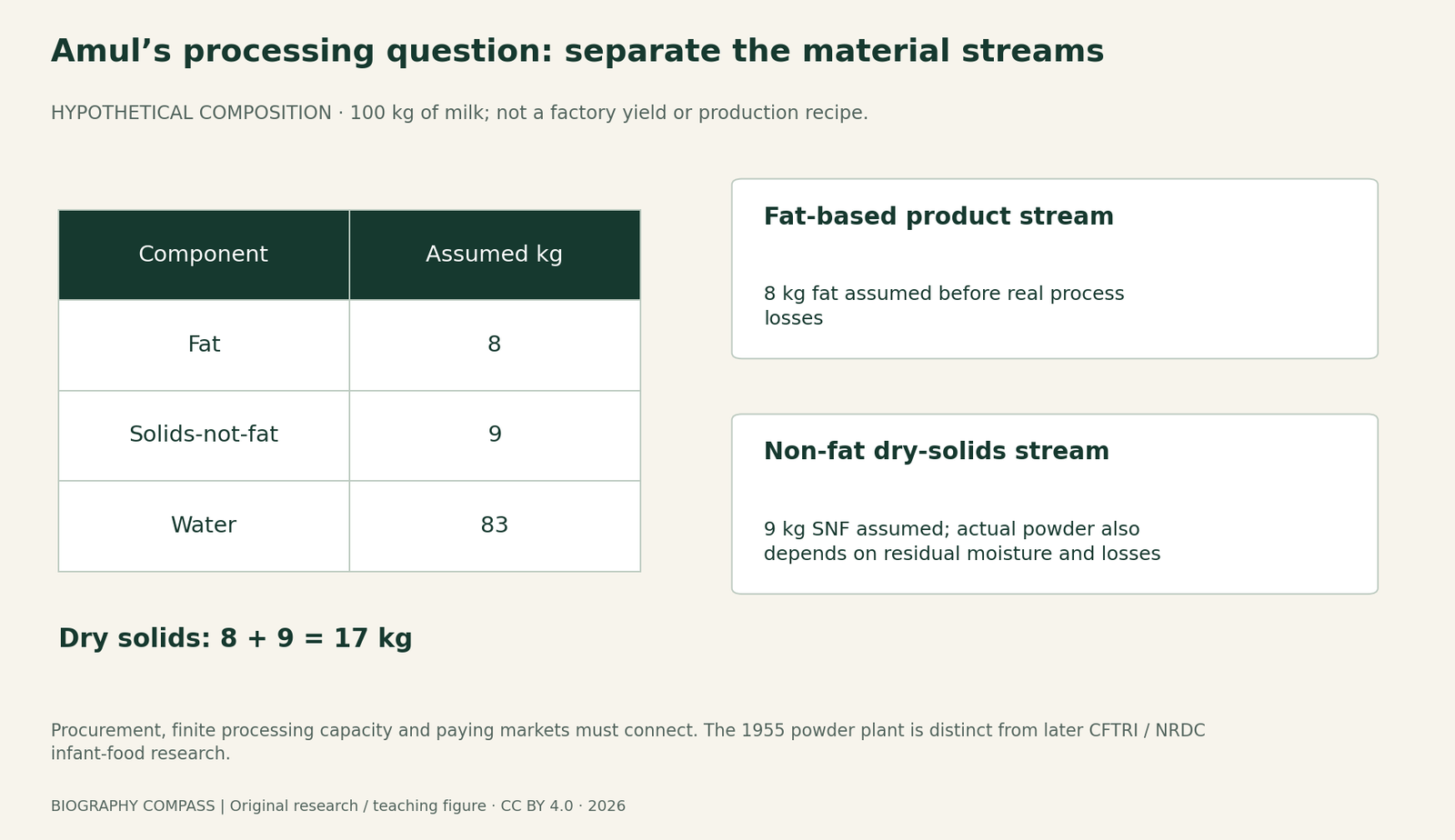
Milk contains water, fat and solids-not-fat, or SNF. Kurien’s chapter gives illustrative buffalo-milk composition ranges of 7–10 percent fat and 9–9.5 percent SNF. It describes how converting milk mainly into ghee could leave non-fat material with relatively little market value. Separating cream and producing powder from skim milk created another product stream. Removing water can make those solids more storable, but powder production requires equipment and energy. A statement that the factory made milk storable should therefore identify which product and components it means. It does not mean every litre entered a single identical process or that drying made all handling losses disappear.
Storage capability and economic value were connected
A powder plant gave the cooperative a way to convert a flush-season surplus into products that could be marketed beyond the immediate liquid-milk demand. The 1963 citation links the plant to seasonal supply and to an all-India sales organisation. Kurien’s later economic explanation argues that selling both fat-based products and milk powder captured value that older arrangements left unrealised. This is an argument about product recovery and markets, not free extra value created by a machine. Drying cost, capital, quality and sales prices still determined the margin. The records here explain the mechanism; they do not provide a continuous 1955 factory dataset from which to calculate its actual yield, profit or energy efficiency.
Milk powder and infant food have different histories
The 1955 plant should not absorb every later dairy innovation into its opening date. The government’s science-and-technology portal attributes a buffalo-milk infant-food process to the Central Food Technological Research Institute and says NRDC licensed it to the Kaira union. FAO’s account also distinguishes the 1955 dairy and powder plant from later infant-food production. These records identify additional research and a licensing relationship. They are not evidence that a powdered dairy ingredient and a formulated infant food are interchangeable. Keeping the product categories separate gives appropriate credit to researchers and prevents a later brand’s product history from being projected backward onto the first plant. No nutritional superiority claim is needed to explain the industrial development.
Original comparison: the collection system and the factory
The problem can be represented as three connected capacities. Procurement brings members’ milk into the enterprise. Processing changes its form and shelf-life possibilities. Marketing finds customers for liquid milk, butter, powder and other products. A constraint in one can limit the others. A cooperative with an excellent powder machine but weak collection still lacks raw material; one with expanding collection but no storage or market can face unsold surplus. That comparison follows the institutional sources without pretending to reconstruct a day’s actual production. It also explains why veterinary support, roads, professional staff and producer trust belong in the same industrial history as the dryer.
Exercise: use a transparent composition model
For a teaching example only, assume 100 kilograms of milk containing 8 kilograms of fat, 9 kilograms of non-fat solids and 83 kilograms of water. The chosen composition falls within the ranges in Kurien’s account. Calculate the total dry solids and the non-fat dry solids potentially available after ideal separation. Can either number be published as the factory’s actual powder yield? Then repair this caption: “Kurien alone invented infant food in 1955, so the factory could buy unlimited milk without needing more markets.” Identify the missing technical contributor, the product-history error and the capacity assumption. This model is mass bookkeeping, not a historic production recipe.
Reference answer: mass balance is not factory performance
The idealised dry solids total 17 kilograms, and the non-fat share is 9 kilograms. Neither is an observed powder yield: residual moisture, residual fat, process losses and the chosen product specification affect an actual result. Dalaya belongs in the technical account alongside Kurien’s management, Patel’s producer organisation and the wider plant team. The later CFTRI/NRDC infant-food process is separate from the 1955 butter-and-powder opening. Finally, a plant has finite throughput and requires paying customers; processing changes a surplus problem rather than eliminating every capacity or market constraint. These distinctions explain why the plant mattered without turning industrial cooperation into a magical invention story.
Continue the chronology
Related history guides
Connected biographies
People and institutions
1921–2012
Verghese Kurien
Dairy engineer, cooperative manager and institution builderVerghese Kurien helped build farmer-owned dairy enterprises and the institutions supporting them. His career linked engineering, professional management, marketing and the financing of cooperative development.Read biography1903–1994
Tribhuvandas Patel
Cooperative organiser and founding Kaira Union chairmanTribhuvandas Patel organised milk producers into village societies and the Kaira district union. He helped establish farmer ownership, recruited professional management and later supported a cooperative-linked rural health foundation.Read biographyQuick answers
Common questions
- Did Kurien alone develop the plant’s technology?
- The institutional accounts and Kurien’s own chapter credit H. M. Dalaya’s technical work, alongside management, producer leadership, staff and outside assistance.
- Was the 1955 plant the same event as the later infant-food process?
- No. The records distinguish butter and powder manufacture from the later CFTRI process licensed through NRDC to the Kaira union.
Primary and institutional sources
How this history was checked
Original technical records, institutional accounts and evaluations supply the evidence. Participant recollections are identified. Comparisons, exercises and proposed figures are original teaching material. This article was reviewed on 27 October 2026.
- Kaira District Co-operative Milk Producers’ Union, Amul DairyHistory: Kaira Union, seasonal surplus and the 1955 plant
- Ramon Magsaysay Award FoundationPatel, Tribhuvandas: 1963 Community Leadership citation, jointly recognising Patel, Kurien and Khurody
- Amul DairyDr. H. M. Dalaya, 1921–2004
- Verghese Kurien; World Bank and MacmillanIndia’s Milk Revolution: Investing in Rural Producer Organizations, chapter 2 in Ending Poverty in South Asia, 2007
- India Science, Technology & Innovation Portal, Department of Science and TechnologyInfant Food: CFTRI process licensed to Kaira Union through NRDC
- Food and Agriculture Organization, World Animal ReviewDairying systems in India, by A. Banerjee, NDDB Executive Director
- National Dairy Development BoardThe Anand Pattern: three-tier organisation