
The short answer
An announcement can sound positive while leaving someone else to carry its cost. This study asks how sequence and repetition let a short text challenge that one-sided accounting.
Actual process and original decisions
Compare the record with a new working plan
The record supplies a specific process; the new example makes its planning choices explicit.
| Decision | Selected record | Original task |
|---|---|---|
| Pattern | Repeated loss/replacement contrasts shape the argument. | Pair an announced gain with a concrete deferred cost. |
| Scale | The ending expands the stakes beyond everyday consumption. | Choose whether the second line narrows or widens the issue. |
| Voice | Satirical speech need not endorse what it appears to praise. | Preserve the announcement’s wording, then expose its limit. |
Chronology
A timeline of the turning points
Selected text
No More Boomerang.
A list that argues
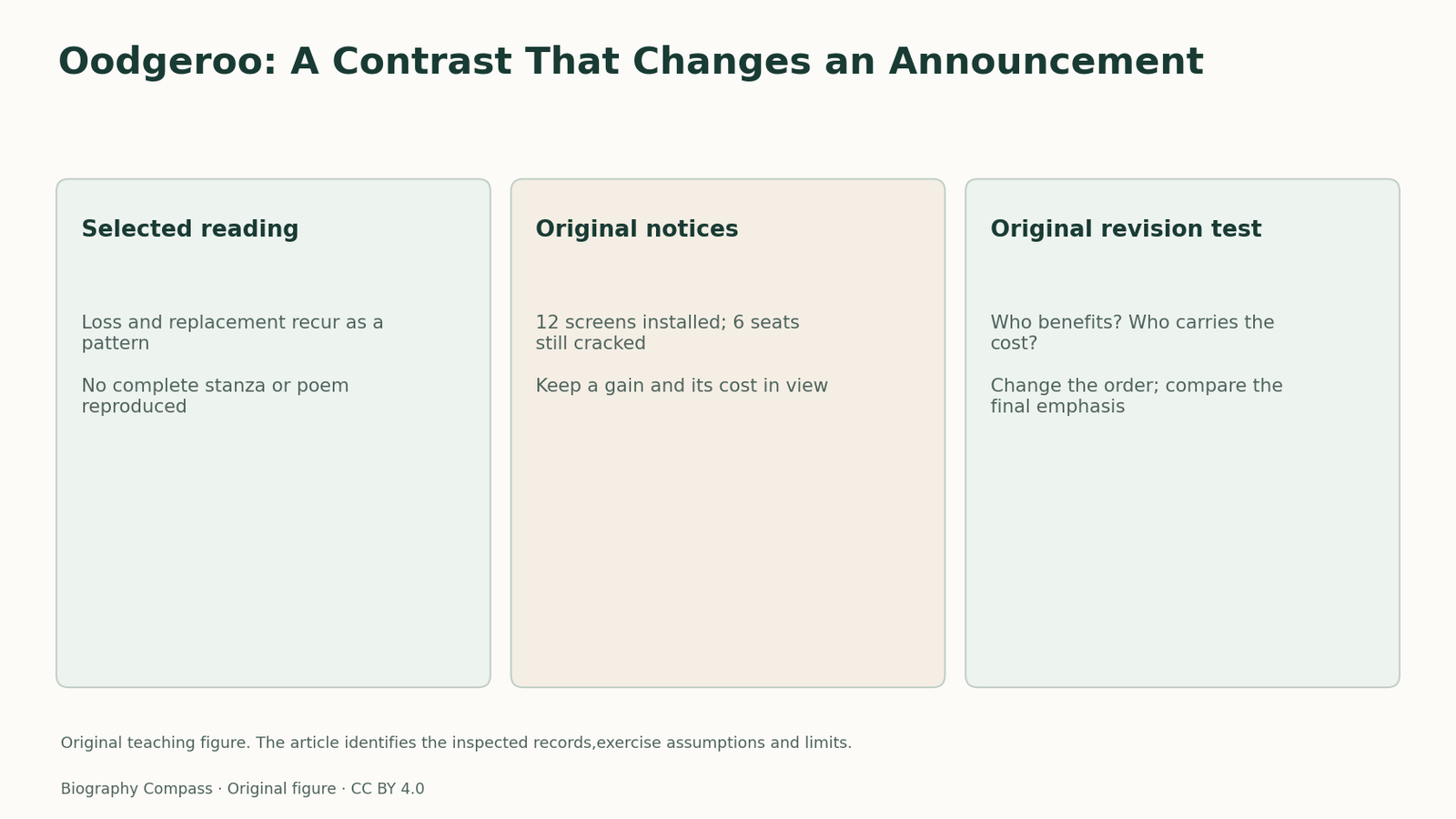
In No More Boomerang, Oodgeroo juxtaposes lost practices with replacements presented as civilisation. The recurring two-word opening “No more” prepares a pattern of subtraction and substitution. Paying for entertainment, wage work and long housing payments complicate any simple promise of improvement.
One reading: repeated exchanges make each promised gain answerable to its cost; the speaker’s apparent approval becomes unstable.
Sources for this section: [1]
Escalation changes the scale of the argument
The teaching transcription moves from everyday substitutions toward television advertising and an atomic ending that threatens everyone. That shift enlarges the consequences rather than merely adding another household convenience.
The museum locates her writing within public advocacy against racial exclusion.
Original task: revise an announcement
Here are two invented notices: “Installation complete: twelve bright screens.” “Repairs deferred: six cracked seats.” Put them in a two-line sequence that preserves an official announcement’s voice while exposing the cost. Then write a different pair about a transport service. Do not imitate the poem’s Indigenous speaker, reproduce its examples or borrow another stanza.
Reference answer 1: “Upgrade complete: twelve bright screens. Seating repairs: deferred again.” The positive verb comes first, but the second line qualifies what improvement means. Reference answer 2: “Service extended: one more train. Ramp still locked: who can board?” These are original replacement lines. Their question about access is not an assertion about any actual station or budget.
Sources for this section: [1]
Check what your revision makes the reader do
A strong answer keeps both sides in view rather than deleting the announcement and substituting a general complaint. Ask a partner to identify the claimed gain, the remaining cost and the person likely to experience each. If the cost is too vague to locate, make the second line more concrete. Reversing the order is another useful test: it changes which voice receives the last word without changing the invented facts.
Sources for this section: [1]
Continue the chronology
Related history guides
Biography context
Explore Australia through connected lives
Connected biographies
Follow the working life
Quick answers
Common questions
- Are the train and screen lines Oodgeroo’s?
- No. They are original teaching examples and describe no actual service or purchase.
Primary and institutional sources
How this history was checked
The displayed university teaching transcription is the selected text; the museum biography supplies public-career context. No first-edition collation or recorded adaptation is claimed. This article was reviewed on 31 October 2026.