
The short answer
Moving a table closer to a bed solves one problem only if the base and the walking route still fit. A small, explicit model helps separate those requirements before making claims about comfort.
Actual process and original decisions
Compare the record with a new working plan
The record supplies a specific process; the new example makes its planning choices explicit.
| Decision | Selected record | Original task |
|---|---|---|
| Mechanism | Telescopic supports allow height changes. | Use only the two heights stipulated in our task. |
| Base | The described base is incomplete and circular. | Assume a 6 cm proposed base, then test its gap. |
| Use | A flexible-use claim still needs actual requirements. | Check top, base and route separately. |
Chronology
A timeline of the turning points
Design date
Adjustable table.
Teaching record
IMMA resource, selected page 12.
Read the mechanism, not a legend
IMMA’s 2013 resource dates the E-1027 table to 1927. An open base, telescopic supports and a pin-lock permit repositioning beside bed or chair. The sister’s breakfast story is labelled alleged.
The National Museum links Gray’s planning to occupants’ needs and materials. This asks us to consider use as well as appearance.
Separate three checks
First ask whether the top clears the bed. Then ask whether the base can enter the available floor gap. Finally check the route that another person must use. These are different tests. A table can be high enough yet block passage, or leave an aisle open while its base cannot slide into position.
Our model deliberately does not assign the historical table a real adjustment range. Nor does a single catalogue dimension supply a safe ergonomic recommendation. We are comparing stated geometric conditions in a new room, not certifying a product or reconstructing the villa.
Sources for this section: [1]
Original task: choose and explain a position
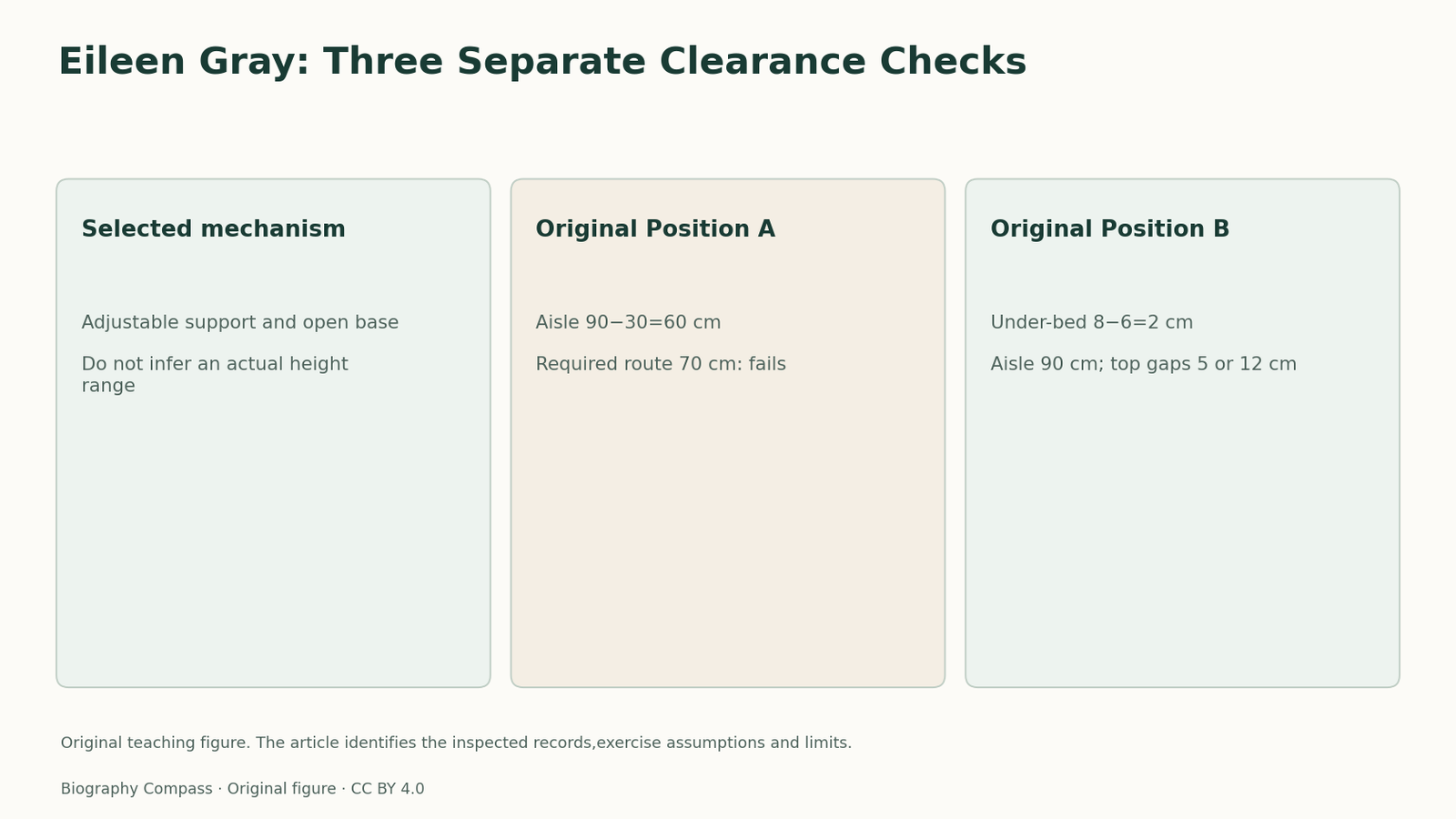
Assume a bed surface 60 cm high, top settings 65 or 72 cm, a proposed base 6 cm high, and 8 cm of under-bed clearance. The aisle is 90 cm wide. Position A projects 30 cm into it; Position B projects nothing because the assumed base goes under the bed. Require a 70 cm route. Which position satisfies these supplied clearance conditions?
Reference answer: A leaves 90−30=60 cm, less than 70, so fails the route condition. B leaves 90 cm and has 8−6=2 cm of base clearance. Both supplied top settings exceed 60 cm, by 5 and 12 cm respectively. The model therefore permits B under either height setting. It cannot choose the more comfortable height without further requirements or establish actual historic dimensions.
Sources for this section: [1]
Turn the result into a design brief
Record what remains undecided: reach, stability, load, access needs and the furniture’s actual geometry. A revised brief can state which of these must be tested next. Keeping the assumptions visible makes the calculation useful without treating one passing clearance check as a complete design solution.
Sources for this section: [1]
Continue the chronology
Related history guides
Biography context
Explore Roquebrune-Cap-Martin, France through connected lives
Connected biographies
Follow the working life
Quick answers
Common questions
- Is the invented 6 cm base a measured E-1027 dimension?
- No. It is a supplied assumption; the exercise does not certify any original or reproduction.
Primary and institutional sources
How this history was checked
The selected IMMA page describes an object’s mechanism and possible uses. The National Museum supplies the human-use context; the new dimensions are not catalogue measurements. This article was reviewed on 31 October 2026.