
The short answer
Why can an advertisement printed for one business be held in a collection named for another, and how should the object be described?
The records answer different questions
Keep the measures separate
The question changes when the object, unit or reporting period changes.
| Record or measure | What it establishes | What it does not establish |
|---|---|---|
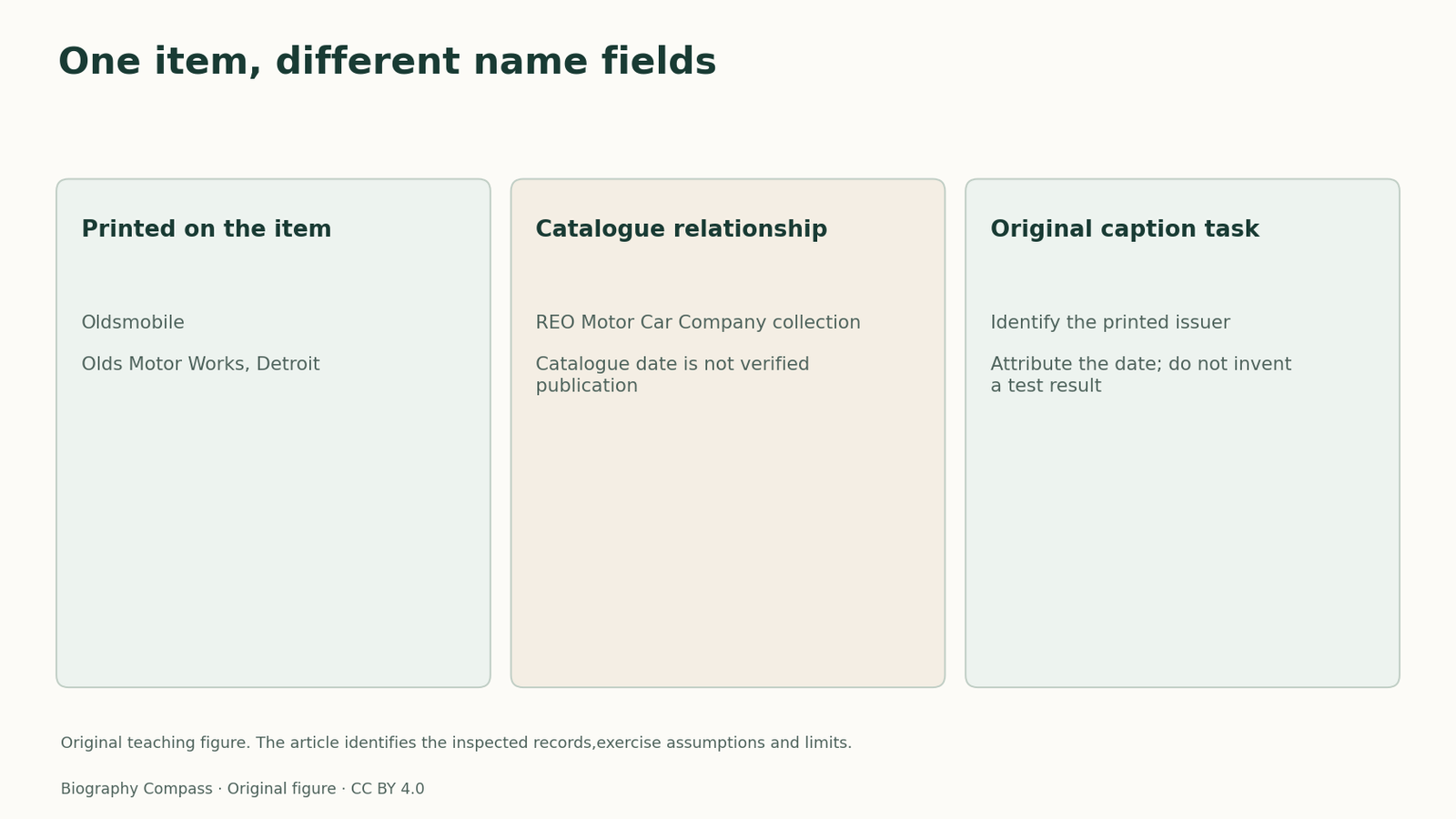
| On the item | Oldsmobile; Olds Motor Works | That every later custodian issued it. |
| In the catalogue | REO collection; 1902 date | An independently verified publication date. |
| In our caption | Attributed fields and a stated gap. | Personal authorship or a performance test. |
Chronology
A timeline of the turning points
Business stage
Olds Motor Works formed.
Object date
Attributed to the catalogue.
Another enterprise
REO established.
Read the item before its collection heading
The advertisement prints Oldsmobile and Olds Motor Works, Detroit. MSU catalogues it as A005786 with a 1902 date and relates it to the REO Motor Car Company collection. Those fields describe different relationships to one item. A collection name is not automatically the name of the organisation that issued every document inside it.
The supplied image also contains a handwritten date and signature. They are part of the surviving object; they do not by themselves establish when the advertisement was published or who wrote its prose. The study preserves the catalogue’s date as a catalogue statement rather than silently upgrading it into a verified publication date.
Sources for this section: [1]
Why the names cannot be flattened
MSU’s history distinguishes Olds Motor Works from the REO business founded after Olds’s 1904 departure. A person’s career provides a route by which records about different enterprises can come together. That does not merge their legal or commercial identities.
The advertisement claims a connection with the Louisiana Purchase Exposition at Saint Louis. It is promotional evidence of what the issuer asserted, not an independently read judging report. The visible reference is useful for further dating work; this study does not invent an exact publication day from it.
Original task: repair a caption
A learner writes: “REO published this 1902 car advertisement, written by Ransom Olds, and the world’s fair independently proved its performance.” Make a four-row correction table: product name; printed issuer; archive relation; date and claimed endorsement. Use only the object and catalogue inspected here.
Then write a short replacement caption that another researcher could safely use. Keep the catalogue date attributed, identify what is printed on the item, and separate the advertisement’s claim from the missing independent evidence. No image reproduction is needed.
Reference answer: preserve the relationships
The visible product name is Oldsmobile; the issuer is Olds Motor Works. REO is the catalogue’s collection relation, not the printed issuer. The file does not establish personal authorship or supply an independent performance test.
A defensible caption is: “An Olds Motor Works advertisement, catalogued by MSU as 1902 in its REO collection.” A following note can distinguish the stated date from verified publication and identify the promotional fair claim. This is more useful than treating every familiar name as a synonym.
For a final check, remove the founder’s name from your table. Can you still identify the item’s product, issuer and archive relation? If so, the description rests on documentary fields rather than personal-name recognition alone.
Sources for this section: [1]
Continue the chronology
Related history guides
Biography context
Explore United States through connected lives
Connected biographies
The connected careers
1864–1950
Ransom Eli Olds
Automobile manufacturerOlds developed businesses and a town project.Read biographyQuick answers
Common questions
- Does a collection name identify every item’s issuer?
- No. Custodial history and the company named on an item are different relationships.
Primary and institutional sources
How this history was checked
Read these dated records together; the original task states its own assumptions and separates them from reported facts. This article was reviewed on 31 October 2026.