
The short answer
What did the selected freezing process organise inside a package, and what additional work was needed to make a retail business?
The records answer different questions
Keep the measures separate
The question changes when the object, unit or reporting period changes.
| Record or measure | What it establishes | What it does not establish |
|---|---|---|
| Manufacturing | Package and freezing sequence | An entire later delivery route. |
| Distribution | Transport and retail equipment | The contents of a factory process log. |
| Our file | Three stipulated records. | A continuous measured history. |
Chronology
A timeline of the turning points
Process record
Patent issued.
Retail test
Springfield test marketing.
Retail equipment
Manufacturing joint venture.
The package belongs inside the process
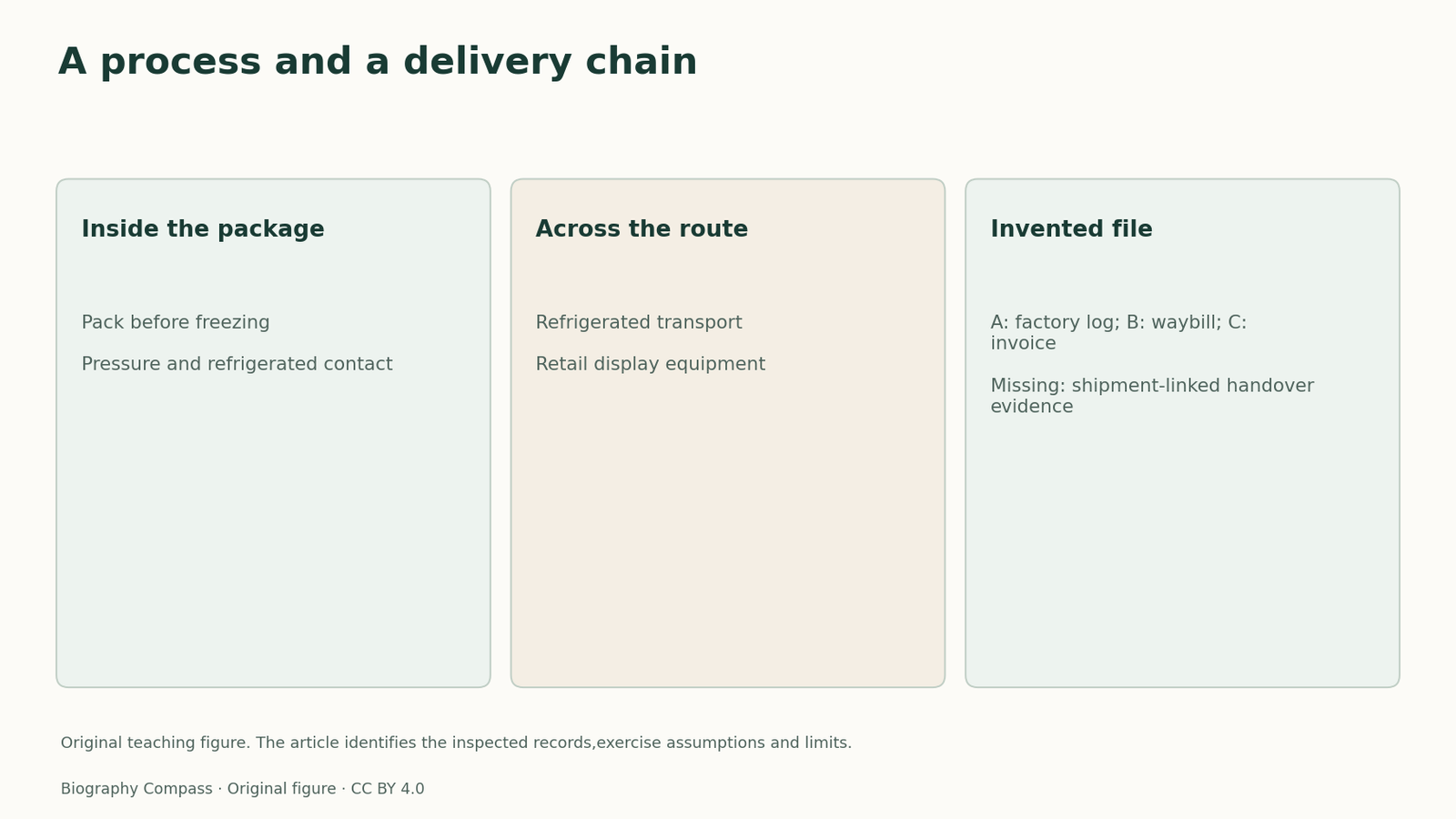
Claim 1 of the 1930 patent describes packing food in its marketing container before freezing under pressure applied to substantial surface areas. Claim 4 describes contact with refrigerated heat-conducting elements. These are descriptions of sequence and contact. They do not reduce the invention to making a room cold.
The order matters. In a process diagram, a package can be an object being acted upon rather than merely a label attached to an already finished product. Draw the actions in sequence before adding later transport or storage. This gives each record a concrete job in the explanation.
Sources for this section: [1]
The commercial route extends beyond the machine
The 1930 Springfield retail test involved refrigerated transport and leased display cases. Display-case manufacturing arrangements followed in 1934. Those records describe another layer of organisation: a product needed equipment at places its manufacturer did not simply control by operating the original freezer.
The patent and the business histories therefore answer connected but distinct questions. One describes a manufacturing arrangement; the others describe getting goods to sellers and customers. Evidence that a package completed a factory step cannot be silently extended over all later handovers. Conversely, a retailer’s equipment invoice does not show precisely how a particular batch was manufactured.
Original task: build a record graph
Use this invented file, not a historical shipment. Card A is a factory log recording packing followed by pressure-freezing. Card B is a waybill naming a refrigerated railcar. Card C is an invoice for a display case at a shop. Draw three nodes and label what each card directly records. Then assess the proposed sentence: “These three cards prove uninterrupted temperature control throughout this shipment.”
Choose one additional kind of record that would help test that sentence. Explain the missing link rather than inventing a reassuring temperature or assuming that buying equipment proves its use. The task concerns documentary support, not the edibility of any product.
Reference answer: connect, but do not fill gaps
A addresses the packing-before-freezing sequence; B identifies a transport arrangement; C identifies equipment purchased for a retailer. None supplies a continuous shipment-specific temperature record or documents every transfer. The proposed sentence goes beyond the supplied file.
A dated transport log or handover record tied to the same shipment could help connect two nodes. It would still need to be read for its own period, identifier and measurement method. The better research note states which link the new evidence supports; it does not replace one overstatement with a claim that nothing is known.
The historical lesson is practical: technical design, distribution agreements and retail equipment contribute to the same business without becoming interchangeable documents. A useful explanation shows their connections and preserves the limits of each.
Continue the chronology
Related history guides
Biography context
Explore United States through connected lives
Connected biographies
The connected careers
Quick answers
Common questions
- Do the invented cards establish product safety?
- No. They test a documentary inference and contain no basis for a present food-safety assessment.
Primary and institutional sources
How this history was checked
Read these dated records together; the original task states its own assumptions and separates them from reported facts. This article was reviewed on 31 October 2026.