
The short answer
How should an Oblation be credited when several campus statues share an original design but have different makers, materials and dates?
Compare the records
Which claim does the record support?
Keep the object, event and credited role distinct when combining these records.
| Record | What it records | What follows |
|---|---|---|
| CCP object history | Original 1935 concrete; later 1958 bronze | A design date and a cast’s production history are different. |
| UP protocol Appendix E | Different makers, materials and dates | Credit the particular campus version as well as the original design. |
| Fictional database repair | Four identical rows | Retain distinct cast credits; do not invent the Manila date. |
Chronology
A timeline of the turning points
Original Oblation
Tolentino’s painted-concrete work was installed in Manila.
Bronze version
The later bronze was unveiled in Diliman.
Abueva casts
The handbook dates Los Baños and Miag-ao concrete casts.
Protocol handbook
Appendix E records the four compared campus examples.
Begin with the original design and its material
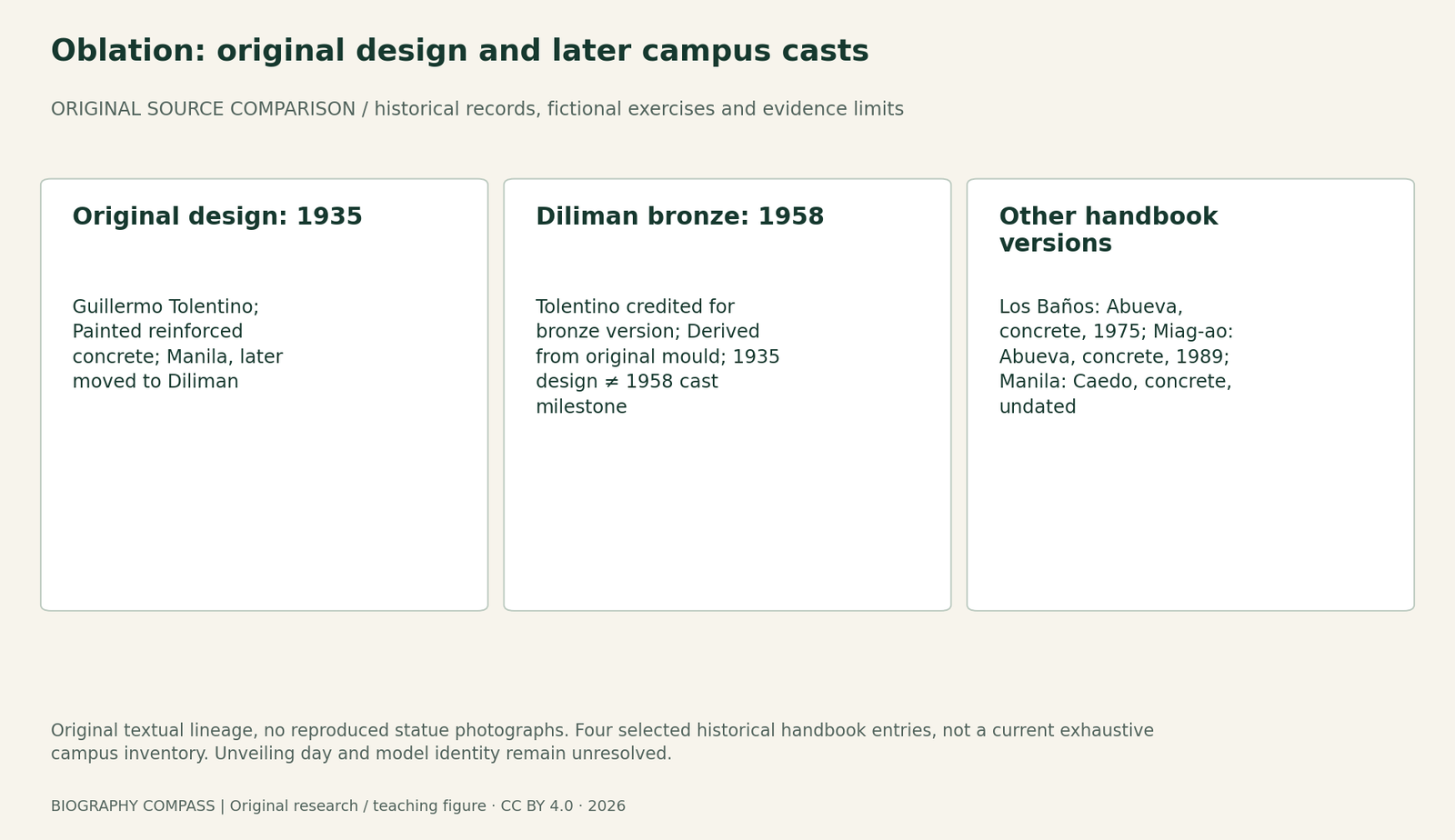
CCP’s object history identifies Guillermo Tolentino as the artist of the original Oblation, completed in 1935. It describes painted reinforced concrete, rather than a bronze original. UP’s sites account also identifies concrete treated to resemble bronze. This matters because appearance, material and design are separate catalogue fields. A bronze-looking surface does not by itself identify a bronze casting. The original design can continue to be recognised across later objects while their physical production belongs to different moments and, in some cases, other sculptors.
A later bronze has its own production history
The CCP account distinguishes the original from the bronze version unveiled at Diliman in 1958, made from a mould taken from the original. UP’s 2005 protocol handbook labels the Diliman image with Tolentino’s name, 1935 and the fact that it is a bronze cast from the original. Read together, the entries show why a work’s originating date need not be the date when a particular physical cast was made. Rather than choosing one number and discarding the other, a careful entry can distinguish the 1935 design from the 1958 bronze.
The handbook gives later makers concrete credit
Appendix E, printed page 71 of the protocol handbook, presents four campus examples. Its labels credit Napoleon Abueva for the Los Baños concrete cast dated 1975 and the Miag-ao concrete cast dated 1989. The Manila example is credited to Anastacio Caedo and gives no date. These labels preserve a relation to Tolentino’s original without erasing the sculptor named for the later version. A shared title or pose is therefore insufficient grounds for assigning every object to the same person and year. The maker and version fields need to travel with the title.
Sources for this section: [1]
Do not turn uncertain fields into invented precision
The source comparison also has limits. UP and CCP accounts differ over the exact November day of the original unveiling, although they agree on 1935. The handbook’s Manila label explicitly leaves the date unspecified. An editor should retain the year where it is secure and leave the undated cast undated. Likewise, the CCP article discusses uncertainty about the original figure’s models; no famous individual should be named as the model merely because a popular story is repeated. Reliable attribution includes the discipline to preserve an unresolved field.
An original four-entry repair exercise
A fictional database contains four rows: Diliman, Los Baños, Manila and Miag-ao. Every row currently says Tolentino, bronze, 1935. Repair the records using only the inspected sources. The worked answer is: Diliman, Tolentino, bronze version unveiled in 1958, deriving from the 1935 original; Los Baños, Abueva, concrete cast, 1975; Manila, Caedo, concrete cast, date not indicated; Miag-ao, Abueva, concrete cast, 1989. This exercise changes fields supported by the sources rather than inferring a new date from the opening of a campus or the age of a photograph.
Continue the chronology
Related history guides
Spoliarium: A Medal, a Transfer and a Later Replica
Separate Spoliarium’s 1884 medal, its 1958 transfer and a later commissioned replica, then practise writing an accurate caption from institutional records.
Read the timeline1983–2015Reading Kasilag’s Concerto Record: Works, Tracks and Credits
Read the original Kasilag concerto booklet to distinguish works, movements, performers and recording dates, with a worked timing and catalogue exercise.
Read the timelineBiography context
Explore Philippines through connected lives
Guillermo Tolentino
Guillermo Tolentino developed a classical sculptural practice through study in Manila, the United States and Rome. His monuments, portraits and teaching made him a major presence in Philippine public art and university life.
Explore the biographiesArtist biographyNapoleon Abueva
Napoleon Abueva worked across wood, stone, metal and other materials, making sculptures for museums, campuses, buildings and public spaces. His training joined classical representation with a sustained openness to abstract forms.
Explore the biographiesConnected biographies
Artists and their working lives
1890–1976
Guillermo Tolentino
Sculptor and fine-arts teacherGuillermo Tolentino developed a classical sculptural practice through study in Manila, the United States and Rome. His monuments, portraits and teaching made him a major presence in Philippine public art and university life.Read biography1930–2018
Napoleon Abueva
Sculptor and teacherNapoleon Abueva worked across wood, stone, metal and other materials, making sculptures for museums, campuses, buildings and public spaces. His training joined classical representation with a sustained openness to abstract forms.Read biographyQuick answers
Common questions
- Does the 1935 label make the Diliman bronze a bronze cast made in 1935?
- No. CCP separately dates the bronze unveiling to 1958. The shared 1935 reference belongs to the originating work.
- Does this identify a single model for the original figure?
- No. The selected CCP account does not establish one named model; the guide makes no such attribution.
Primary and institutional sources
How this history was checked
Compare the original institutional records and participant accounts, with attention to the dates, objects and roles each one identifies. This article was reviewed on 28 October 2026.