
The short answer
How many works does the six-track concerto release contain, who does what, and which of its dates actually describes the recording?
Compare the records
Which claim does the record support?
Keep the object, event and credited role distinct when combining these records.
| Record | What it records | What follows |
|---|---|---|
| Track grouping | Three movements under each of two work titles | Six track entries do not mean six concertos. |
| Production credit | Violinist, orchestra and conductors | Roles differ from authorship of a composition. |
| Date fields | 1983 recording; 1984 foreign performance; 1986/2015 notices | Preserve the event described by each date. |
Chronology
A timeline of the turning points
Recording session
The booklet identifies the CCP Main Theatre session.
Performance abroad
The booklet identifies Moscow with soloist Grigory Zhislin.
Rights notices
The package prints separately labelled phonogram and copyright years.
A recording can contain fewer works than tracks
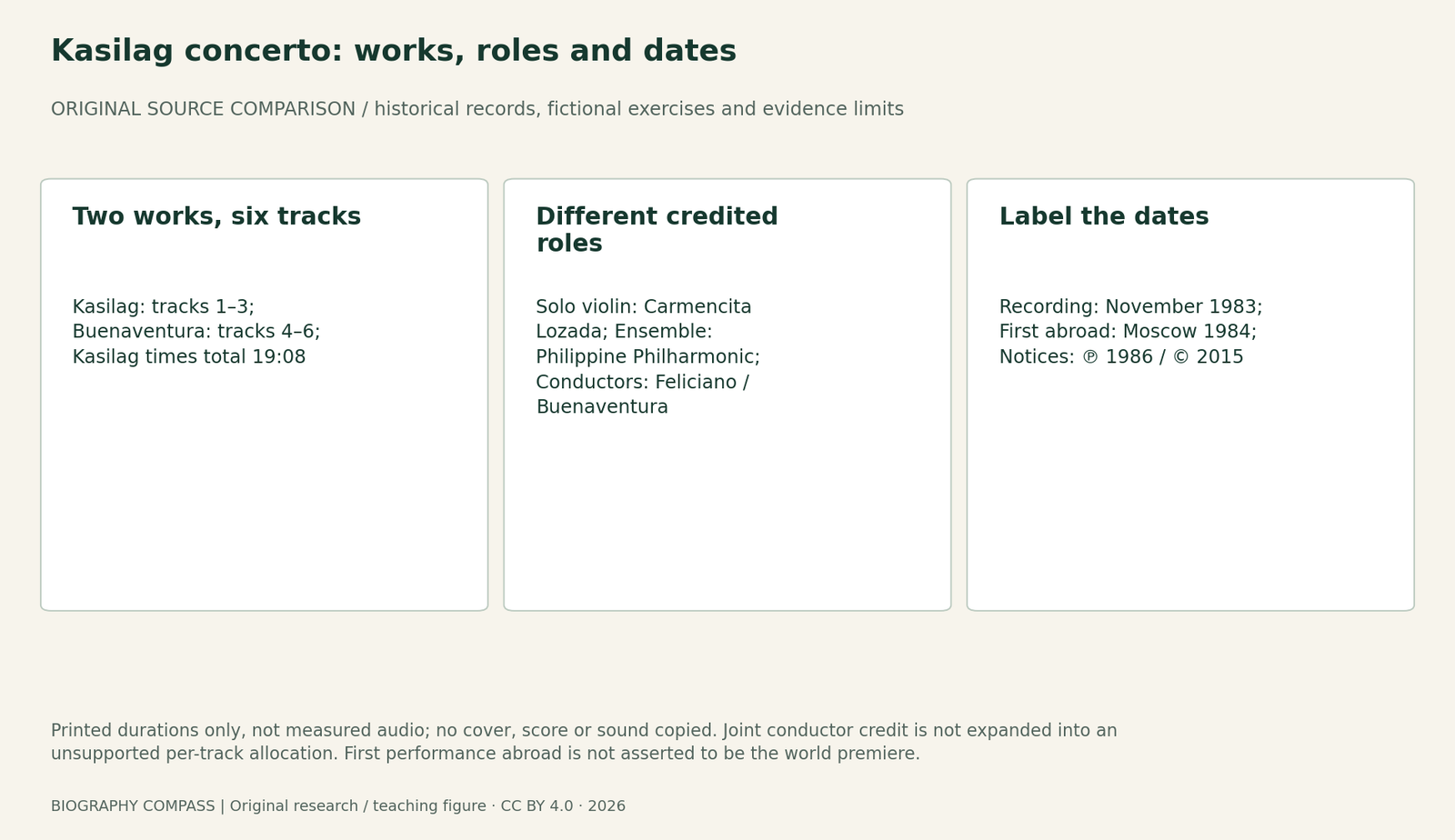
The Marco Polo booklet for catalogue 8.220419 groups six tracks under two compositions. Tracks one to three belong to Kasilag’s Violin Concerto, LK 241; tracks four to six belong to Alfredo Buenaventura’s concerto Lakambini. The movement headings sit beneath their respective work titles. A list of six track numbers therefore does not establish six independent concertos. Before counting a release, identify whether the requested unit is the album, the composition, a movement or an individual recorded track. Each is useful, but they answer different questions.
Sources for this section: [1]
Read credits as roles within a particular production
The label identifies Carmencita Lozada as violin soloist and the Philippine Philharmonic Orchestra as the ensemble. Francisco Feliciano and Alfredo Buenaventura appear as conductors. Kasilag’s name identifies the composer of one work; Buenaventura has both compositional and conducting credit on the release. The printed joint conductor line alone does not allocate every individual track between the two conductors. A role-based record can preserve the information actually supplied without turning the soloist into the composer or guessing a complete session-by-session assignment.
Sources for this section: [1]
Recording, performance and rights dates answer different questions
The production credits date the recording at the CCP Main Theatre to November 1983. The booklet separately describes a first performance abroad in Moscow in 1984, with Grigory Zhislin as soloist, followed by Beijing in 1985 with Lozada. A first performance abroad is not a claim about the world premiere. The package also carries a 1986 phonogram notice and a 2015 copyright notice. These dates should retain their labels. Neither a rights year nor a later publication notice automatically replaces the explicitly stated recording date.
Sources for this section: [1]
Compare the booklet with a wider biographical record
The heritage library describes Kasilag’s education, teaching, cultural administration and interest in bringing Philippine and Western musical resources into conversation. Keith Anderson’s label notes concern a much narrower object: a specific work and its recorded presentation. The sources therefore serve different scales of description. A general statement about a composer’s interest in indigenous instruments is not a list of instruments used in every composition. Here the inspected production credits support violin and orchestra; they do not warrant inventing a traditional-instrument part that the selected record does not specify.
An original timing exercise with a worked solution
Using the printed Kasilag movement times, calculate the combined duration: 5:36, 6:47 and 6:45. Convert them to seconds before adding: 336 + 407 + 405 = 1,148 seconds, or 19:08. For the other concerto, 13:09 + 6:50 + 5:32 gives 1,531 seconds, or 25:31. Together the six printed track times total 44:39. These are sums of label timings, not durations independently measured by listening. They also do not establish how much silence, indexing space or other material a particular playback edition might add between tracks.
Sources for this section: [1]
Repair a fictional record without inventing a listening review
A fictional library entry says: Six Kasilag concertos, composed and played by Lozada, first performed in 2015. A worked repair reads: Two violin concertos, one by Kasilag and one by Buenaventura, presented across six tracks; Lozada is the credited violinist; the recording is dated November 1983. Retain the 1984 first-foreign-performance statement separately, with its different soloist. The resulting card is more useful because it preserves the levels of work, production and event. Our diagram contains original credit boxes, track-group arithmetic and labelled dates; it copies no cover art, notation or recorded sound.
Continue the chronology
Related history guides
Spoliarium: A Medal, a Transfer and a Later Replica
Separate Spoliarium’s 1884 medal, its 1958 transfer and a later commissioned replica, then practise writing an accurate caption from institutional records.
Read the timeline1935–2005The Oblation: Original Design, Later Casts and Sculptor Credit
Use UP’s protocol handbook and CCP’s object history to distinguish the original Oblation from later casts, their dates, materials and credited sculptors.
Read the timelineBiography context
Explore Philippines through connected lives
Connected biographies
Artists and their working lives
1918–2008
Lucrecia Kasilag
Composer, pianist and music educatorLucrecia Kasilag combined composition with teaching, performance and cultural administration. Her career connected family music-making, conservatory study and institutional work with an interest in relationships between Philippine and Western musical resources.Read biographyQuick answers
Common questions
- Was the recording listened to for this guide?
- No. The booklet’s text, credits and printed durations were inspected. The timing exercise adds those printed values.
- Does the 1984 Moscow date establish the world premiere?
- No. The booklet specifically describes the first performance abroad; it does not make that broader claim.
Primary and institutional sources
How this history was checked
Compare the original institutional records and participant accounts, with attention to the dates, objects and roles each one identifies. This article was reviewed on 28 October 2026.