
The short answer
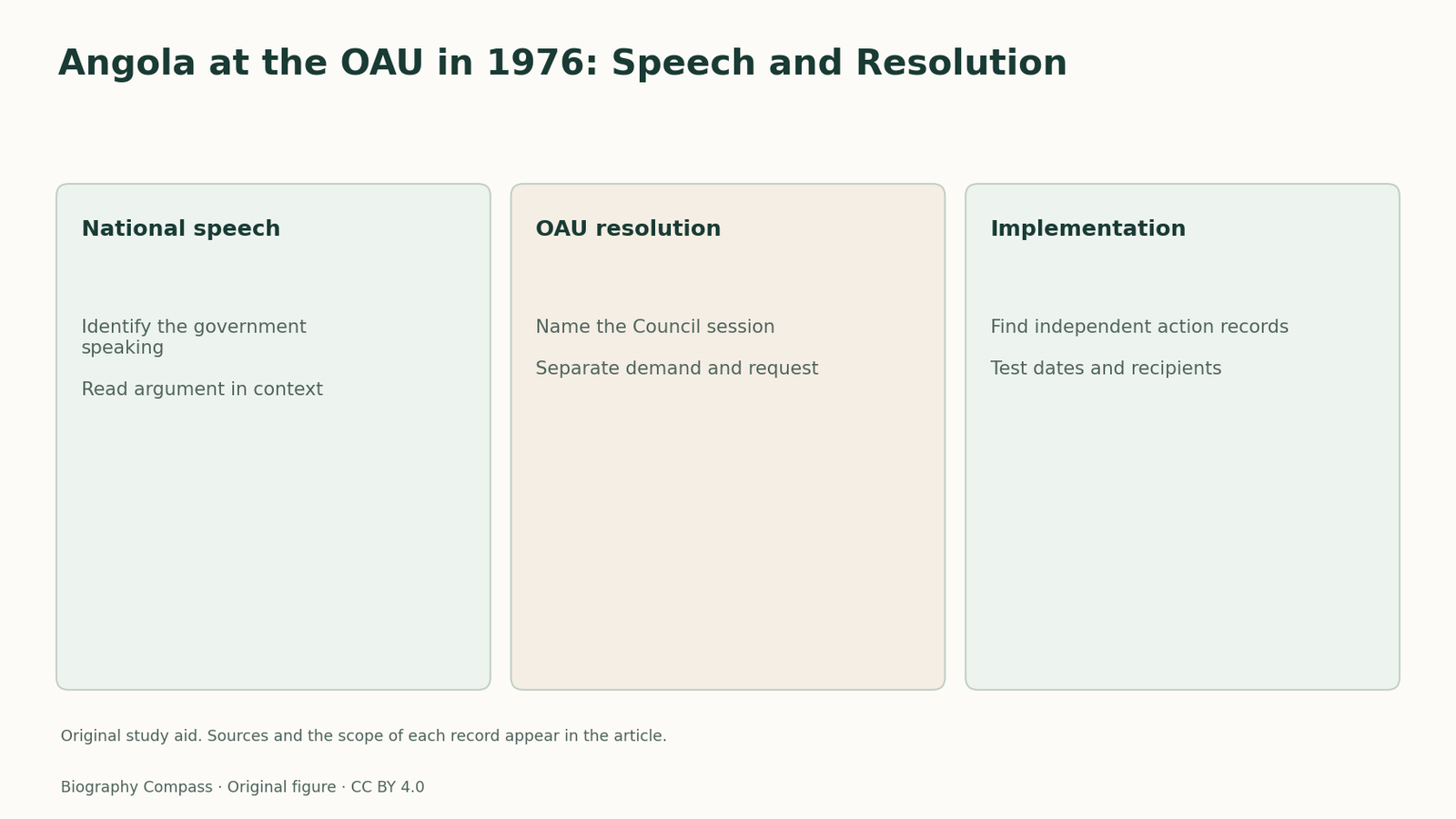
A speech can argue for an organisation to act. A resolution can record an institutional position. In 1976 the two appeared at different OAU meetings about Angola.
Evidence and interpretation
What each record can establish
Read each record in the context in which it was produced.
| Record | Evidence it supplies | Limit of inference |
|---|---|---|
| January speech | Nigeria’s public argument and intended audience | An OAU decision or actual delivery |
| Council resolution | The Council’s demands and requests | Compliance by every named party |
| Delivery or withdrawal record | A dated action on the ground | What all speakers intended |
Chronology
A timeline of the turning points
Nigeria’s address
Mohammed speaks at the extraordinary session in Addis Ababa.
Council of Ministers session
The Council records its resolution concerning Angola.
Identify the speaking voice
The January address presents Angola as a question of liberation and opposition to external intervention. Mohammed was speaking as Nigeria’s head of state before other governments. Its forceful language helps identify what he wanted the organisation to recognise. It is direct evidence of Nigeria’s public diplomatic case in that speech, while a claim about the decision of the OAU as a whole needs a different record.
Sources for this section: [1]
Read the collective instrument
The Council of Ministers resolution CM/Res. 454 came from a later ordinary session. It demanded the withdrawal of South African forces and requested several kinds of assistance to Angola. Its verbs give readers a way to sort different actions. A demand addressed to a military power, a request to member states and a recommendation concerning United Nations admission are distinct even within the same resolution.
Sources for this section: [2]
Use contemporary analysis with care
An American assessment prepared before the January meeting considered how South African involvement might affect the negotiating positions of states that recognised the MPLA government. Its uncertainty belongs to the moment when it was written. Place it in a column for expectations, alongside the speech as advocacy and the later resolution as a recorded position. None of the three establishes by itself what assistance was delivered.
Sources for this section: [3]
Make a three-part record
Write one sentence describing Nigeria’s stated position, another identifying a demand in the Council resolution and a third naming a record that would demonstrate implementation. In the last sentence seek an observable act, such as a dated withdrawal report or a delivery record. This exercise prevents the rhetoric of agreement from substituting for evidence of compliance.
Continue the chronology
Related history guides
Biography context
Explore Nigeria through connected lives
Connected biographies
People behind the records
1938–1976
Murtala Mohammed
Army officer and military head of stateMohammed led Nigeria for less than seven months, announced a programme for civilian transition and addressed the OAU on Angola.Read biographyQuick answers
Common questions
- Did the January speech itself establish the later Council resolution?
- The speech and resolution come from different meetings. The latter is a separate institutional record.
Primary and institutional sources
How this history was checked
The records below support the chronology and the evidence comparison. The reading exercise is original. This article was reviewed on 5 November 2026.
- Murtala Mohammed, speech transcriptionAfrica Has Come of Age, 11 January 1976
- Organisation of African Unity, African Union archivesOAU Council of Ministers, CM/Res. 454 (XXVI)
- Foreign Relations of the United States, Office of the HistorianIntelligence memorandum on Angola and the approaching OAU meeting