
The short answer
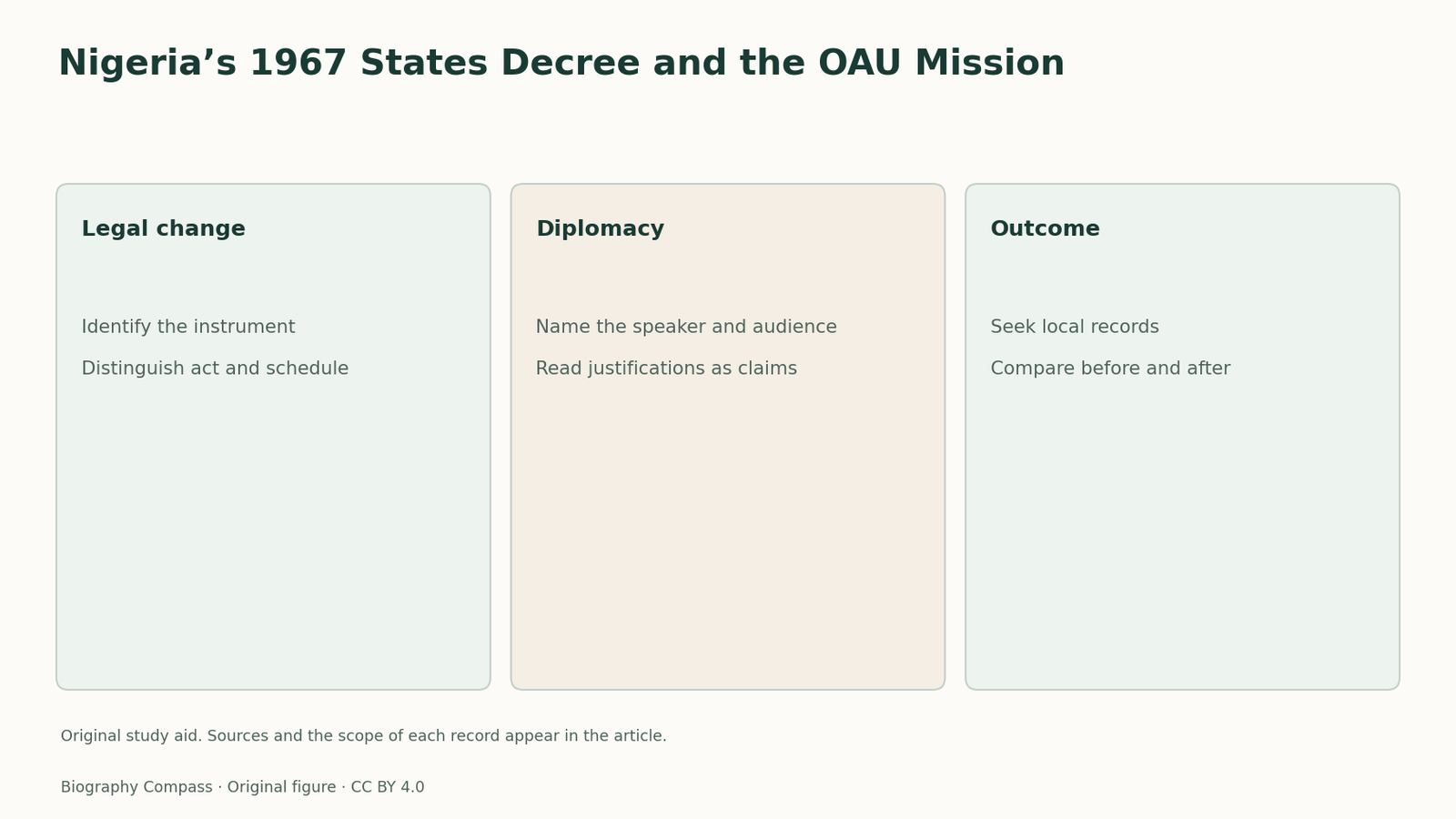
The text creating a state, a schedule defining its territory and a speech explaining the change serve different purposes, even when preserved in one publication.
Evidence and interpretation
What each record can establish
Read each record in the context in which it was produced.
| Record | Evidence it supplies | Limit of inference |
|---|---|---|
| Decree | A legal reorganisation of federal units | How residents experienced it |
| Territorial schedule | The land assigned to particular units | Why political leaders chose it |
| Address and outside assessment | Arguments and contemporary interpretations | Independent proof that intended effects followed |
Chronology
A timeline of the turning points
States creation decree
The federal government replaces four regions with twelve states.
OAU mission
Gowon addresses a consultative mission in Lagos.
Begin with the decree and schedule
Decree No. 14 of 1967 established the states framework. The National Library’s catalogue of the OAU mission publication identifies the decree and its territorial schedule as separate components. For a legal or geographical claim, the schedule is the place to check which territory was assigned to a named unit. The number of states does not itself give their boundaries or later adjustments.
Put the explanation in its setting
The same publication contains Gowon’s welcome address to the OAU mission. The catalogue describes his case that a twelve-state structure would respond to minority fears and problems with the former regions. That identifies the case put to a diplomatic audience during a war. A stated purpose does not demonstrate how communities experienced the new division or whether a proposed benefit was achieved.
Sources for this section: [1]
Add a contemporary outside reading
A 1970 United States assessment describes the move from four regions to twelve states and discusses it as part of the struggle over federal power. It is useful as evidence of how an external office assessed the arrangement after the war. It was also written for a different audience. Do not use the assessment as a substitute for a decree or as a survey of Nigerian opinion.
Sources for this section: [2]
Build an evidence key
List one claim about the number of units, one about a boundary, one about the government’s justification and one about an effect on residents. Assign each claim a type of document that could support it. If a claim about effects ends up beside only a speech or a legal schedule, leave the conclusion open until local or administrative evidence is available.
Continue the chronology
Related history guides
Biography context
Explore Nigeria through connected lives
Connected biographies
People behind the records
Born 1934
Yakubu Gowon
Army officer and military head of stateGowon led Nigeria’s federal military government during the civil war and its first years of postwar reconstruction.Read biographyQuick answers
Common questions
- Why read the territorial schedule separately?
- It identifies the territory attached to named states. A speech can give reasons for reorganising without providing that legal detail.
Primary and institutional sources
How this history was checked
The records below support the chronology and the evidence comparison. The reading exercise is original. This article was reviewed on 5 November 2026.