
The short answer
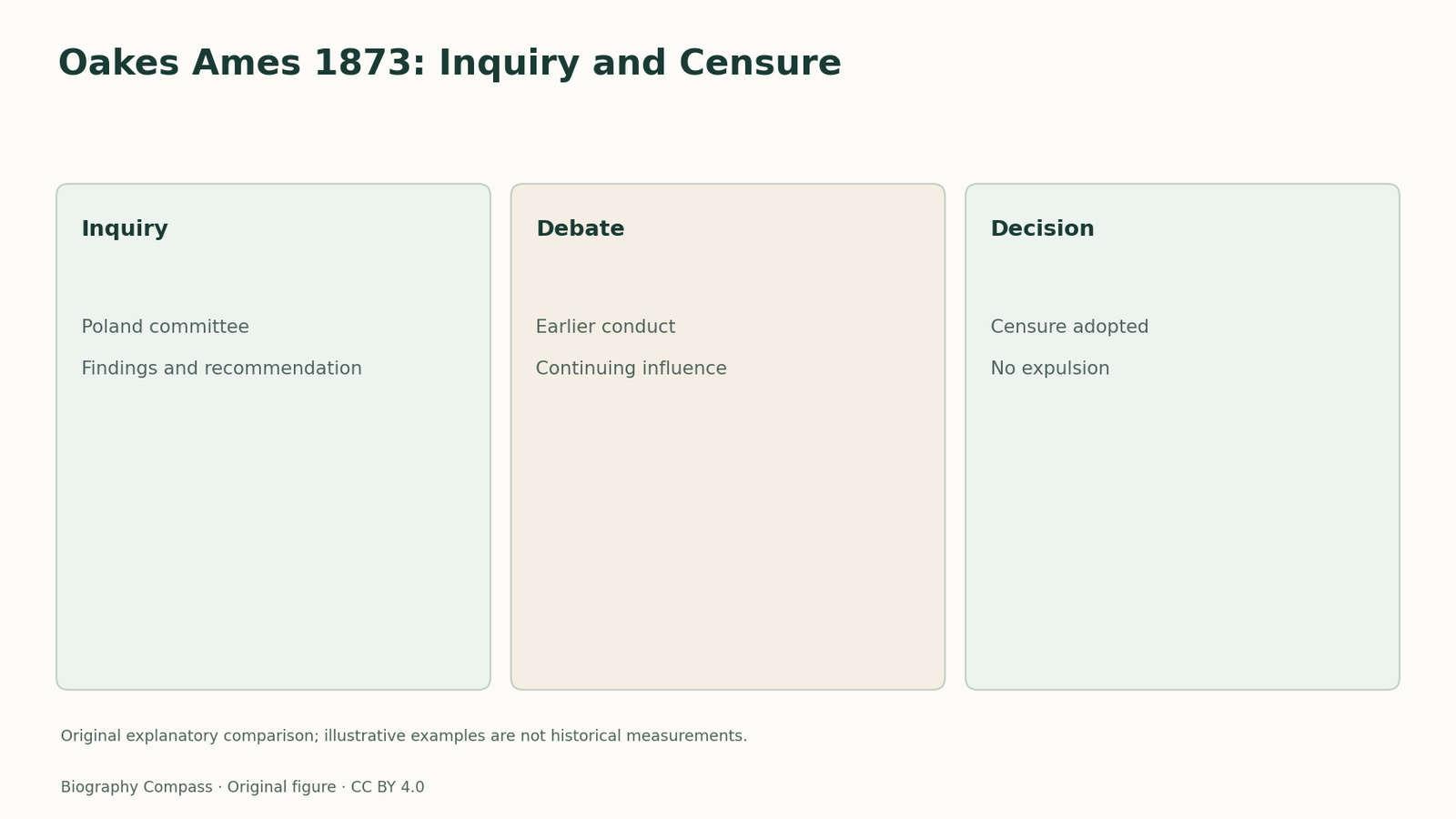
The 1873 Crédit Mobilier inquiry produced a recommendation that is often confused with the House’s final action. Hinds’ Precedents, section 1286, reproduces the committee’s proposed expulsion resolutions and summarises the subsequent proceedings. The committee alleged that Oakes Ames sold stock below its true value with an intention to influence congressional decisions. A reader must identify whose conclusion this was and what action followed. The useful comparison is between the committee’s findings, its proposed remedy and the separate resolution ultimately adopted by the chamber.
A worked comparison
What each part contributes
Use the specific distinctions developed in the study.
| Part or record | What it establishes | Why the distinction matters |
|---|---|---|
| Committee finding | 18 February report | Alleged motive and stock transactions |
| Proposed remedy | Expulsion | Recommendation, not completed action |
| House decision | 27 February censure | Condemnation without expulsion |
Recommendation and decision are different records
The 1873 Crédit Mobilier inquiry produced a recommendation that is often confused with the House’s final action. Hinds’ Precedents, section 1286, reproduces the committee’s proposed expulsion resolutions and summarises the subsequent proceedings. The committee alleged that Oakes Ames sold stock below its true value with an intention to influence congressional decisions. A reader must identify whose conclusion this was and what action followed. The useful comparison is between the committee’s findings, its proposed remedy and the separate resolution ultimately adopted by the chamber.
Sources for this section: [3]
How the committee was appointed
On 2 December 1872, Speaker James G. Blaine left the chair and addressed allegations involving himself and other members. Samuel S. Cox, occupying the chair, appointed the investigating committee, headed by Luke Poland. This procedural detail matters because it shows an attempt to separate the implicated Speaker from selecting the investigators. It does not prove that every subsequent finding was uncontested. Hinds identifies changes in committee membership as well as the resolution’s purpose: to determine whether members had been bribed in connection with the companies.
Sources for this section: [3]
The question of an earlier Congress
The transactions preceded the election of the current House. The investigating committee argued that their intended influence was continuing, because railway matters could come before future Congresses. A Judiciary Committee report took a different view of the relationship between expulsion and earlier conduct. The disagreement was therefore not simply whether shares existed. It also concerned the chamber’s jurisdiction, the relationship between voters and representatives, and the meaning of a remedy designed to protect the House. These are arguments recorded in the proceedings, rather than a single unanimous constitutional judgment.
Sources for this section: [3]
Reading the final action
The House’s official biographical entry records censure on 27 February 1873, while Hinds explains why the proposed expulsion was not the outcome. In the adopted Ames resolution, the House condemned seeking to obtain congressional attention and favour through the stock transactions. A censure expresses institutional condemnation without removing the member from his seat. Ames’s term ended on 3 March. Combining the committee’s recommendation with the end of that term would produce the false claim that he had been expelled shortly before leaving Congress.
A document-order exercise
Arrange three statements in order: a newspaper controversy prompts investigation; a committee recommends expulsion; the House adopts censure. The correct sequence is allegation and inquiry, recommendation, then final action. Now ask which document supports “Ames was expelled.” None of those stages supports that sentence, because the final action was censure. This exercise also explains why the article does not reconstruct every disputed individual stock account from a procedural digest. The inspected source supplies the institutional decision trail; a full financial reconstruction would require the underlying testimony and accounts.
Continue the chronology
Related history guides
Union Pacific: Construction and Finance
Separate federal assistance, railway capital and contractor payments in Union Pacific construction using the original 1862 statute and institutional records.
Read the timeline1863–1865Jay Cooke: Selling Civil War Bonds
Compare Cooke’s 1863 bond circular with the 1865 agency form to understand local distribution, advertising obligations and restrictions on commissions.
Read the timelineBiography context
Explore United States through connected lives
Connected biographies
People and wider context
1804–1873
Oakes Ames
manufacturer and United States representativeOakes Ames was a manufacturer and United States representative, known for Ames shovel business and the Crédit Mobilier censure.Read biographyQuick answers
Common questions
- Was Oakes Ames expelled from the House in 1873?
- No. The committee recommended expulsion, but the House censured him on 27 February 1873. His term ended on 3 March.
Primary and institutional sources
How this history was checked
Read the cited original records, institutional accounts and later interpretations. The comparison and exercise explain the specific evidence used in this study. This article was reviewed on 8 November 2026.