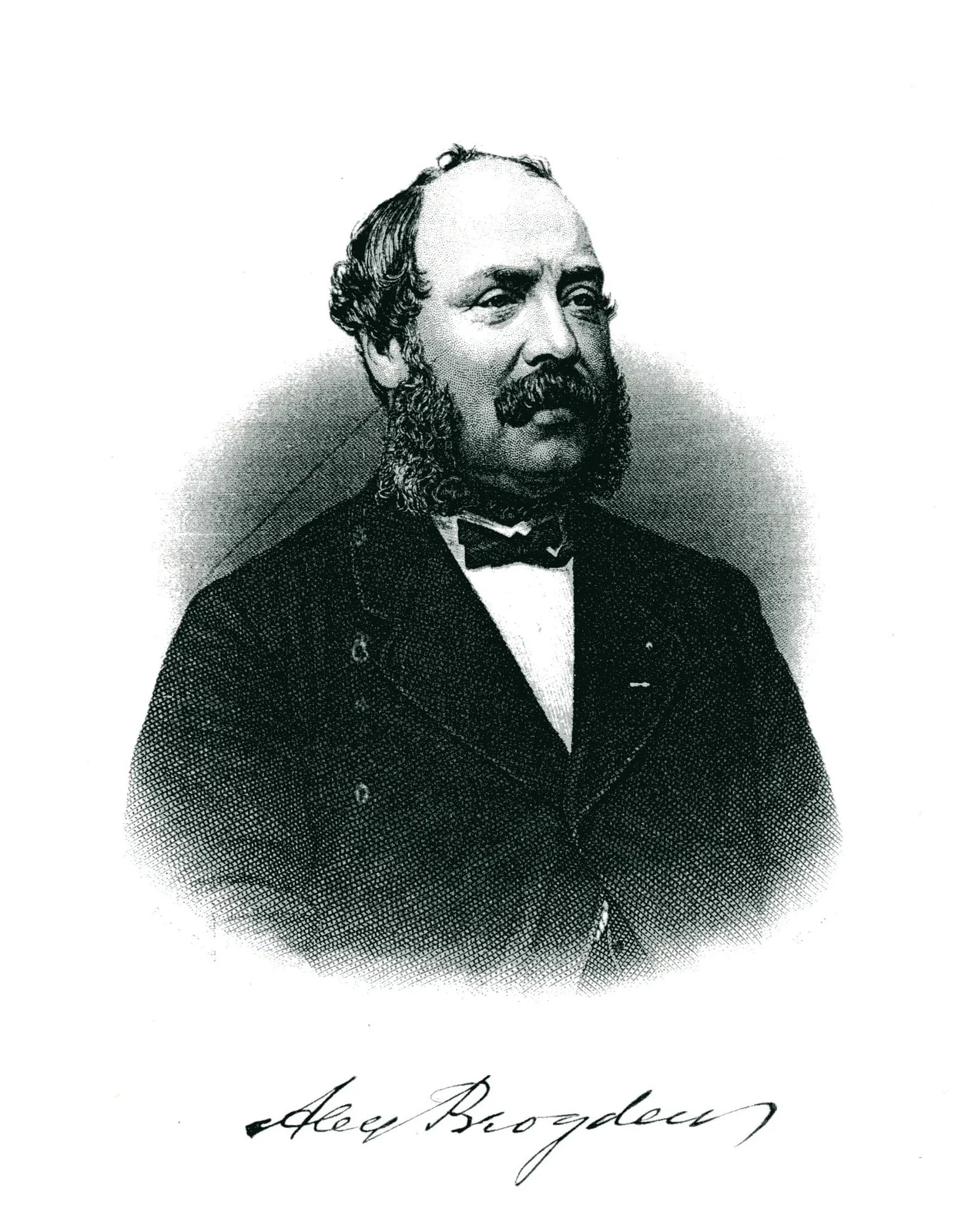
In this biography
Quick facts
- Born
- 10 January 1804
- Died
- 8 May 1873
- Birthplace
- Easton, Massachusetts
- Country
- United States
- Nationality
- Not independently established
- Known for
- Ames shovel business and the Crédit Mobilier censure
- Known for
- Ames shovel business and the Crédit Mobilier censure
- Life
- 1804–1873
Why this life matters
Ames shovel business and the Crédit Mobilier censure.
Timeline
Key moments
The shovel manufacturer
Oakes Ames grew up in Easton, Massachusetts, where his family developed a major shovel-manufacturing business. His father Oliver Ames established the enterprise; Oakes and his brother, also named Oliver, expanded its commercial reach. The nineteenth-century Appletons biography connects demand with western mining and the Civil War. His industrial experience preceded his best-known financial controversy. Understanding that manufacturing career explains why contemporaries associated the Ames name with tools and employment as well as railroad investment, construction and congressional discipline.
Sources for this section: [1]
Congress and railway capital
Ames served Massachusetts in the United States House from 4 March 1863 to 3 March 1873, according to the House’s official biography. That corrects the earlier starting year given by Appletons. He became deeply involved in financing the Union Pacific and in Crédit Mobilier, the construction company whose stock transactions produced a national scandal. These positions created a public-interest problem: a sitting legislator was handling interests connected with a railroad dependent on congressional legislation and federal assistance.
Investigation and censure
The House investigated the stock dealings after public allegations in 1872. A committee chaired by Luke Poland reported on 18 February 1873 and recommended expulsion of Ames and James Brooks. The eventual House action on 27 February censured them instead. Hinds’ Precedents reproduces the competing reasoning about conduct before election and the chamber’s authority to discipline members. Ames was therefore censured, not expelled, and the distinction is central to describing both his congressional record and the disputed institutional response.
Death and later rehabilitation claims
Ames died on 8 May 1873, only months after the House proceedings. His industrial and railway contributions remained important to supporters who considered the congressional treatment unjust. Appletons records a later Massachusetts legislative resolution favourable to him, but a state’s posthumous statement did not undo the House vote. His biography requires room for both the scale of the enterprise he supported and the conflict created by offering advantageous interests to legislators. Neither industrial accomplishment nor later commemoration removes the need to read the disciplinary record precisely.
Quick answers
Frequently asked questions about Oakes Ames
- Was Oakes Ames expelled from the House in 1873?
- No. The committee recommended expulsion, but the House censured him on 27 February 1873. His term ended on 3 March.
Keep exploring
Lives connected to this story
- Thomas Clark Durant
Read Thomas Clark Durant’s separate career to compare congressional inquiry and financial conflict with Union Pacific construction and the Crédit Mobilier.
- Jay Cooke
Read Jay Cooke’s separate career to compare congressional inquiry and financial conflict with Civil War bond distribution and Jay Cooke & Co..
Sources and further reading
Explore the evidence
These references support the biography and offer further reading. Official records, first-person accounts and independent reporting provide different perspectives; image records document attribution and licensing.
- 1. Appletons’ Cyclopædia of American BiographyAmes, Oakes
The committee recommended expulsion, but the House adopted censure. Hinds reproduces the relevant proceedings; the entire stock-testimony volume has not been read.
- 2. United States House of RepresentativesOakes Ames official biography
- 3. United States House of RepresentativesHinds’ Precedents, volume II, section 1286