
The short answer
A customer’s payment and a retailer’s revenue can be different amounts. The useful first question is what the business has promised to provide: its own products, or an arrangement connecting another supplier with a buyer. Selected operating and accounting records let us compare those obligations before adding numbers.
The records answer different questions
Keep the measures separate
The question changes when the object, unit or reporting period changes.
| Record or measure | What it establishes | What it does not establish |
|---|---|---|
| Operating model | How inventory and marketplace arrangements are described. | The amount earned on every individual contract. |
| Recognition policy | Product delivery versus arranging commission. | Profit after unspecified expenses. |
| Invented orders | Equal spending, different supplied obligations. | Actual fee rates or group results. |
Chronology
A timeline of the turning points
Operating record
The report describes four models.
Accounting record
Consolidated policy distinguishes products and arranging services.
An operating model is not an accounting answer
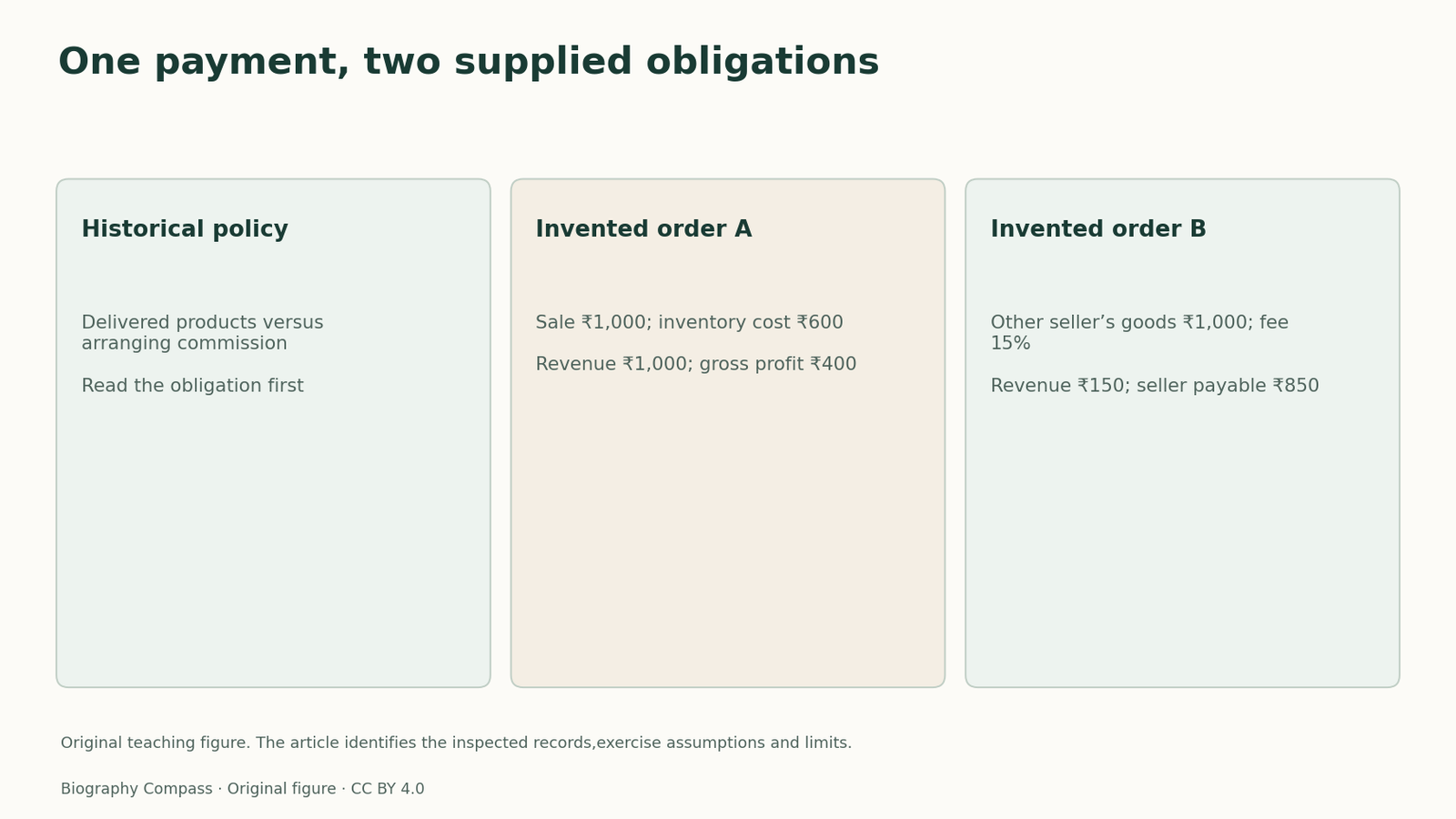
Nykaa’s FY2024–25 report lists inventory, sale-or-return, curated marketplace and just-in-time models. The same report’s consolidated policy recognises product revenue when control transfers, normally on delivery; an obligation merely to arrange another party’s supply earns the commission due.
The company describes activities across beauty, fashion and B2B. A channel label alone therefore cannot settle every accounting question. Read the contract’s obligation before choosing which amount to compare. Physical possession, the price paid by a customer and the amount earned for a service should not be treated as interchangeable labels.
Read the policy beside the business description
The policy also describes marketplace transaction and related fulfilment fees when services are rendered, generally when the underlying sale concludes. Product-sale consideration is adjusted for discounts, returns and other specified items, and excludes taxes collected for government.
These clauses answer a different question from the operating list. One describes how stock and brands can be organised; the other identifies the performance that gives rise to revenue. A comparison should retain both, rather than assuming that every order follows the most familiar retail pattern.
Sources for this section: [1]
Exercise: two explicitly simplified orders
Use invented rupee amounts and ignore tax, returns, discounts, shipping and every cost except the one supplied. Order A is an own-product sale: the product is delivered for ₹1,000 and its inventory cost is ₹600. Order B is an arranging service for another seller’s ₹1,000 product, with an invented contractual commission of 15%. Assume its service obligation is satisfied. Calculate revenue for each order, A’s gross profit, and the amount payable to B’s seller if the arranger collects the whole payment. State which comparison remains unjustified.
Reference answer: A has ₹1,000 revenue and ₹400 gross profit. B has ₹150 commission revenue and an ₹850 seller payable under the supplied cash-collection assumption. Revenue differs even though the customer spends the same amount. B’s ₹150 is not its profit: no operating costs are supplied. Nor does the exercise give actual fees, a group revenue forecast or a complete gross-merchandise-value reconciliation.
Sources for this section: [1]
A reusable reading sequence
For a new order, write four separate boxes: customer payment, promised performance, recognised revenue and remaining obligations. Fill only what the record establishes. Then list missing adjustments before making a comparison. This prevents a large customer-spend number from quietly becoming a revenue or profit number.
The original example deliberately holds spending constant to expose the effect of the promise. In a real comparison, timing and contractual detail can differ as well. The historical records here explain the selected policy; they are not personalised accounting or investment advice.
Continue the chronology
Related history guides
Biography context
Explore India through connected lives
Connected biographies
The connected careers
born 1963
Falguni Nayar
Nykaa founder and CEONayar founded Nykaa after a banking career.Read biographyQuick answers
Common questions
- Does collecting the full payment always make it revenue?
- No. First identify the promised performance and amounts owed to another party.
Primary and institutional sources
How this history was checked
Compare the dated company records with the independent or regulatory context. Original task inputs are labelled separately from reported historical measures. This article was reviewed on 31 October 2026.