
The short answer
An executed trade and its settlement occupy different points in a market process. The notation T+1 counts a qualifying day after the trade; it is not a stopwatch. A historical changeover notice gives this distinction practical force, especially when old and new cycles overlap.
The records answer different questions
Keep the measures separate
The question changes when the object, unit or reporting period changes.
| Record or measure | What it establishes | What it does not establish |
|---|---|---|
| Historical broker notice | The 2023 last-batch date and old/new trade examples. | A signed exchange circular or present universal rule. |
| Exchange explanation | Qualifying-day counting with specified exclusions. | Twenty-four elapsed hours or every withdrawal condition. |
| Invented calendar | A:T+1 Tuesday; B:Friday; A:T+2 Wednesday. | An actual holiday schedule. |
Chronology
A timeline of the turning points
Phasing
The notice dates the phased start.
Final batch
The notice dates the final migration batch.
Later explanation
The inspected exchange page includes T+0 and T+1.
A phased transition with a mixed-cycle boundary
Zerodha’s 24 January 2023 notice says phased migration began on 25 February 2022, with the final batch moving on 27 January 2023. It distinguishes purchases on 25 January under the old T+2 cycle from those on 27 January under T+1; both examples settle on the following Monday.
This is more informative than a slogan that settlement became faster. At the boundary, the trade date selects the applicable cycle, and the calendar then determines the settlement date. Two different cycles can therefore produce the same date for different trades. The broker’s notice is not itself the exchange circular linked from it.
Sources for this section: [1]
The exchange’s calendar convention
NSE’s selected settlement explanation excludes bank and exchange holidays, Saturdays and Sundays when arriving at settlement day. Its later page describes both T+1 and T+0 arrangements.
That later context is a reason to keep the 2023 example historical rather than present it as a universal 2026 instruction. A settlement-day rule is also not a promise about every customer’s withdrawal time or every exceptional delivery. The task below supplies a deliberately simple calendar and assumes ordinary successful settlement.
Sources for this section: [2]
Exercise: count open settlement days
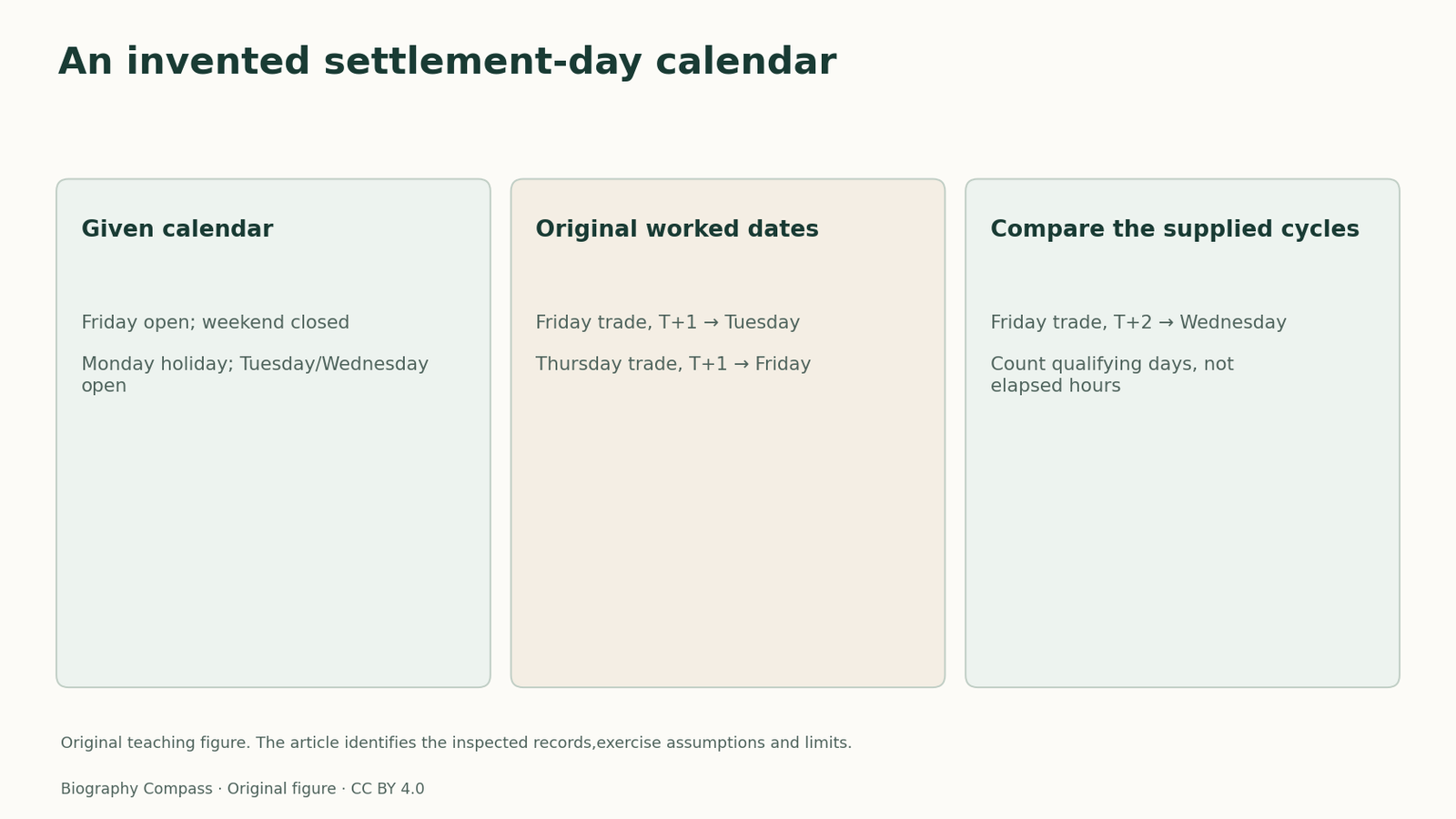
Use an invented week. Thursday and Friday are open trading and settlement days. Saturday and Sunday are closed. Monday is an invented settlement holiday; Tuesday and Wednesday are open. Trade A occurs on Friday under T+1. Trade B occurs on the preceding Thursday under T+1. For comparison, apply T+2 to trade A using the same supplied calendar. What are the three settlement days?
Reference answer: A under T+1 settles Tuesday, the first open settlement day after Friday. B settles Friday. A under T+2 settles Wednesday. The elapsed interval for A is more than 24 hours even though its cycle counts one settlement day. Monday’s closure is an exercise assumption, not a claim about a real holiday in 2023 or 2026.
Sources for this section: [2]
Separate a rule, a schedule and a service promise
A reliable explanation records four fields: trade date, applicable cycle, excluded days and resulting date. If any field is missing, mark the result conditional. Then keep customer-facing availability statements in a separate field because they may require additional operational conditions.
The historical bulletin supplies the changeover example; the exchange explanation supplies the business-day convention. The original calendar tests whether those roles have been kept distinct. No trade was placed, no clearing account inspected and no investment or current operational instruction is offered.
Continue the chronology
Related history guides
Biography context
Explore India through connected lives
Connected biographies
The connected careers

Quick answers
Common questions
- Is T+1 always exactly twenty-four hours?
- No. Settlement-day counting excludes the specified weekends and holidays.
Primary and institutional sources
How this history was checked
Compare the dated company records with the independent or regulatory context. Original task inputs are labelled separately from reported historical measures. This article was reviewed on 31 October 2026.