
The short answer
How did graphene’s Hall measurements test electronic behaviour beyond the 2004 transistor experiment?
Read the evidence
A thin film and a quantum-transport result
The context, observable and effective model must remain attached to the claim each supports.
| Record or test | What it establishes | What remains different |
|---|---|---|
| Earlier gate response | Shows controllable electrical transport in the film. | Does not by itself establish the later Hall pattern. |
| 2005 Hall measurements | Test a distinctive magnetic-field response. | Are not a direct measurement of every property of a free electron. |
| Effective Dirac description | Connects the observed electronic behaviour with a useful model. | Does not replace the material’s characteristic velocity with the vacuum speed of light. |
The magnetic-field experiment added a new test
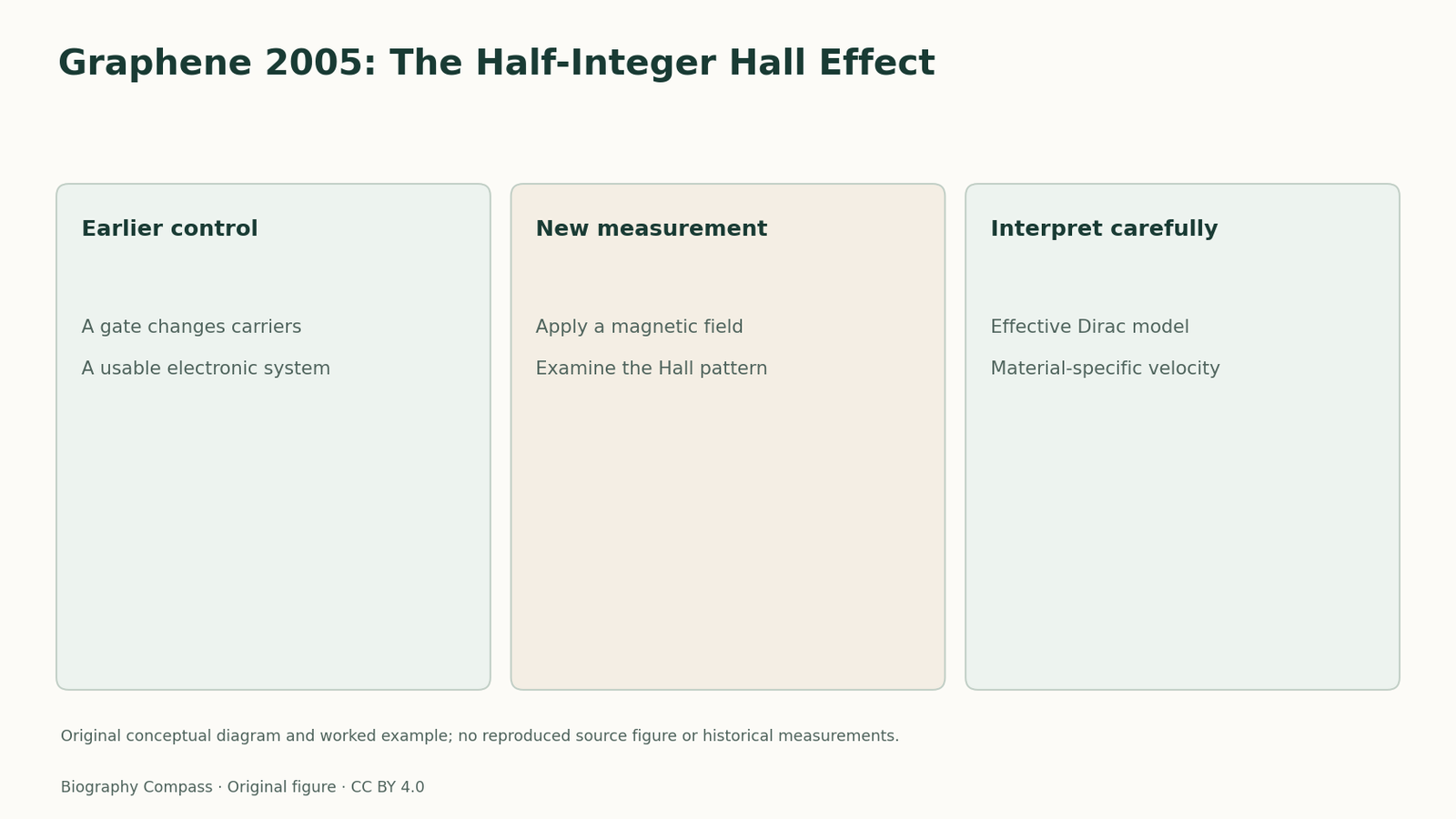
The earlier carbon-film study established useful electrical control. The 2005 paper asked a different question: how did graphene carriers behave in a magnetic field, and what model described that behaviour? Its abstract reports an anomalous integer quantum Hall effect occurring at half-integer filling factors, alongside other distinctive observations. The claim is therefore about a pattern of transport and its interpretation. It is not simply another way of saying that the sample was thin or that its current could be changed by a gate.
Sources for this section: [2]
Massless is an effective description here
The authors describe carriers that mimic relativistic particles with zero rest mass and obey a Dirac-like equation at an effective velocity far below the vacuum speed of light. That is a statement about the electronic system. It does not mean that the electron’s fundamental rest mass has disappeared everywhere or that the solid has become a miniature vacuum particle accelerator. Effective descriptions are useful because they capture the relationships relevant to a system, while retaining the distinction between an analogy in the equations and identity between all physical settings.
Sources for this section: [2]
A model needs the right observable
Novoselov’s lecture slides separate the first two-dimensional crystal, unusual electronic properties and possible applications as different parts of the research story. The 2004 gate response is a useful context for why measurements were possible, but the Hall test is what addresses the narrower magnetic-transport question here. A retrospective award description summarises the overall achievement; it cannot make those experimental stages interchangeable. This is also why a promising application does not count as a measurement of the same quantum effect.
An original analogy-check exercise
A student reads that graphene carriers behave like massless Dirac particles and writes three conclusions: an effective equation describes their transport; every property of free-space particles must be identical; no magnetic-field measurement is needed once a carbon sheet is found. Which conclusion is supported? Only the first follows from the stated model. The second confuses an effective description with complete physical identity, and the third removes the experiment that tested the specific transport claim. Now replace the third statement with a request to compare the measured Hall pattern with the model’s expectations. That is the appropriate next step. These are invented interpretation cards, not a reproduction of the original Hall data or a derivation of all its quantised values.
Continue the chronology
Related history guides
Graphene 2004: Isolation and Field Effect
Read the 2004 carbon-film experiment as both materials preparation and an electrical test, separating a thin specimen from evidence of gate-controlled carriers.
Read the timeline1928–1933Dirac’s Positron: Prediction and Observation
Compare Dirac’s 1931 anti-electron proposal with Anderson’s positive-track evidence, distinguishing theoretical properties from experimental identification.
Read the timelineBiography context
Explore United Kingdom through connected lives
Connected biographies
Researchers and related approaches
1974–
Konstantin Novoselov
Experimental physicistKonstantin Novoselov moved from Moscow through Nijmegen to Manchester, developing a research partnership with Andre Geim and experiments on graphene’s electronic behaviour.Read biographyQuick answers
Common questions
- What was unusual about graphene’s Hall effect in the 2005 paper?
- The authors reported an anomalous integer quantum Hall effect at half-integer filling factors, characteristic of their Dirac-like carrier description.
- Why distinguish the 2004 and 2005 papers?
- The first established gate-controlled electronic behaviour; the second tested further quantum transport in a magnetic field.
Primary and institutional sources
How this history was checked
The 2005 abstract carries the Hall claim; the 2004 paper provides limited context. The original exercise tests the scope of an effective-model analogy. This article was reviewed on 7 November 2026.
- Novoselov, Geim and colleagues / ScienceElectric field effect in atomically thin carbon films
- Novoselov, Geim and colleagues / NatureTwo-dimensional gas of massless Dirac fermions in graphene
- Konstantin Novoselov / Nobel Prize.orgGraphene: Materials in the Flatland, Nobel lecture slides
- Nobel Prize OutreachKonstantin Novoselov — Facts
- Nobel Prize OutreachKonstantin Novoselov — Biographical