
The short answer
How did Dirac’s hole theory differ from the experimental identification of the positron?
Read the evidence
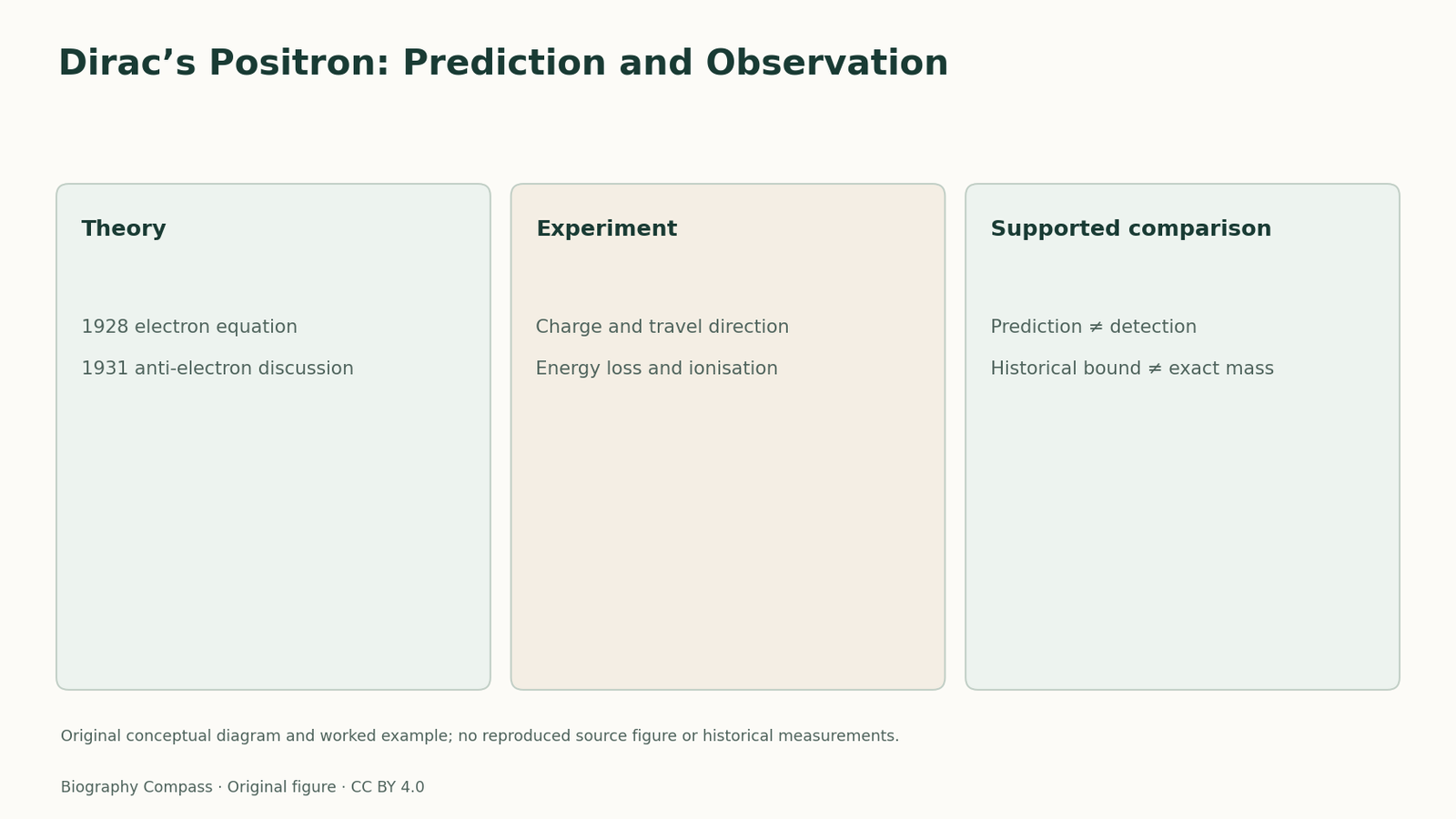
A theoretical object and an observed track
The records answer different questions about the same eventual particle identification.
| Record or test | What it establishes | What remains different |
|---|---|---|
| Dirac’s 1931 paper | Discusses an anti-electron within the theoretical interpretation. | Does not contain an experimental detection. |
| Anderson’s 1933 report | Uses chamber tracks, ionisation and energy loss to argue for a light positive particle. | Its historical mass constraints are not a modern precision mass measurement. |
| Cambridge research history | Places prediction and subsequent experiments in chronological context. | A retrospective chronology is not a substitute for the original measurements. |
The equation did not begin as a photograph
The familiar story compresses several events into one discovery. Dirac’s 1928 relativistic electron theory came before a settled interpretation of all its solutions. By 1931, his discussion of unoccupied negative-energy states explicitly introduced an anti-electron. This was a proposal about the particle content of a theory. It supplied expected relationships between charge and mass, but it did not itself produce a track in a detector. Keeping 1928 and 1931 separate makes the conceptual development visible instead of treating every later conclusion as present in the original equation.
What an early experimental report established
Anderson’s 1933 paper, following his 1932 announcement, examined cosmic-ray chamber photographs. Its abstract describes positive tracks inconsistent with a proton’s large mass and uses ionisation and energy loss to constrain their interpretation. The reported bounds were not the same thing as a modern precision determination of an electron–positron mass equality. The article is valuable precisely because it shows the observations and the argument available at that stage. A later summary may identify the particles confidently; the historical report still needs to be read in its own experimental language.
Sources for this section: [5]
Why charge sign alone is insufficient
A curved track in a magnetic field supplies information only in combination with the direction of travel and other measurements. Protons can also be positively charged. The scientific question is therefore not whether a track bends in a visually striking way, but whether alternative particle interpretations remain compatible with its curvature, energy loss and ionisation. Blackett and Occhialini’s later evidence belonged to this experimental development. The Cambridge account distinguishes their contribution from Dirac’s prediction; it does not make the researchers members of one laboratory or authors of one paper.
A claim-sorting exercise and answer
Place three invented statements beside the records: a theory permits a particle with specified properties; a detector contains a light positively charged track; the particle’s mass has been measured with arbitrarily high precision. Match each to the evidence actually described. The first belongs to the theoretical proposal. The second can be supported by the chamber investigation, subject to its measurements and alternatives. Neither record as presented supports the third. Now change the second statement to say that every positive track must be an anti-electron. That also fails: positive charge does not uniquely identify a particle species. The exercise illustrates why a successful prediction and a convincing observation are complementary achievements rather than interchangeable descriptions.
Continue the chronology
Related history guides
Feynman’s Paths: Amplitudes, Not Trajectories
Read Feynman’s 1948 path-integral formulation beside his teaching on interference, with a worked example separating amplitudes from probabilities.
Read the timeline1949–1950; retrospective lecture 1989Ramsey’s Separated Fields and Interference
Compare Ramsey’s 1950 resonance calculation with his later explanation of separated fields, including phase coherence and a worked timing exercise.
Read the timelineBiography context
Explore United Kingdom through connected lives
Connected biographies
Researchers and related approaches
1902–1984
Paul Dirac
Theoretical physicistPaul Dirac developed mathematical foundations of quantum mechanics, linking a Bristol engineering education with Cambridge research and a prediction tested by particle experiments.Read biographyQuick answers
Common questions
- Did Dirac predict antimatter in 1928 or 1931?
- The relativistic electron equation appeared in 1928; his explicit anti-electron discussion followed in 1931. Those are different stages of the theoretical development.
- Why does this topic compare a 1931 paper with a 1933 report?
- The first is the theoretical anti-electron discussion. Anderson’s 1933 article documents experimental evidence following his 1932 announcement.
Primary and institutional sources
How this history was checked
The original theoretical discussion is compared with an experimental report and Cambridge’s institutional chronology; no original detector photographs are reproduced. This article was reviewed on 7 November 2026.
- Nobel Prize OutreachPaul A.M. Dirac — Facts
- Nobel Prize OutreachPaul A.M. Dirac — Biographical
- University of Cambridge, DAMTPDirac: Biographical and Research Highlights
- P.A.M. Dirac / Proceedings of the Royal Society A; Brazilian Physical Society copyQuantised Singularities in the Electromagnetic Field (1931)
- Carl D. Anderson / American Physical SocietyThe Positive Electron (1933)