
The short answer
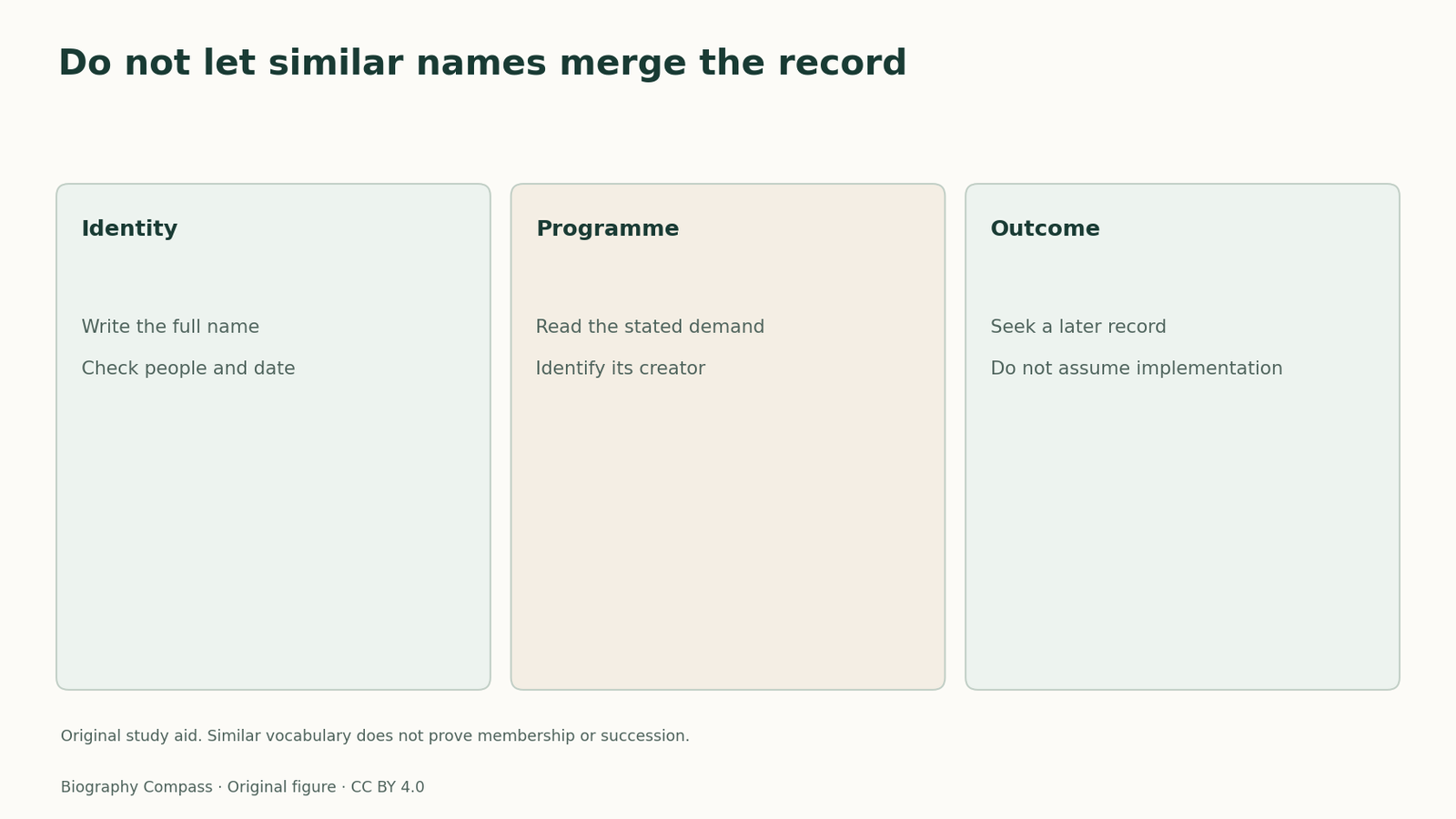
Similar abbreviations can produce a false lineage. This guide separates an organisation associated with Cissie Gool from a later movement’s declaration, then shows how to read the programme without treating a demand as an achieved reform.
Evidence and interpretation
Identify before comparing
Keep the organisation and the evidence type visible in every note.
| Record | Identification | Limit |
|---|---|---|
| United Front | 1938; linked to Gool in the cited biography | A biography does not establish every later affiliation |
| Unity Movement | 1943; associated with a separate declaration and programme | A programme is not proof that demands were achieved |
| Later history | An author’s interpretation of the movement | Perspective must be identified, not erased |
Chronology
A timeline of the turning points
United Front
SAHO identifies Gool with the Non-European United Front.
Unity Movement
A separate movement adopted a democratic programme.
Start with names, dates and people
South African History Online places Gool at the head of the Non-European United Front in 1938. Baruch Hirson’s insider history dates the Non-European Unity Movement to 1943. These are distinct organisational labels, not interchangeable expansions of an acronym.
Hirson writes as a participant and critic of a political tradition. His perspective is useful evidence of that tradition’s debates; it should not be mistaken for a neutral catalogue description.
What the 1943 text claims
The Declaration of Unity presents its participating bodies as federations rather than political parties. It rejects segregation between oppressed groups as well as segregation imposed by the state, and links political exclusion with economic and social deprivation.
Its Ten Point Programme demands voting rights, education, civil freedoms and equal rights, alongside changes to land, law, taxation and labour arrangements. Those are the authors’ stated aims, not a list of reforms the movement had already secured.
Sources for this section: [3]
Why a programme is not a membership list
A document can establish the claims made in its own name without establishing every person’s affiliation. Finding Gool in a history of the United Front does not prove that she authored, signed or led the later Unity Movement’s programme.
For a connection between a person and a document, seek an actual byline, signature, office record or reliable account of participation. Shared words such as unity or liberation are insufficient.
A practical archive note
Create four fields for each record: full organisation name, date, creator and document type. Reference answer: the 1943 source is a political declaration and programme, while a later historian’s essay interprets a movement’s development.
Then add one claim the source supports and one it leaves open. The programme supports an account of stated demands; it does not by itself measure membership or implementation. This small distinction prevents both inflated biographies and histories that treat aspirations as completed outcomes.
Continue the chronology
Related history guides
Biography context
Explore South Africa through connected lives
Connected biographies
People behind the records
Quick answers
Common questions
- Does this guide identify Gool as an author of the 1943 programme?
- No. The sources used here do not establish that attribution.
Primary and institutional sources
How this history was checked
Read the selected records below alongside this explanation. A later recollection, an advocacy text and a court ruling answer different questions; cited excerpts do not stand for a complete archival survey. This article was reviewed on 4 November 2026.
- South African History OnlineZainunnisa “Cissie” Gool
- Baruch Hirson, A Short History of the Non-European Unity: An Insider’s View; hosted by South African History OnlineNon-European Unity Movement (NEUM)
- Continuation Committee of the Preliminary Unity Conference; four-page text hosted by South African History OnlineDeclaration of Unity and the Ten Point Programme, 17 December 1943